
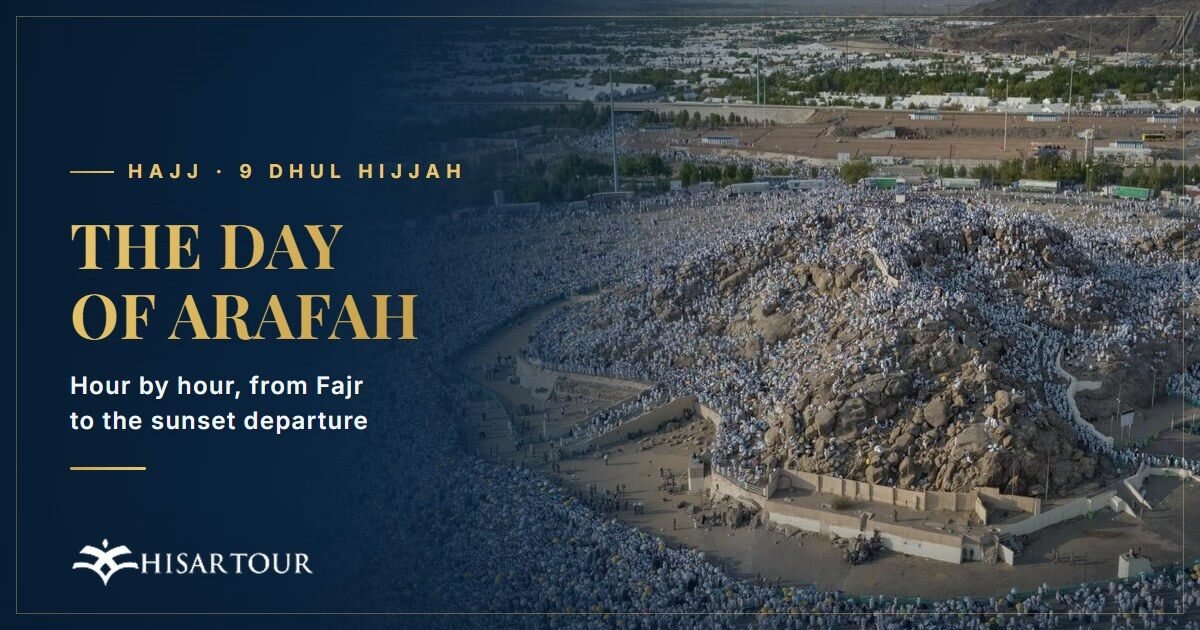
The Day of Arafah is 9 Dhul Hijjah: you stand on the plain of Arafat from midday until sunset in prayer, and without it there is no Hajj.
For Hajj 2027 it is expected on Saturday 15 May 2027, based on the Umm al-Qura calendar and subject to the moon sighting. The day has a simple shape: Fajr in Mina, the move to Arafat, Zuhr and Asr prayed together at midday, an afternoon of dua, and departure for Muzdalifah at sunset. This guide walks through it hour by hour, covers the question of when you may leave, and ends with what the day means for family members at home.
“Hajj is Arafat,” the Prophet (peace be upon him) said, and the narration continues that whoever reaches Arafat before dawn on the night of Muzdalifah has completed his Hajj (Sunan an-Nasa’i 3016). Every other rite has some flexibility or a way to be made up. This one does not, which is why groups plan the whole week around it and why the moon-sighting announcement matters so much to travel plans. If you are planning to be there in 2027, our Hajj 2027 page covers registration and packages on Nusuk.
When Is the Day of Arafah in 2027?
The Day of Arafah is expected on Saturday 15 May 2027, with Eid al-Adha on Sunday 16 May. Both dates come from the Umm al-Qura calendar and can move by one day once the Dhul Hijjah crescent is sighted in Saudi Arabia, roughly a week before Hajj begins. Calendar tables we checked disagree on whether 1 Dhul Hijjah falls on 7 or 8 May 2027, which is exactly the kind of one-day uncertainty to plan around: book leave and flights with a day of margin on either side.
Mosques in the United States and Canada sometimes announce Eid on a different day from Saudi Arabia, depending on whether they follow a calculation or a local sighting. For pilgrims that does not matter; Hajj follows the Saudi announcement. For families at home who want to fast on the same day the pilgrims stand, it is worth checking which convention your local mosque uses.
The Day, Hour by Hour
The pattern of the day comes from the Prophet’s own Hajj, described in detail by Jabir ibn Abdullah in Sahih Muslim 1218, and the Ministry of Hajj and Umrah’s handbook for American pilgrims follows it closely. Times below are for Makkah on the expected date; Arafat is a few kilometers away and your group will announce the exact local times.

- Before sunrise: Fajr in Mina. You spent the night of the 8th in Mina. Pray Fajr there and pack a small day bag: water, an umbrella, your medication, a prayer mat, your Nusuk card.
- After sunrise (about 5:42 am in Makkah): move to Arafat. The Sunnah is to set out after sunrise, as the Prophet did. In practice your group moves when the transport plan schedules it, and the Ministry asks pilgrims to follow that plan.
- Late morning: settle in. Find your group’s tent, confirm you are inside the boundary of Arafat (more on this below), rest, and keep up the Talbiyah.
- Midday (about 12:17 pm): the standing begins. In the Prophet’s Hajj he addressed the people after the sun passed its zenith, then Zuhr and Asr were prayed one after the other with no prayer between them (Sahih Muslim 1218). Pilgrims today pray them together and shortened at the time of Zuhr, usually in their camps.
- Afternoon: dua in the shade. This is the long stretch of the day and the hottest. The handbook’s advice is to stay in your tent or in shade during midday and drink often.
- The last hour: the most focused dua. The Prophet stood facing the qibla until the sun had set and its disc had disappeared (Sahih Muslim 1218). Many pilgrims save their longest supplication for this hour.
- Sunset (about 6:52 pm in Makkah): leave for Muzdalifah. Leave calmly, without rushing, and do not pray Maghrib in Arafat: Maghrib and Isha are prayed together in Muzdalifah. Our Muzdalifah and Jamarat guide covers the night and the next morning.
The Qur’an ties the two places together: “when you depart from ‘Arafat, remember Allah at al-Mash’ar al-Haram” (2:198), and it was on this day, during the Farewell Hajj, that the verse “This day I have perfected for you your religion” (5:3) was revealed, as Umar ibn al-Khattab confirmed (Sahih al-Bukhari 45).
Staying Inside Arafat, and the Heat
The plain of Arafat has marked boundaries, and standing outside them does not count as standing at Arafat. The Ministry’s handbook tells pilgrims to make sure they are inside the marked area and notes that signs and staff help with this. Your group’s camp will be inside, which is one more reason not to wander off on your own.
The same handbook adds a point that surprises many first-timers: all of Arafat is a valid place for standing, and climbing Jabal al-Rahmah, the hill most photographs show, is neither required nor specifically virtuous. It advises avoiding the crowd there rather than seeking it out.
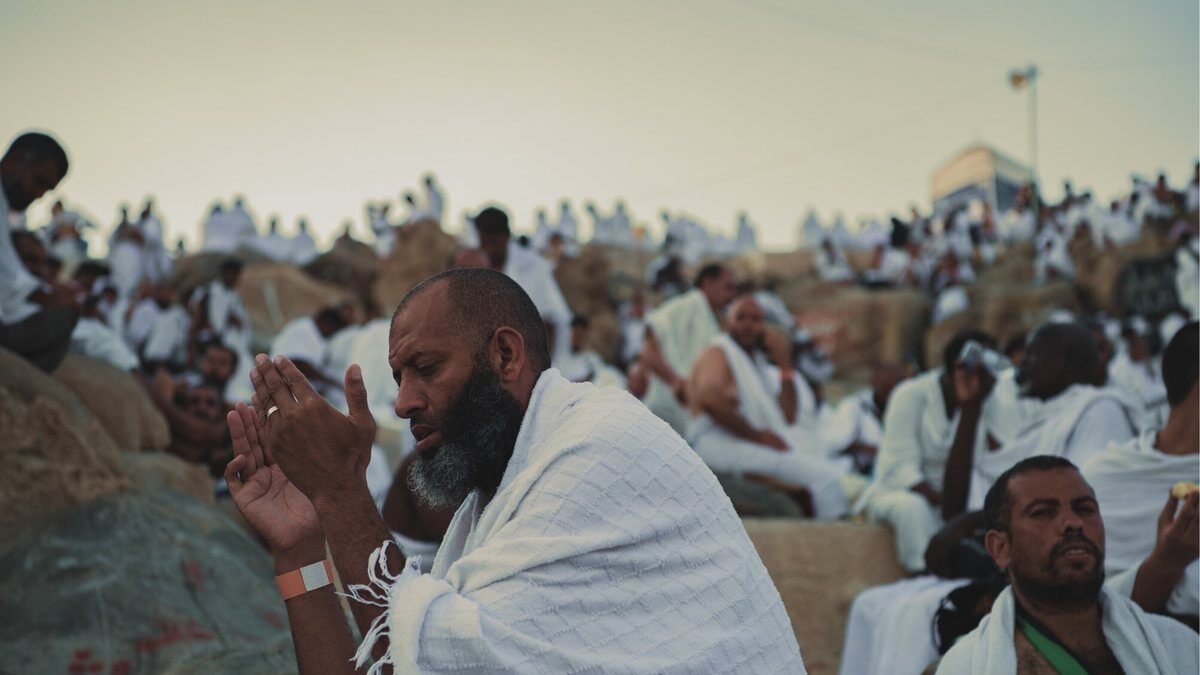
During the days of Hajj a Hisar Tour group leader travels with the group in Makkah, Mina, Arafat and Muzdalifah and is reachable around the clock. On Arafah that mostly means quiet logistics: water, shade, keeping the group together, and getting everyone onto the right bus after sunset.
When Can You Leave Arafat?
The short answer most groups follow: after sunset. The Ministry’s handbook says plainly, “Remain in Arafah until the sun sets, as practiced by the Prophet.” Behind that practical rule sit real differences between the schools of law, which are worth knowing, especially if you are older, unwell or worried about the evening crowds.
| School | Leaving before sunset | If you leave early |
|---|---|---|
| Hanafi | Staying until sunset is obligatory (wajib) | An expiatory sacrifice (dam) is due |
| Shafi’i | Staying until sunset is recommended, not obligatory | No sacrifice is obligatory; offering one is recommended to avoid the disagreement |
| Hanbali | Whoever stands only in the daytime should stay until sunset | An expiatory sacrifice is due |
| Maliki | The essential standing is a portion of the night | Ask a Maliki scholar for the detail |
Swipe the table sideways to see every column. Summary based on Egypt’s Dar al-Ifta fatwa on the time of standing at Arafat.
Two points are agreed. The time for standing, in the majority view, begins at midday on the 9th and ends at dawn on the 10th; the Hanbali school starts it at dawn on the 9th. And scholars are unanimous that a pilgrim who reaches Arafat for any part of the night before dawn has caught the standing, which is what the Prophet’s words “Hajj is Arafat” protect. The ruling that applies to you depends on your school and your circumstances, so ask a scholar or your group’s imam before you travel, not on the day.
What to Do with the Hours
“There is no day when Allah sets free more servants from the Fire than the Day of Arafah” (Sahih Muslim 1348). Pilgrims who have waited years for this afternoon often find it goes faster than they expected, and the most common regret is spending it on things that could have happened any other day. A few practical suggestions:
- Write your dua list before Hajj, including the people at home who asked you to remember them. On the day, you will not have the energy to compose it from memory.
- Put the phone away after one message home. The Ministry’s handbook asks pilgrims to focus on worship, not photography or social media, on this day in particular.
- Mix the forms of worship: Talbiyah, Qur’an, dhikr, and long personal dua in your own language. There is no prescribed text you must recite.
- Rest without guilt in the early afternoon if you need to, so that you are awake and focused for the last hours before sunset.
For Family at Home: Fasting and the Day
If you are not on Hajj, the Day of Arafah is still one of the most significant days of the year. Fasting it is an established Sunnah: the Prophet said he hoped from Allah that fasting the Day of Arafah would expiate the sins of the year before and the year after (Sahih Muslim 1162). For pilgrims standing at Arafat the advice is the reverse: the Ministry’s handbook recommends that pilgrims do not fast on this day, so they keep their strength for worship.
For a US family with someone on Hajj, the time difference shapes the day. Makkah is seven hours ahead of New York during daylight saving time, so sunset at Arafat on the expected date falls at around midday on the East Coast. The pilgrims’ last hour of dua is your late morning; a call after Maghrib in Makkah will reach them on the road to Muzdalifah, which is not the moment for a long conversation.
Stand at Arafat with a group that has planned the day
Pre-register for Hajj 2027 and we will guide you through the Nusuk steps and prepare you for the five days, Arafah included.
Hajj 2027 pre-registration WhatsApp +1 201-201-8992A UAMA community organization
When is the Day of Arafah in 2027?
It is expected on Saturday 15 May 2027 (9 Dhul Hijjah 1448), with Eid al-Adha on Sunday 16 May. The dates follow the Umm al-Qura calendar and may move by a day after the official moon sighting in Saudi Arabia.
What time does the standing at Arafat start and end?
In the majority view it begins when the sun passes its zenith at midday on 9 Dhul Hijjah and its time ends at dawn on the 10th. Pilgrims are advised to remain until sunset, as the Prophet did. The Hanbali school starts the time at dawn on the 9th.
Can I leave Arafat before sunset?
Schools differ. Hanafi and Hanbali scholars hold that a pilgrim who stands only during the day and leaves before sunset owes an expiatory sacrifice; the Shafi’i school holds that it is recommended, not obligatory. The Saudi Ministry advises all pilgrims not to leave before sunset. Ask your scholar if your situation is unusual.
Do I have to climb Jabal al-Rahmah?
No. The Ministry of Hajj and Umrah states that all of Arafat is a valid place for standing and that climbing the hill is neither required nor specifically virtuous. It advises avoiding the crowding there.
Should pilgrims fast on the Day of Arafah?
The Ministry’s guidance is that pilgrims should not fast on this day, to keep their energy for worship. Fasting the day is a Sunnah for Muslims who are not performing Hajj (Sahih Muslim 1162).
*The date of the Day of Arafah 2027 is expected only, based on the Umm al-Qura calendar, and is confirmed by the Dhul Hijjah moon sighting in Saudi Arabia. Sun times are for Makkah on 15 May 2027 as listed by timeanddate.com; Arafat times differ slightly. The Nusuk Hajj platform still showed the 1447 season when we checked on 16 November 2026. Summaries of the schools of law are for orientation only; for a ruling that applies to you, ask a scholar or your group’s imam. This page replaces our earlier note on the time for leaving Arafat. Last reviewed: November 2026.
Sources: Sahih Muslim 1218 · Sunan an-Nasa’i 3016 · Sahih Muslim 1348 · Sahih Muslim 1162 · Sahih al-Bukhari 45 · Qur’an 2:198 · Ministry of Hajj and Umrah, Hajj Handbook, American Pilgrim’s Edition · Nusuk Hajj, The Journey · Dar al-Ifta al-Misriyyah, the time for standing at Arafat · timeanddate.com, Makkah sun times, May 2027