
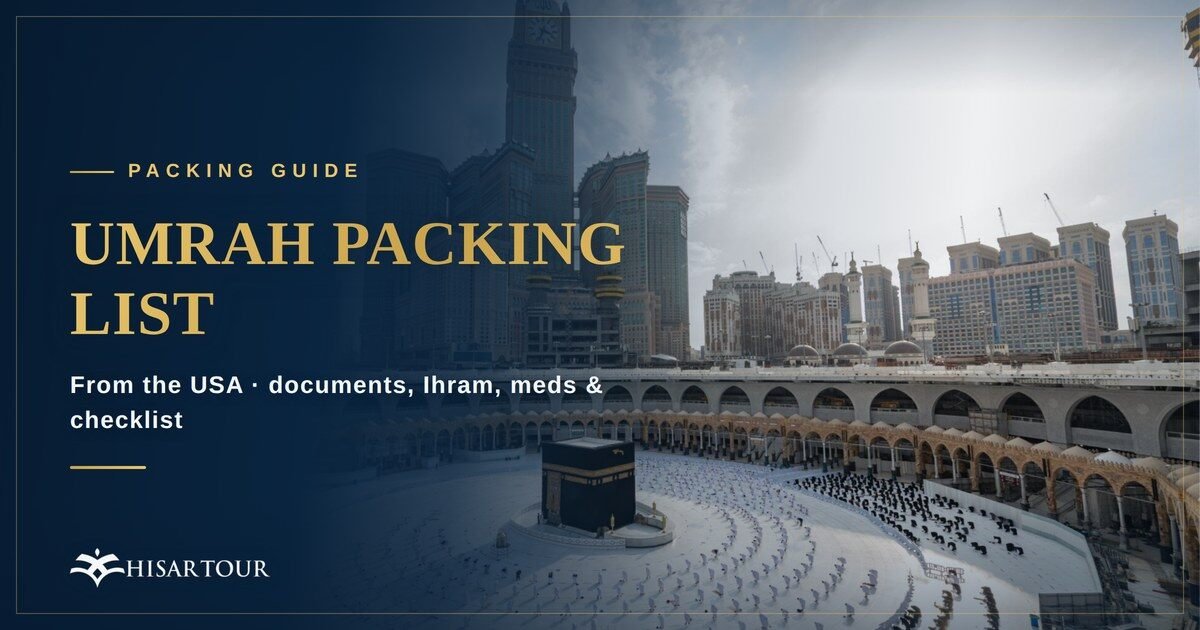
An Umrah packing list from the USA comes down to five groups: documents, Ihram and modest clothing, unscented toiletries and medication, electronics with a Type G adapter, and a small day bag for the Haram.
Pack one checked bag and a carry-on that holds everything you need on day one, including the Ihram sheets. The single most useful rule: if you would need it in the first 24 hours, it goes in the carry-on. Bags do go missing on a connection, and a pilgrim whose Ihram sheets are in a lost suitcase has a real problem. Hisar Tour, the Hajj and Umrah brand of the United American Muslim Association (UAMA), gives every traveler an Ihram kit before departure and serves breakfast and dinner daily, which takes two whole categories off your list; the rest of this guide covers what remains.
Plug · Type G, 220–230 V
Zamzam · one sealed 5 L bottle*
Controlled meds · SFDA permit, 30-day cap*
This guide has been rebuilt from the packing list we first published in 2024 and from what our group leaders see at every check-in: the things people forget, the things they bring three of, and the two or three items that decide whether the trip is comfortable. It is written for travelers leaving from the United States and Canada, so it covers TSA rules at the start, Saudi rules on medication at the other end, and the weather in the months most families actually travel. Read it with the Ihram guide for what men may and may not wear, and print the checklist at the bottom.
Before You Pack: Three Rules That Save the Trip
Three rules decide whether your packing works: keep day-one items in the carry-on, keep everything unscented, and read your baggage allowance on the e-ticket before you buy a bigger suitcase. The first protects your Ihram if a bag is delayed. The second protects your Ihram from a scented soap or wipe used without thinking. The third protects your wallet: allowances differ by airline, route and fare class, and the number printed on your ticket is the only one that counts at check-in.
- Carry-on holds day one: Ihram sheets and belt (men), one modest outfit, sandals, medication, unscented wipes and soap, chargers, documents.
- Unscented everything: soap, shampoo, deodorant, sunscreen, lip balm, wet wipes, laundry sheets. Read the label for “fragrance” or “parfum”.
- Weigh the checked bag at home. Leave a quarter of it empty; dates, prayer rugs and Zamzam come back with you.
Documents and Money
Five documents are essential for Umrah from the USA: your passport, your visa, the meningococcal vaccination certificate, your flight and hotel confirmations, and a copy of your prescriptions. Everything else in this section is backup.
| Item | Why | Where to keep it |
|---|---|---|
| Passport (valid six months beyond entry) | Checked at the airline counter, Saudi immigration, hotel check-in and the Haramain train | Waist pouch; photocopy and phone photo in the suitcase |
| Saudi visa (eVisa printout or the group visa your agency issued) | Immigration may ask for the printed page even when it is electronic; options are in our visa guide | With the passport, plus a PDF on the phone |
| Meningococcal ACYW certificate | Required for pilgrims aged one year and older, issued no less than 10 days and no more than 3–5 years before arrival (CDC Yellow Book 2026)* | With the passport; photo on the phone |
| Flight e-tickets, hotel vouchers, group itinerary | Airline and hotel desks; the itinerary shows the Madinah–Makkah move date | Printed set plus PDFs |
| Prescriptions and a doctor’s letter for any regular medication | Saudi customs and pharmacies; required for any controlled medicine* | Carry-on, with the medicine |
| Travel insurance card and emergency contacts | Hisar packages include health insurance; keep the policy number with you | Wallet and phone |
| ID card, a credit card that works abroad, some US dollars | Cards work in hotels and malls; small cash for taxis, barbers and street vendors. Exchange a little at the airport, more in the city | Split between pouch and bag; never large amounts of cash |
| Nusuk app installed and logged in | Rawdah permits are booked in the app; check the current rule for Umrah permits before you fly | Phone, with your passport details saved |
Ihram and Clothing for Men
A man needs two sets of Ihram sheets, a belt, sandals that leave the ankles uncovered, and then four or five days of ordinary modest clothing, because Ihram is worn only for the hours of the Umrah itself. Ihram sheets are two unstitched pieces of white cloth; cotton towelling holds better than thin microfiber. A second set matters: a sheet that gets wet in Sa’i or soiled on the coach is simply swapped.
- Two sets of Ihram (Hisar Tour provides one kit; bring the second) and an Ihram belt or waist pouch for the passport.
- Sandals or slides that leave the ankle bones uncovered; the Hanafi school also asks that the top of the foot be exposed, so choose open sandals over closed slides if you follow it. Comfortable walking shoes for everything outside Ihram.
- Thobes or loose trousers and long shirts for the days in Madinah and after the Umrah. Four or five outfits; hotels have laundry.
- Lightweight socks for cold mosque marble at Fajr in winter (not in Ihram).
- A cap or kufi for outside Ihram, and sunglasses.
- A light jacket or shawl for December and January evenings and the air-conditioned Haram.
Clothing for Women
Women have no special Ihram garment, so a woman packs the modest clothing she is comfortable praying in for eight to ten days: abayas or long dresses, scarves that stay put without face pins, and shoes that slip off at the mosque door. Dark or mid-tone fabrics hide marble dust; white shows everything. A face veil tied over the face and gloves are not worn in Ihram, so pack a scarf long enough to drape loosely if you prefer to screen your face when men pass. The full list of what is allowed is in the Ihram guide.
- Four or five abayas or long, loose outfits; one lighter set for the Umrah itself
- Scarves and under-caps; a prayer garment (isdal) that goes over anything
- Slip-on shoes and a pair of walking shoes; socks for cold marble
- A drawstring shoe bag so shoes stay with you inside the mosque
- Sanitary supplies for the whole trip (available in Saudi pharmacies, but your own brand is easier)
- A light cardigan or shawl for the air-conditioning in the Haram
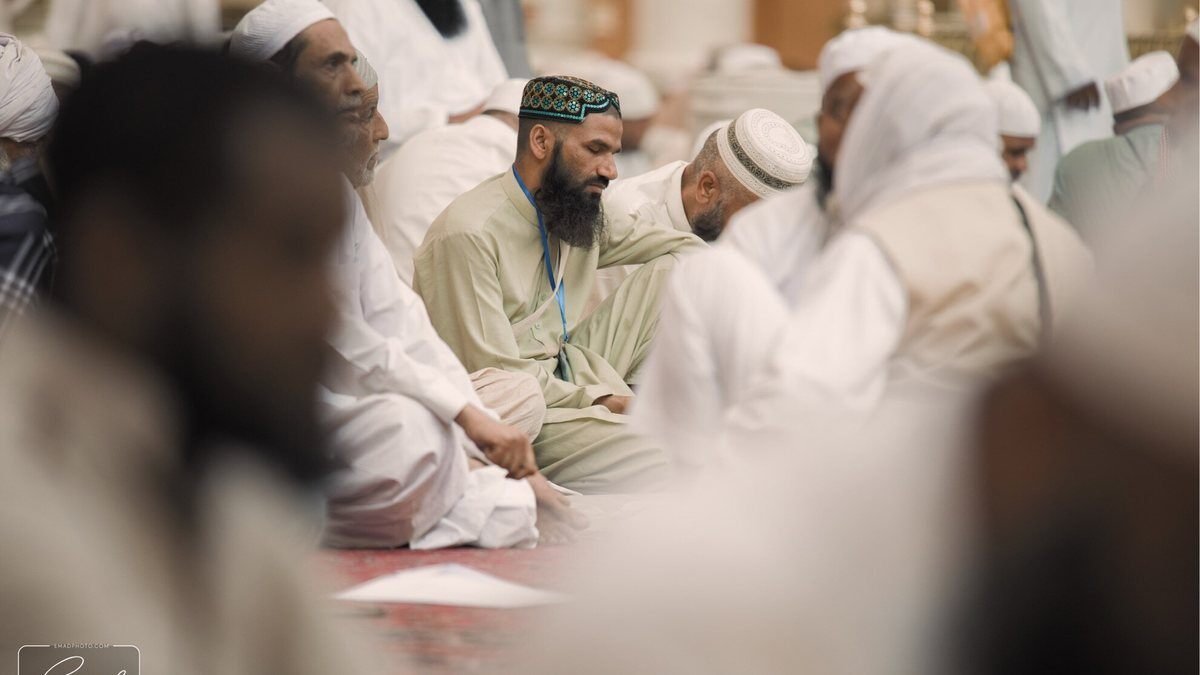
Toiletries: Unscented, and Under 3.4 Ounces in the Carry-On
Toiletries for Umrah follow two rules: unscented while you are in Ihram, and no container over 3.4 ounces (100 ml) in the carry-on, all fitting in one quart-size bag under the TSA 3-1-1 rule. Hotels provide the basics, but hotel soap is scented and cannot be used in Ihram, so the unscented set in your carry-on is the one that matters.
- Unscented soap and shampoo (travel size); toothbrush and unscented toothpaste
- Unscented deodorant, fragrance-free sunscreen and lip balm
- Unscented wet wipes, and hand sanitizer under 3.4 oz
- A small towel or washcloth; a microfiber travel towel dries overnight
- Nail clippers, used before Ihram and packed in the checked bag
- A disposable razor for men who plan to shave at the end (barbers are also available outside the Marwah exit)
- Tissues; a small bottle of unscented laundry detergent or laundry sheets
Medication and Health Supplies
Bring every regular medication in its original packaging with a copy of the prescription, in quantities for the whole trip plus a few days, in the carry-on. Saudi pharmacies are well stocked, but your own brand, dose and instructions are simpler than explaining them at midnight in a second language.
- Prescription medication in original packaging, with prescriptions and a doctor’s letter
- Pain relievers, anti-diarrheal medicine, an antacid, throat lozenges, an antihistamine
- Band-aids, blister plasters, antiseptic cream; a basic first-aid kit
- Face masks for crowded prayer times; hand sanitizer
- Oral rehydration sachets for summer or Ramadan trips
- Your vaccination record: the meningococcal ACYW certificate is required; CDC also recommends being current on routine vaccines, influenza and COVID-19, and polio proof applies to travelers from countries where polio is reported*
Electronics: Type G Adapter, Power Bank, Nusuk App
Saudi hotels use Type G sockets (the British three-pin) at 220–230 volts, 60 Hz, so a US traveler needs a plug adapter; phone and laptop chargers marked “100–240 V” need no voltage converter. Some older buildings still have 110–127 volt sockets, so check the label on anything with a heating element before plugging it in.***
- Smartphone with the Nusuk app installed, plus WhatsApp for the group chat
- Type G adapter (two are better than one), phone charger, a short extension lead if your room shares one socket
- Power bank, in the carry-on only; airlines do not allow lithium batteries in checked bags
- Earphones; Hisar Tour groups use Bluetooth headsets during Umrah and ziyarah, and a personal pair for Qur’an apps is useful
- An eSIM or a local SIM bought at the airport for data; hotel Wi-Fi is variable
- A camera if you want one; a phone is enough for most travelers, and photography inside the mosques should be discreet
The Day Bag for the Haram
The bag you carry into the Haram should be small and cross-body, because large bags and rolling luggage are stopped at the gates, and it should hold only what you use inside: shoe bag, water, phone, Qur’an, prayer beads, and your passport pouch.
- A small cross-body bag or a lightweight backpack that folds flat
- A drawstring shoe bag, so your shoes stay with you and are never left at a gate
- A refillable water bottle; Zamzam coolers are everywhere inside both mosques
- Pocket Qur’an or Qur’an app; tasbih; a small dua booklet if you use one
- A foldable prayer mat for the outer courtyards (optional; the mosques are carpeted inside)
- A compact umbrella for sun in the courtyards; allowed in Ihram
- Snacks such as dates or nuts for long waits between prayers
- A notebook and pen for the lessons and for the names of people who asked you to pray for them
- Plastic bags for wet Ihram sheets and laundry
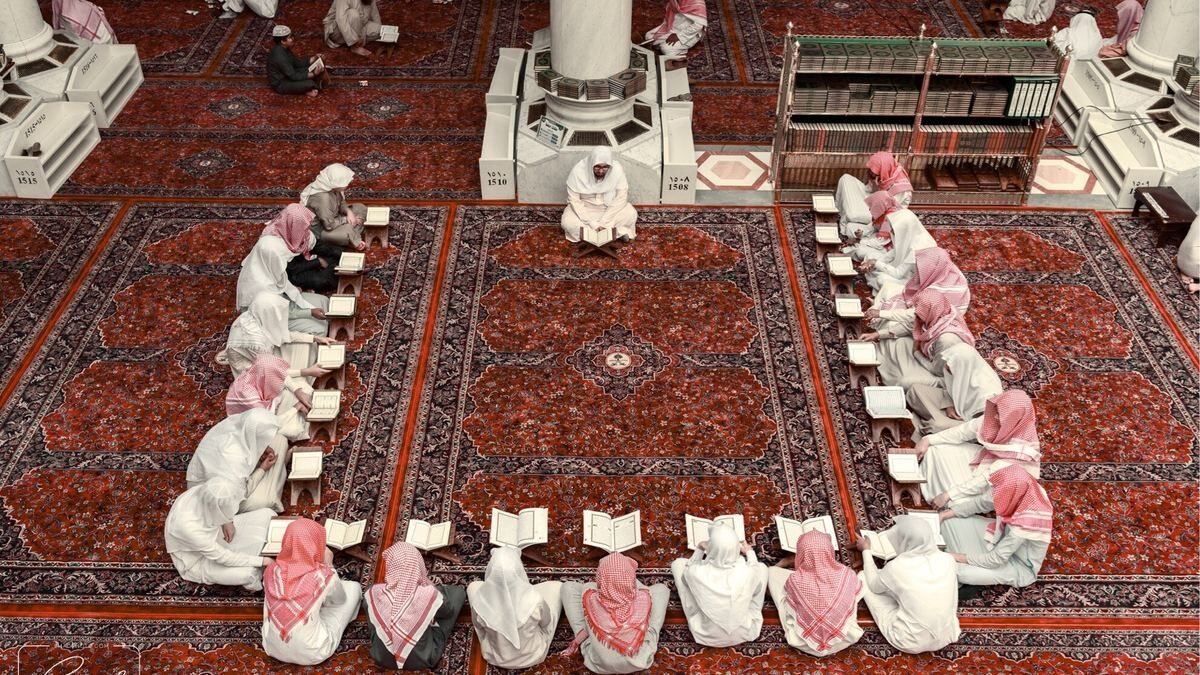
Zamzam, Dates and Gifts: Packing for the Way Home
Each pilgrim may take home one factory-sealed 5-liter bottle of Zamzam, bought at the official counters at Jeddah or Madinah airport and handed in at check-in, where most major carriers accept it as a separate item outside the checked allowance.* Confirm your own airline’s rule before you rely on it, and leave a quarter of your suitcase empty for the rest: Madinah dates (Ajwa keeps for months), prayer rugs, misk, and the small gifts every relative expects. Do not carry Zamzam in your own bottles; security will not let it through.
Packing by Season
Makkah is warm in every month; what changes is how hot the afternoons get and how cool the evenings in Madinah become. December, when most US and Canadian families travel, brings Makkah daytime highs of about 85–88 °F (29–31 °C) and lows around 62–66 °F, while Madinah runs cooler at 76–82 °F by day and 56–61 °F at night, with almost no rain.**
| Season | What to expect | Adjust your list |
|---|---|---|
| Winter break and New Year (December–January) | Warm days, cool nights, cold marble at Fajr, air-conditioned mosques | Add a light jacket or shawl, socks for prayer times, a thin blanket layer for the Madinah–Makkah coach. See the December school-break guide |
| Ramadan (early 2027) | Very crowded, long nights in the Haram, iftar in the mosque courtyards | Add a foldable mat, extra water bottle, rehydration sachets, dates; keep bags minimal for the crowds |
| Spring and after Hajj (March–April, July–August) | Hot afternoons, quieter mosques | Add an umbrella, high-SPF unscented sunscreen, a hat for outside Ihram, breathable cotton |
| Summer (May–September) | The hottest months of the year; afternoon courtyards are punishing | Plan Tawaf for night or early morning; lightest fabrics; electrolytes; a cooling towel |
Families, Elderly Parents and First-Timers
Families and travelers with elderly parents add a short list of their own: a folding stool for waiting outside prayer areas, a lightweight travel wheelchair or a plan to rent one near the Haram, medication in a labeled weekly organizer, and for children, a small ID card with the hotel name and your phone number in the pocket. A child’s own small backpack with snacks, a water bottle and a coloring book turns a two-hour wait into an ordinary afternoon. First-timers should pack the itinerary with the Madinah–Makkah date circled, because that is the morning the Ihram sheets must be on top, not at the bottom, of the suitcase.
What to Leave at Home
- Scented toiletries “for after Ihram.” Bring one small bottle at most; the risk of using it by mistake is real.
- Large amounts of cash, expensive jewelry, anything you would be upset to lose in a crowd of a million people.
- Political or religious materials that could be questioned at customs; books other than Qur’an and dua are unnecessary.
- Your own Zamzam bottles for the flight home; only sealed airport bottles are accepted.
- More than one suitcase per person. Group coaches have limited hold space and hotel rooms are shared.
- Heating appliances such as kettles or irons; hotels provide them, and the voltage question disappears.
- Lithium power banks in checked bags; they go in the carry-on or not at all.
The Printable Umrah Packing Checklist
The checklist below is the whole guide on one page: print it, tick the boxes as you pack, and put the sheet in the carry-on so you can reverse the process on the last night in Makkah.
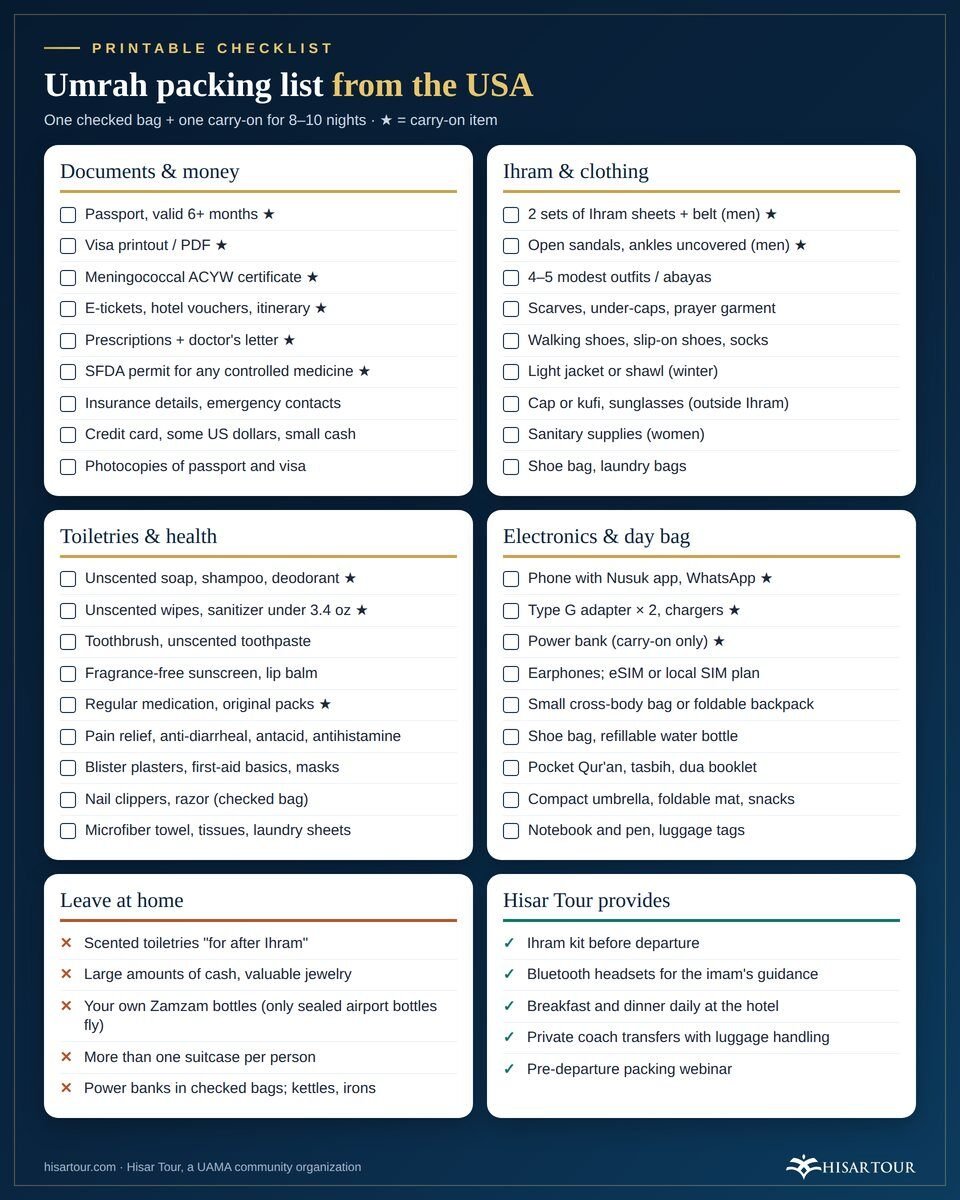
| ☐ | Documents & money | ☐ | Ihram & clothing | ☐ | Toiletries & health | ☐ | Electronics & day bag |
|---|---|---|---|---|---|---|---|
| ☐ | Passport (6+ months) ★ | ☐ | 2 sets Ihram sheets + belt (men) ★ | ☐ | Unscented soap, shampoo, deodorant ★ | ☐ | Phone with Nusuk app, WhatsApp ★ |
| ☐ | Visa printout / PDF ★ | ☐ | Open sandals (men) ★ | ☐ | Unscented wipes, sanitizer (3.4 oz) ★ | ☐ | Type G adapter × 2, chargers ★ |
| ☐ | Meningococcal ACYW certificate ★ | ☐ | 4–5 modest outfits / abayas | ☐ | Toothbrush, unscented toothpaste | ☐ | Power bank (carry-on only) ★ |
| ☐ | E-tickets, hotel vouchers, itinerary ★ | ☐ | Scarves, under-caps, prayer garment | ☐ | Fragrance-free sunscreen, lip balm | ☐ | Earphones; eSIM or local SIM plan |
| ☐ | Prescriptions + doctor’s letter ★ | ☐ | Walking shoes, slip-on shoes, socks | ☐ | Regular medication, original packs ★ | ☐ | Small cross-body bag or foldable backpack |
| ☐ | SFDA permit if any controlled medicine ★ | ☐ | Light jacket or shawl (winter) | ☐ | Pain relief, anti-diarrheal, antacid, antihistamine | ☐ | Shoe bag, refillable water bottle |
| ☐ | Insurance details, emergency contacts | ☐ | Cap or kufi, sunglasses (outside Ihram) | ☐ | Blister plasters, first-aid basics, masks | ☐ | Pocket Qur’an, tasbih, dua booklet |
| ☐ | Credit card, some US dollars, small cash | ☐ | Sanitary supplies (women) | ☐ | Nail clippers, razor (checked bag) | ☐ | Compact umbrella, foldable mat, snacks |
| ☐ | Photocopies of passport and visa | ☐ | Shoe bag, laundry bags | ☐ | Microfiber towel, tissues, laundry sheets | ☐ | Notebook and pen, luggage tags |
★ = carry-on item.
What Hisar Tour Provides, So You Can Pack Less
Hisar Tour travelers pack less than the list above because several items are provided by the group: an Ihram kit before departure, Bluetooth headsets for the imam’s guidance during Umrah and ziyarah, breakfast and dinner every day at the hotel, private coach transfers with luggage handling, and a pre-departure webinar that goes through this list line by line with the actual departure date and season in mind. What remains is personal: your clothing, your medication, your documents, and the small day bag you will carry into the Haram. Bring those well, and the rest of the journey is already arranged.
Pack for a trip where the rest is handled
Imam-led Umrah departures from New York, Washington, Los Angeles and Toronto, with hotels near the Haram, two meals a day and an Ihram kit included.
See Umrah Packages
WhatsApp +1 201-201-8992
A UAMA community organization
Continue with the rules of Ihram, where to enter Ihram on your flight, the flights guide, and what your first Umrah looks like day by day.
Frequently Asked Questions
What should I pack in my carry-on for Umrah?
Everything you need in the first 24 hours: the Ihram sheets and belt (men), one modest outfit, sandals, all medication with prescriptions, unscented soap and wipes under 3.4 oz each, chargers and a power bank, and your passport, visa, vaccination certificate and tickets. If a checked bag is delayed, you can still enter Ihram and perform Umrah.
How many Ihram sets should a man bring?
Two. One is worn from the Miqat through Tawaf and Sa’i; the second is a clean spare in case the first gets wet or soiled. Cotton towelling stays in place better than thin microfiber. Hisar Tour provides one kit; bring the second yourself.
Can I bring my prescription medication to Saudi Arabia?
Yes, in original packaging with a copy of the prescription, in quantities for the trip. Medicines containing narcotic or psychotropic substances require a traveler’s permit from the Saudi Food and Drug Authority before arrival, capped at a 30-day supply, with a prescription issued within six months. Ask your pharmacist whether your medicine is controlled and apply early.
What plug adapter do I need for Saudi Arabia?
A Type G adapter, the British three-pin plug, for 220–230 volt sockets. Phone and laptop chargers rated 100–240 V work without a converter. Some older buildings have 110–127 volt sockets, so check the label on any appliance with a heating element.
How much Zamzam water can I bring back to the USA?
One factory-sealed 5-liter bottle per pilgrim, bought at the official counters at Jeddah or Madinah airport and handed in at check-in. Most major airlines carry it as a separate item outside your checked allowance; confirm your airline’s rule before you travel. Personal bottles of Zamzam are not allowed through airport security.
What do women wear for Umrah?
Ordinary modest clothing: abayas or long, loose outfits in any color, with a scarf. There is no special Ihram dress for women. A face veil fastened over the face and gloves are not worn in Ihram, so pack a scarf long enough to drape loosely if you wish to screen your face.
What is the weather like in Makkah in December?
Warm days and mild nights: daytime highs around 85–88 °F (29–31 °C) and lows around 62–66 °F, with almost no rain. Madinah is cooler, with highs of 76–82 °F and nights of 56–61 °F, so pack a light jacket or shawl and socks for early-morning prayers.
*Health, medication, customs and airline rules change: confirm the meningococcal requirement on the CDC Saudi Arabia page, the controlled-medicine permit on sfda.gov.sa, the TSA liquids rule on tsa.gov and the Zamzam allowance with your airline before you travel. **Temperatures are long-term December averages (Weather Spark). ***Socket and voltage information from travel-adapter references; check the label on your device. Hisar Tour inclusions as read on hisartour.com/umrah-packages/ on September 7, 2026. Last reviewed: September 2026.
Sources: TSA: liquids, aerosols and gels rule · CDC Yellow Book: Saudi Arabia, Hajj and Umrah · SFDA: Traveler’s Permit for Controlled Drugs · Saudi Ministry of Health · Saudia (baggage and Zamzam rules) · Nusuk.