
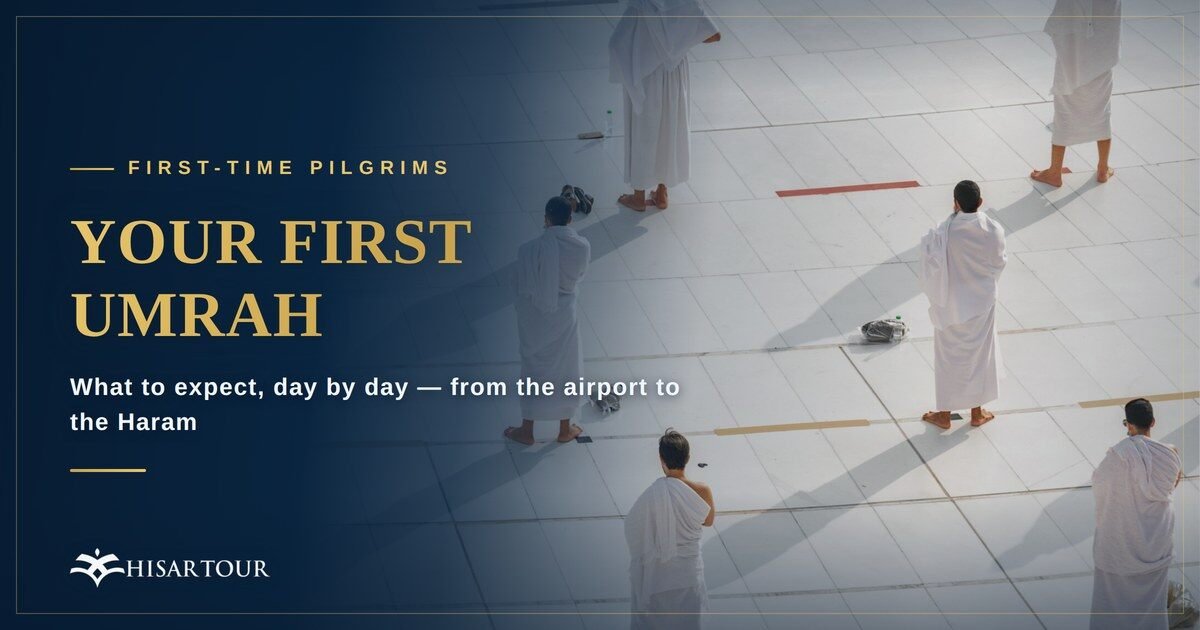
A first Umrah from the USA is usually nine or ten nights: two days of travel, three or four days in Madinah, the Umrah itself on the day you move to Makkah, and four to six days of prayer at the Haram.
You will be tired on arrival, moved at your best moments, and surprised by how much of the trip is simply walking, waiting and praying. This is the honest day-by-day of a typical imam-led group trip — not the brochure version — so that nothing on the ground catches you unprepared.*
Nonstop NY–Jeddah · ~12 h*
Umrah rituals · 2–4 h*
“We didn’t know what to expect.” In our review analysis of more than 2,600 public Google reviews of nine US Hajj and Umrah operators, that sentence — or its cousins — appears in review after review by first-time travelers, and it splits cleanly in two. Travelers who had someone explaining each day as it came wrote about awe. Travelers who were handed a voucher and a hotel address wrote about confusion: the unexplained early-morning wake-up, the coach that left without them, the “walking distance” that was not. Nearly one in six reviews across the market mentions a first-time journey. This guide is for you: here is what actually happens, day by day, on a typical Hisar Tour Madinah-first group departure from New York.
Before You Fly: The Four Weeks That Decide the Trip
- Documents. Passport valid six months beyond arrival; Saudi visa (on our groups, processed for you — see how Umrah visas work for US citizens); the free Umrah permit in the Nusuk app, which we book for the group.
- Health. The quadrivalent meningococcal (ACWY) vaccine at least ten days before arrival, certificate in your hand luggage. Refill prescriptions for the full trip plus a week; carry them in original packaging.
- The webinar. Our pre-Umrah webinar covers the rituals, Ihram, the schedule and the packing list. Attend it — the questions you think of afterwards are exactly the ones the imam will answer on WhatsApp before departure.
- Packing. Two sets of Ihram sheets for men, comfortable broken-in sandals or slip-on shoes for everyone, a light bag for the mosque, a refillable bottle. The full list is in our packing guide from America.
- Your body. Start walking 30–45 minutes a day. Tawaf on a crowded evening plus Sa’i is a two-to-three-mile walk on marble after a long journey; the trip is far more joyful when it is not also your first exercise in months.
The Trip, Day by Day
This is a typical nine-night, Madinah-first program: four nights in Madinah, five in Makkah, flying Saudia nonstop from New York JFK to Jeddah. Your own departure will differ in dates, hotels and small details — the group program you receive before departure governs — but the shape is the same on almost every trip we run.*
- Day 1 — Departure evening. Meet the group and the imam at the airport three hours before the flight. Check-in is as a group; families are seated together. Eat, sleep on the plane if you can, and do not put on Ihram: with Madinah first, there is nothing to do on this flight but rest. Roughly twelve hours to Jeddah.*
- Day 2 — Arrival and the road to Madinah. Land in Jeddah in the late afternoon or evening local time, clear immigration (biometrics are taken at the counter), collect luggage, and meet the coach. The drive north to Madinah is about four to five hours on a modern highway*; most people sleep. Check-in is late. If you have the energy, walk to the Prophet’s Mosque for Isha or Fajr — the first sight of the green dome at night is one you will remember.
- Day 3 — Madinah: the greeting and the Rawdah. After Fajr and breakfast, the imam takes the group to give salam at the Prophet’s grave and to his two companions, and explains the etiquette of the mosque. Rawdah entry is by timed permit booked in the Nusuk app; your slot may be at an unusual hour and lasts only minutes — that is normal, and the coordinator will have it arranged. The afternoon is rest and prayer; the evening is the imam’s first teaching session.
- Day 4 — Madinah ziyarah. A half-day coach ziyarah: Masjid Quba (pray two rak’ahs), the site of the Battle of Uhud and the martyrs’ cemetery, Masjid al-Qiblatayn, and the Seven Mosques area, with the imam narrating the history at each stop. Afternoon and evening free for the Haram and the markets around it.
- Day 5 — Madinah: a full day of worship, then Ihram preparation. The calmest day of the trip. Pray all five prayers in the Prophet’s Mosque, visit al-Baqi’ cemetery after Fajr or Asr, and rest. After Isha the imam holds the Ihram briefing in the hotel: the sheets, the intention, the Talbiyah, the restrictions. Men try on the Ihram; questions are answered; luggage is packed for the morning.
- Day 6 — Umrah day. The longest and greatest day. Details below.
- Day 7 — Makkah: rest and rhythm. Sleep in. From today the day follows the prayers: Fajr in the Haram, breakfast, rest, Dhuhr and Asr, dinner, Maghrib and Isha, an evening Tawaf if you wish. The imam’s daily session after Asr or Isha covers a topic each day — the history of the Kaaba, the meaning of Tawaf, how to prepare for Hajj one day.
- Day 8 — Makkah ziyarah. A morning coach ziyarah of the Hajj sites — Mina, Muzdalifah, Arafah and Jabal al-Rahmah — plus Jabal al-Nur (the Cave of Hira, seen from below) and Jabal Thawr, with the imam explaining what will happen there if you return for Hajj. Optional: a second Umrah, entering Ihram at Masjid Aisha in Tan’im, for those who wish and whose school of law encourages it.
- Day 9 — Makkah: Jumu’ah or a free worship day. If the trip includes a Friday, arrive at the Haram two hours before Jumu’ah or you will pray in the street (which is also valid, and also memorable). Zamzam for home is bought sealed at the airport, not carried from the mosque; gifts are bought today.
- Day 10 — Farewell. A farewell Tawaf (recommended after Umrah, not required), check-out, and the coach to Jeddah airport — about an hour and a half to two hours.* The westbound flight lands in New York the same calendar day. Most people are quiet on this flight. That is normal too.
Umrah Day, Hour by Hour
Day 6 deserves its own timeline, because it is the day first-timers worry about most and the day that goes most smoothly when the group is prepared. Times are illustrative.
Shower, trim nails, apply perfume to the body (men) before dressing, put on the Ihram sheets (men) or normal modest clothing (women). Pray Fajr in the Prophet’s Mosque in Ihram if the schedule allows, eat breakfast, check out. Do not make the intention yet.
Twenty minutes out of Madinah the coach stops at the Miqat mosque (Abyar Ali). Wudu, two rak’ahs, then — on the imam’s cue — the intention, “Labbayka Allahumma ‘Umratan”, and the Talbiyah together. From this moment you are in Ihram. The coach fills with the sound of Talbiyah for the first hour of the highway; it fades to individual dhikr and sleep.
A comfort stop halfway (restrooms are Ihram-friendly; use unscented soap or none). You may eat and drink normally. Arriving in Makkah, the coach drops the group at the hotel; rooms are assigned quickly, luggage goes up, and you have an hour to pray, rest and drink water. Stay in Ihram — this is where the mistake of “changing to rest” happens.
After Maghrib or Isha, headsets on, the group walks to the Haram behind the imam. Tawaf takes 45–90 minutes in an evening crowd*; the imam calls each circuit and every landmark on the headset. Two rak’ahs, Zamzam, then Sa’i for 45–60 minutes*, counting laps together. Elderly members ride wheelchairs pushed by staff or family. Outside the Marwah exit, men shave or trim at the barbers; women trim a fingertip of hair discreetly. You are out of Ihram. It is probably close to midnight. The step-by-step of every ritual is in How to Perform Umrah.
Late dinner or a snack near the hotel, a shower, normal clothes, and sleep. Tomorrow has no schedule until the imam’s afternoon session. You have done it.
What Surprises First-Timers
- How safe and orderly both cities feel, at any hour, for women and families
- How quickly strangers help — a chair, water, a place in the row
- The calm of Madinah after the intensity of travel; most people call it their favorite city
- How much the imam’s headset commentary changes Tawaf from a walk into worship
- How good the hotel buffets are after a day of fasting-like schedules
- That your phone works, your card works, and the coffee is excellent
- Crowds. Even in the “quiet” months the Haram at Isha is a sea of people; in December and Ramadan it is a river
- Heat in the warmer months; cold marble at Fajr in winter — bring a light layer
- The Rawdah slot may be at 2 a.m. and last a few minutes
- Waiting: for coaches, for elevators, for the prayer to start — patience is part of the worship
- Jet lag is real; the first two days feel like a dream, and not always a pleasant one
- Emotions arrive unannounced. Grown men cry at the first sight of the Kaaba. Let them
If You Are Traveling with Elderly Parents or Children
Many of our first-time travelers are bringing a parent. Tell us before departure: we arrange wheelchairs for Tawaf and Sa’i, seat the family near the coach door, and keep the pace of the ziyarah days humane. Children are not obliged to perform Umrah before puberty, but they may, and many do; most families carry the little ones through Tawaf on the quieter upper levels and let school-age children walk with a parent holding each hand. Strollers are generally not permitted in the Mataf area; wheelchairs are — ask the coordinator what works on your dates. Our imams will tell you frankly which days to keep the children at the hotel with one parent and which to bring them.
Why the Group Matters on a First Trip
You can, in principle, book a flight and a hotel and do all of this alone. Experienced travelers sometimes do. But every “hard surprise” above is softened by having someone whose job it is to have seen it before: the imam who has led more Tawafs than he can count and knows which gate to use at Isha in December, the coordinator who has the Rawdah permits on her phone, the driver who is waiting at the door when the group comes out at midnight. In the review data, first-timers’ complaints cluster almost entirely around the absence of exactly this — nobody to ask, nobody waiting, nobody who explained. On a Hisar Tour group the answer to “what happens now?” is always standing next to you. That is what you are paying for, and it is the difference between a trip you survived and a journey you will describe for the rest of your life.
Make your first Umrah the one you were hoping for
Imam-led groups from New York, Washington, Los Angeles and Toronto, hotels a few minutes’ walk from the Haram, breakfast and dinner daily, pre-departure webinars and a team with you from the airport to the airport.
See Umrah Packages
WhatsApp +1 201-201-8992
A UAMA community organization · First-time pilgrims are the majority of our travelers
Next: why we usually go to Madinah first, what a complete package includes, and the full Umrah FAQ for US and Canadian travelers.
Frequently Asked Questions
How many days do you need for a first Umrah?
Nine or ten nights is the sweet spot for a first trip from North America: two travel days, three to four nights in Madinah, and four to six in Makkah. Seven-night trips are possible but rushed after a 12-hour flight; longer trips suit Ramadan or retirees.
When do you actually perform the Umrah on a Madinah-first trip?
On the day you travel from Madinah to Makkah — typically day five or six. You enter Ihram at the Miqat outside Madinah in the morning, arrive in Makkah in the afternoon, rest briefly, and perform Tawaf, Sa’i and the haircut with the group in the evening.
Is Umrah physically difficult?
The rituals themselves are a two-to-three-mile walk over two to four hours, usually in the evening. Most healthy adults manage comfortably; the challenge is doing it after long travel and in a crowd. Elderly or unwell pilgrims use wheelchairs or electric carts, which are fully valid. Daily walking for a month before the trip makes a noticeable difference.
What does a typical day in Makkah look like after the Umrah?
The day follows the five prayers in the Haram: Fajr, breakfast, rest, Dhuhr and Asr, an imam-led session, dinner, Maghrib and Isha, and an optional evening Tawaf. One day is a guided ziyarah of the Hajj sites; one day is usually left free for worship and shopping.
Can I visit the Rawdah on my first trip?
Yes, with a timed permit booked in the Nusuk app; on organized groups the coordinator books it for you. Slots can fall at unusual hours and the visit itself is short. Rules on how often one may book have changed several times, so check the current rule in the app or ask your coordinator.
Do I wear Ihram on the flight from the USA?
Not if your trip goes to Madinah first, which is the usual pattern for organized groups. You travel in normal clothes and enter Ihram at Dhul-Hulayfah before the coach to Makkah. Only pilgrims flying into Jeddah with Makkah as their first city must be in Ihram before the aircraft crosses the Miqat.
*Durations are approximate and vary by airline schedule, road conditions, season and crowd levels. The itinerary is a typical example modeled on Hisar Tour’s 9-night Madinah-first group program; each departure’s published program governs. Review-analysis references are to Hisar Tour’s internal August 2026 audit of 2,600+ public Google reviews across nine US operators; no competitor is identified. Last reviewed: September 2026.