
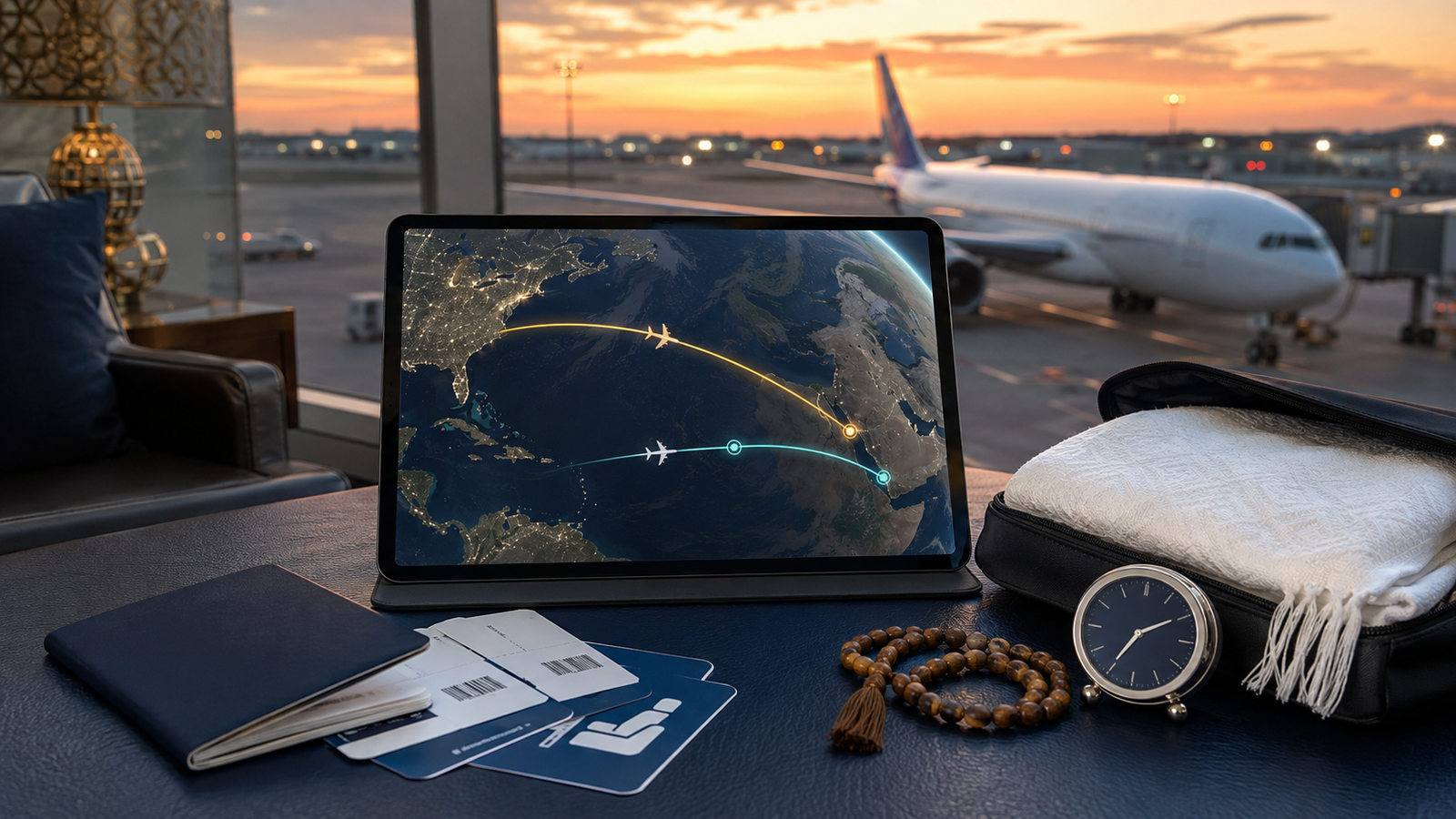
Only one airline flies nonstop from the USA to Saudi Arabia — and for many pilgrims, the one-stop routing is actually the better choice.
Saudia connects New York, Washington D.C. and Los Angeles nonstop to Jeddah in roughly 12 hours.* Everyone else — and everyone starting in Madinah — connects once through Istanbul, Doha, Dubai or Cairo. Which is right for your family depends on three things this guide walks through: your home airport, whether you begin in Makkah or Madinah, and who is traveling with you.
Nonstop to Jeddah · ~12 hrs*
Ideal connection · 2.5–4 hrs
In our review analysis of 2,600+ public reviews of US Hajj and Umrah operators this summer, flights were the number one complaint category in the entire market — ahead of hotels, ahead of everything. Not because planes are late (they sometimes are), but because of decisions made at booking: families ticketed separately and seated apart, connections too tight to make with grandparents and strollers, itineraries that force an exhausted family to enter ihram in chaos. The flight is the first third of your Umrah. Here is how to get it right.
Option 1: Nonstop — Saudia from JFK, Washington and Los Angeles
As of the current schedules, Saudia (Saudi Arabia’s national carrier) is the only airline flying nonstop between the United States and the Kingdom — from New York JFK, Washington Dulles and Los Angeles to Jeddah several times weekly, plus Riyadh services. Nonstop Madinah flights from the US appear only as occasional seasonal or Hajj operations, so for practical planning, nonstop means Jeddah.*
| Route | Approx. duration* | Practical notes |
|---|---|---|
| New York (JFK) → Jeddah | ~11.5–12.5 hrs | The workhorse of East Coast Umrah travel; most of our New York groups fly it |
| Washington (IAD) → Jeddah | ~12 hrs | Serves the DMV community; slightly fewer weekly frequencies* |
| Los Angeles (LAX) → Jeddah | ~15–16 hrs | The longest nonstop; West Coast families sometimes prefer a one-stop with a break |
Why choose nonstop: no missed-connection risk, no second takeoff with sleeping children, and the shortest door-to-door time from the East Coast. The trade-offs: it lands only in Jeddah (so Makkah must be your first city, with ihram beginning on the plane — see below), departures are limited to three gateways, and seats sell out fastest in December and Ramadan.
Option 2: One-Stop — and Why It Is Often the Smarter Routing
From every other US city — and often even from New York — the normal Umrah routing is one stop through a major hub. The strong carriers on these routes are Turkish Airlines via Istanbul, Qatar Airways via Doha, Emirates via Dubai, Etihad via Abu Dhabi, EgyptAir via Cairo and Royal Jordanian via Amman, with wide US networks feeding them from most major cities.*
- Single ticket, one airline (or true partners) end to end
- Connection of 2.5–4 hours — enough for delays, prayer and a walk
- Arrives in Madinah, or in Jeddah at a civilized hour
- Whole family on one reservation, seats assigned together
- Checked bags tagged through to the final airport
- Two separate tickets “because it was cheaper” — a delay on leg one is legally your problem, not the airline’s
- A 70-minute connection in a mega-hub with passport control
- An 11-hour overnight layover with children and no hotel plan
- Family members on different airlines “to save $150”
- Basic-economy fares with no seat selection, discovered at check-in
Ihram and Your Flight: The Detail That Decides Your Routing
If your first stop is Makkah (landing in Jeddah), you must be in ihram before the aircraft crosses the miqat boundary — on Jeddah-bound flights the crew or your group leader announces it, typically around an hour before landing. Practically, men change into ihram garments either before boarding the final leg or early in that flight, make the intention at the announcement, and land ready. It is entirely manageable — millions do it every year — but it is one more thing happening at hour eleven of a long journey.
If your first stop is Madinah, no ihram is needed on the plane at all. You enter ihram days later, rested, at the miqat of Dhul-Hulayfah just outside the city, usually after a calm morning and a shower at the hotel. This is why we route most first-timer groups Madinah-first. Our pre-departure webinars cover the exact procedure for whichever routing your group flies — and your group imam is beside you when it happens.
Booking Well: Seats, Timing and the Group Advantage
- Book 2–4 months out for normal dates; earlier for December and Ramadan. Holiday-week seats to Jeddah behave like the school calendar says they should — see our December school-break guide and month-by-month timing guide.
- Prefer evening departures eastbound. Leaving the US at night lands you in Saudi Arabia in the evening or at night local time; sleep on the plane and your first full day starts almost on local rhythm.
- Choose seats for the people, not the map. Aisle seats for elderly travelers (easier standing, walking and wudu trips), bulkhead bassinets for infants requested at booking, and the family seated together confirmed at ticketing — not “sorted at the gate.”
- Request wheelchair assistance when booking, not at the airport. It is free on every airline, transforms the connection experience in a mega-hub, and no elderly parent should walk forty-five minutes of terminal to save the pride of asking.
- Hydrate and move. A 12-hour flight followed by Tawaf is a physical event; compression socks for older travelers and water over juice/coffee are the unglamorous advice that works. The packing guide covers the carry-on checklist.
Why Group Flights Are Part of the Package
When Hisar Tour builds a group, we contract group seats with the airline: the whole group on one flight, ticketed together, families seated together, baggage rules confirmed, and a group leader in the cabin from the departure gate — the same person who has answered your questions in the webinars. When a flight delays or a connection breaks, the airline rebooks the group, and our team works the problem; nobody stands alone at a transfer desk in a foreign hub with a phone that does not work abroad. That — not the fare — is the real difference between a group ticket and eleven browser tabs of “cheap flights to Jeddah.” It is one of the eight components of a complete package we break down in what a quality Umrah package actually includes.
Tell us your city — we will tell you the smart routing
Departures with group flights from New York, Washington D.C., Los Angeles and Toronto, and routings for families flying from any US city. Ask us what we would book for our own parents.
See Umrah Packages
WhatsApp +1 201-201-8992
A UAMA community organization · Group flights · Madinah-first itineraries
Frequently Asked Questions
Are there direct flights from the USA to Saudi Arabia?
Yes — Saudia flies nonstop from New York JFK, Washington Dulles and Los Angeles to Jeddah (plus Riyadh services), taking roughly 12 hours from the East Coast. It is currently the only airline with nonstop US–Saudi service. There are no regular year-round nonstops from the US to Madinah, so Madinah arrivals use one-stop routings.
Is it better to fly into Jeddah or Madinah for Umrah?
For first-timers and families, Madinah first is usually better: no ihram is required on the plane, you recover from jet lag in a calmer city, and you enter ihram rested at the miqat outside Madinah before traveling to Makkah. Flying into Jeddah first is faster from the East Coast but means entering ihram during the flight and performing Umrah soon after a 12-hour journey.
How long is the flight to Jeddah from the USA?
Nonstop from New York or Washington, approximately 11.5–12.5 hours; from Los Angeles about 15–16 hours. One-stop routings through Istanbul, Doha or Dubai typically total 16–20 hours door to door depending on the connection length.
Do I wear ihram on the plane?
Only if you are flying into Jeddah with Makkah as your first city: you must be in ihram before the aircraft crosses the miqat, announced roughly an hour before landing — most men change before boarding the final leg. If you land in Madinah first, no ihram is needed on the flight; you enter ihram at Dhul-Hulayfah before traveling to Makkah.
What is a good layover time for Umrah flights?
Between 2.5 and 4 hours on a single ticket. Under 2 hours in a large hub with passport control is risky with family; over 6 hours is exhausting with children and elderly travelers unless you plan a lounge or hotel. Never book two separate tickets to save money — a delay on the first leg becomes entirely your problem.
Can I bring Zamzam water on the plane?
Generally yes when departing from Jeddah or Madinah: sealed 5-liter bottles purchased at official airport counters travel as specially tagged checked baggage, typically one per passenger. Policies vary by airline and can change, so confirm your airline’s current rule before you fly. Zamzam cannot go in carry-on due to liquid limits.
*Routes, frequencies and durations reflect published schedules as of August 2026 and change seasonally; verify current schedules with the airline before booking. Durations are approximate. Zamzam and baggage policies are set by each airline. Review-analysis references are to Hisar Tour’s internal August 2026 audit of 2,600+ public Google reviews across nine US operators. Last reviewed: August 2026.