
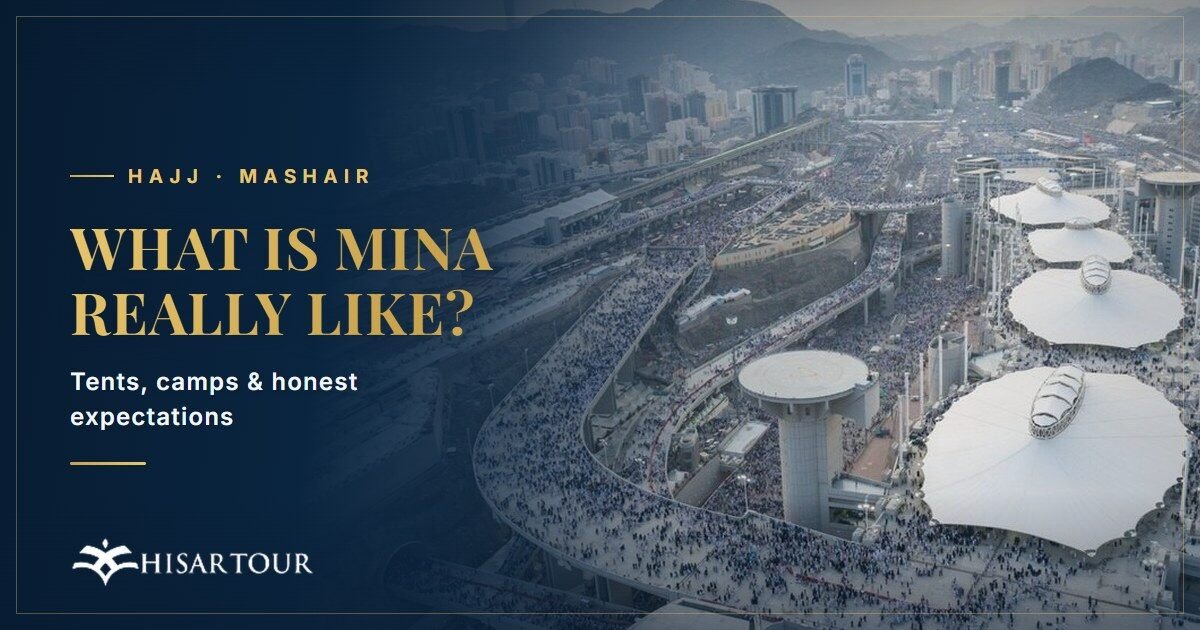
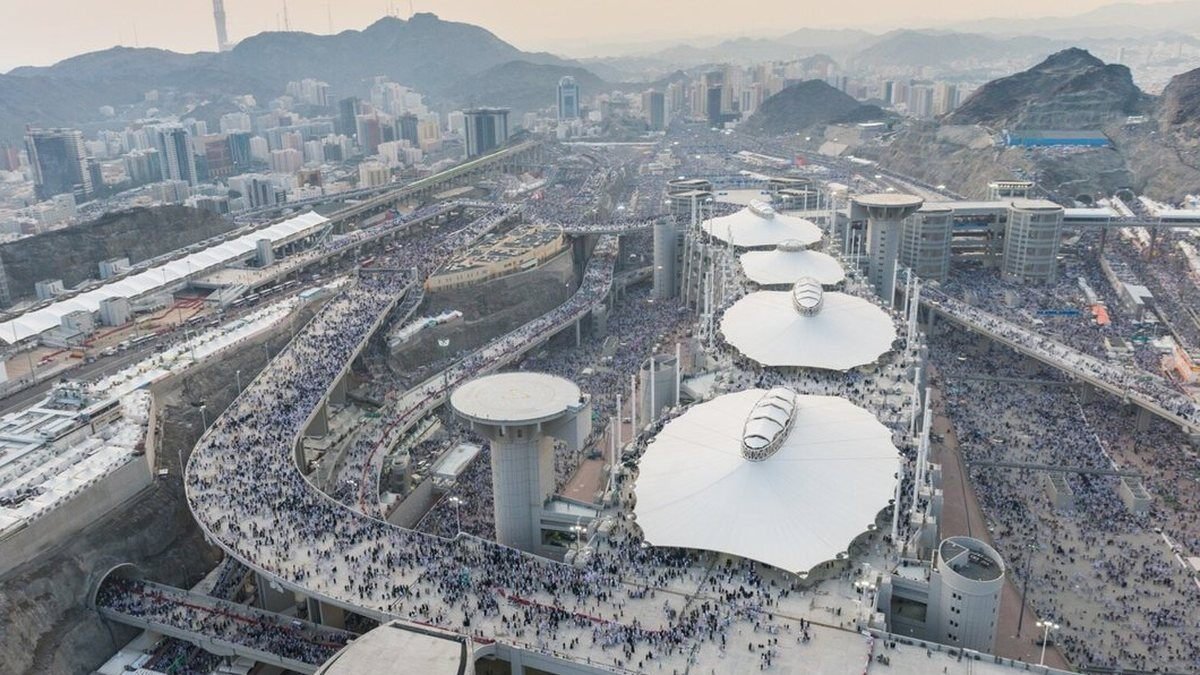
Mina is a valley of permanent tents inside the Haram boundary where you spend up to four nights of Hajj: shared, crowded, cooled, and run on your group’s schedule rather than yours.
You arrive on 8 Dhul Hijjah, leave for Arafat the next morning, and come back on the day of Eid for the Days of Tashreeq. What decides most of your experience is not the tent itself but which camp your package puts you in. Under the Nusuk system, the 2026 season offered two: one 300 to 700 meters from the Jamarat, the other about 4 km away.
Mina gets less honest description than any other part of Hajj. Packages describe it in a line, and first-time pilgrims usually arrive with a picture borrowed from somebody else’s photos. In our internal August 2026 audit of 2,600+ public Google reviews across nine US operators, Mina and Arafat came up in under 8% of written reviews, far less often than hotels or flights, even though these are the days pilgrims remember most. This page sets out what the Saudi authorities actually document about Mina, what they do not, and the questions worth putting to your operator in writing. If you are still choosing a package for 2027, our Hajj 2027 page explains how registration and packages work on Nusuk.
What Mina Is, and When You Are There
Mina is a valley east of Makkah, within the boundaries of the Haram, running east to west between two lines of mountains. The Ministry of Hajj and Umrah’s Mina guide gives its total legal area as about 7.82 square kilometers, of which only about 4.8 are usable (61%); the rest is rugged mountain. The usable stretch is roughly 3.2 km long. Almost every pilgrim on earth that week has to fit into that valley, which explains most of what follows.
You are in Mina on three separate occasions:
- 8 Dhul Hijjah, the Day of Tarwiyah. You arrive in ihram, pray Zuhr, Asr, Maghrib, Isha and the next Fajr there, each shortened but on time, and leave for Arafat after sunrise on the 9th. Expected date for 2027: Friday 14 May.*
- 10 Dhul Hijjah, the Day of Eid. After Arafat and the night in Muzdalifah, you return to Mina to stone Jamrat al-Aqabah, then complete the rest of the day’s rites.
- 11 to 13 Dhul Hijjah, the Days of Tashreeq. You stone all three Jamarat each day and may leave on the 12th or stay until the 13th. The Qur’an permits both (2:203), and the Ministry’s guide says the choice follows your group’s schedule.

The Prophet (peace be upon him) described these as “the days of eating and drinking” (Sahih Muslim 1141), and the Ministry’s guide calls them days of celebration at the completion of Hajj. The physical reality is crowded and tiring, and both things are true at once.
The Camp Decides Your Walk
The single most consequential Mina fact is the distance from your camp to the Jamarat, because you walk it, or ride part of it, at least four times. The official Nusuk Hajj package page for the 1447 AH (2026) season names two camp areas for pilgrims booking through the platform, and every one of its six package categories lists them as “Majar Al-Kabsh or Al-Muaisim”.
| Camp (Nusuk, 1447 AH) | Distance to Jamarat Bridge | Stated capacity | What it means on foot |
|---|---|---|---|
| Majar Al-Kabsh | 300–700 m | around 5,000 | A short walk each day of stoning |
| Al-Muaisim | about 4 km | up to 44,000 | A long walk each way, or train or bus as your group schedules |
Swipe the table sideways to see every column. Source: hajj.nusuk.sa, Packages & Categories page, 1447 AH season, read 21 November 2026.
Two cautions. First, these are the 2026 figures; Nusuk had not published anything for 1448 when we checked on 21 November 2026, and the platform still showed “10 steps closer to 1447 Hajj”. Second, the distance is measured to the camp area, not to your tent. Our own Hajj 2027 programs page says it plainly: distances are approximate walking distances from the camp zone to the Jamarat bridge and vary by the exact tent location within the zone, and the camp itself is chosen inside Nusuk after the package is purchased, subject to availability.
For our 2027 programs, as listed in October 2026, Al-Muaisim is the included camp and Majar Al-Kabsh is an upgrade. For older or less mobile pilgrims we recommend Majar Al-Kabsh together with a non-shifting hotel in Zone A, because the walking adds up quickly across four days. Whether the upgrade is worth it for a fit 35-year-old is a different question, and a fair one to ask us directly.
Tents, Beds and Food: What Is Documented
Here the honest answer starts with what the official pages do not say. The Nusuk categories page describes hotels, zones, camps and room sharing in detail, but it does not publish a specification for the inside of a Mina tent: how many people share it, what you sleep on, or how meals are served. Those are set by the Saudi service provider that operates your package, and they can differ between providers and categories.
- Two camp areas and their distance to the Jamarat (Nusuk, 2026 season)
- Restrooms, barber shops and restaurants are available across Mina (Ministry Mina guide)
- Prayers are prayed shortened, on time, in congregation at the camps
- Your group supervisor and your Nusuk card are your lifelines
- Mashair services are part of every All-Inclusive package (Nusuk)
- How many people share one tent, and how men and women are separated
- Bed, sofa-bed or mattress, and how much floor space each person has
- Meal times, what is served, and whether there is food between meals
- Number of restrooms per tent block
- Whether the train or a bus is included for the Jamarat
What we can add from published reporting: Mina’s tents are permanent, flame-retardant structures made of fiberglass coated with Teflon and equipped with air-conditioning, as Arab News reported in 2021, replacing the cotton tents involved in deadly fires in the past. Cooled does not mean quiet or private. Expect to sleep close to other people, with lights and movement through the night, and plan for it rather than hoping otherwise. The Ministry’s handbook for American pilgrims asks pilgrims not to use phone loudspeakers inside tents, which tells you something about how close quarters are.
What a Day in Mina Feels Like
The 8th is the gentlest day of Hajj, and the Ministry treats it as preparation: recite the Talbiyah, read Qur’an, pray on time, and, in its words, “get enough rest before the Day of Arafat.” The temptation on the 8th is to wander and film. Resist it. Arafat starts early the next morning and is the day that cannot be made up.
The Days of Tashreeq have a different rhythm. Each day is organized around one appointment: your group’s stoning time. The Ministry’s Jamarat guide asks pilgrims to follow the designated stoning schedules and the approved transport plan for their group, and notes that all the Days of Tashreeq are valid for stoning until sunset on the 13th. In practice that means a morning or evening walk, train or bus to the Jamarat, the stoning itself, and a return to camp, with long stretches of rest, prayer and conversation in between. We go through the Mashair schedule hour by hour in the Day of Arafah guide and the Muzdalifah and Jamarat guide.
During the days of Hajj a Hisar Tour group leader travels with the group in Makkah, Mina, Arafat and Muzdalifah and is reachable around the clock. That matters most here, because Mina is where small problems (a lost slipper, a missed bus, a fever) need someone who knows the camp.
Heat, Illness and Getting Lost
Hajj 2027 is expected in mid-May, and the Ministry’s American edition handbook warns that temperatures during the 2025 Hajj season might approach 45°C (about 113°F) during the day. Its advice is simple and worth taking literally: avoid direct sun in peak hours, drink water and fluids regularly even when not thirsty, use sunscreen, carry a sun umbrella, and be careful moving between cooled tents and outdoor heat.
Getting lost is more common than people expect, because, as the Ministry itself warns, roads and camps in Mina can look very similar. Its checklist is the one we would give you:
- Save your area number, street, camp number and gate in your phone, and pin the camp on your map app.
- Note the nearest building or landmark, and the nearest train station number if your group uses the train.
- Carry your Nusuk card at all times.
- Leave only when necessary, never alone, and with your phone charged.
Taxis and ride apps do not operate inside Mina, Muzdalifah and Arafat during the days of Hajj, according to the same handbook. If you are separated from your group, there is no car to call; the plan has to exist before you need it. For what to pack for these days specifically, see our Hajj packing list.
Seven Questions to Ask Before You Pay
Because the inside of the tent is set by the provider, the only reliable way to know it is to ask, in writing, before you commit. These are the questions we would want answered for our own families:
- Which camp area is included, Al-Muaisim or Majar Al-Kabsh, and what does the upgrade cost?
- Who is the Saudi service provider for the Mashair days? (Our explainer on who really runs Nusuk packages covers why this matters.)
- How many people share a tent, and how are women’s areas arranged?
- What do we sleep on, and is bedding provided?
- What meals are served on each Mina day, and at what times?
- How does the group reach the Jamarat: on foot, by train or by bus?
- Who from your company is physically with us in Mina, and how do we reach them at night?
An operator who answers all seven clearly, and puts the answers in writing, is telling you something about how they run the rest of the trip.
Plan your Mina days before the season opens
Pre-register for Hajj 2027 and we will walk you through camps, packages and the Nusuk steps, and tell you when official packages are published.
Hajj 2027 pre-registration WhatsApp +1 201-201-8992A UAMA community organization
How many nights do you spend in Mina during Hajj?
Up to four. You spend the night of the 8th of Dhul Hijjah in Mina, then the nights of the 10th and 11th, and the night of the 12th if you stay until the 13th. The night of the 9th is spent in Muzdalifah. Pilgrims who leave on the 12th spend three nights in Mina.
Are the tents in Mina air-conditioned?
Mina’s permanent tents are flame-retardant fiberglass structures equipped with air-conditioning, according to Arab News reporting. How well the cooling works in your tent, and how many people share it, depends on the service provider and package, so ask before you book.
How far is my Mina camp from the Jamarat?
For the 2026 season, Nusuk listed Majar Al-Kabsh at 300 to 700 meters from the Jamarat Bridge and Al-Muaisim at about 4 km. The 2027 figures had not been published as of 21 November 2026. Your exact tent position within the camp changes the real walk.
Can I choose my own Mina camp?
Under Nusuk the camp is tied to the package and selected inside the platform after purchase, subject to availability. Some packages include one camp and offer the other as an upgrade. Confirm which camp is included before you pay.
Can I leave Mina on the 12th?
Yes. The Qur’an permits leaving after two days or staying for the third (2:203). In practice you follow your group’s schedule, and the Ministry notes that pilgrims who leave early stone on the 11th and 12th only.
*Dates for Hajj 2027 are expected only, based on the Umm al-Qura calendar, and may shift by a day with the official Dhul Hijjah moon sighting. Camp names, distances and capacities are from the Nusuk Hajj platform’s 1447 AH (2026) page; the 1448 AH (2027) packages had not been published when we checked on 21 November 2026. Hisar Tour program details are as listed on our site in October 2026 and are confirmed only when official packages are released. Religious points are summarized from the sources below; for rulings that apply to you, ask a scholar or your group’s imam. Last reviewed: November 2026.
Sources: Nusuk Hajj, Packages & Categories · Nusuk Hajj, The Journey · Ministry of Hajj and Umrah, Mina Awareness Guide · Ministry of Hajj and Umrah, Jamarat Awareness Guide · Ministry of Hajj and Umrah, Hajj Handbook, American Pilgrim’s Edition · Arab News, Mina, the City of Tents (2021) · Sahih Muslim 1141 · Qur’an 2:203