
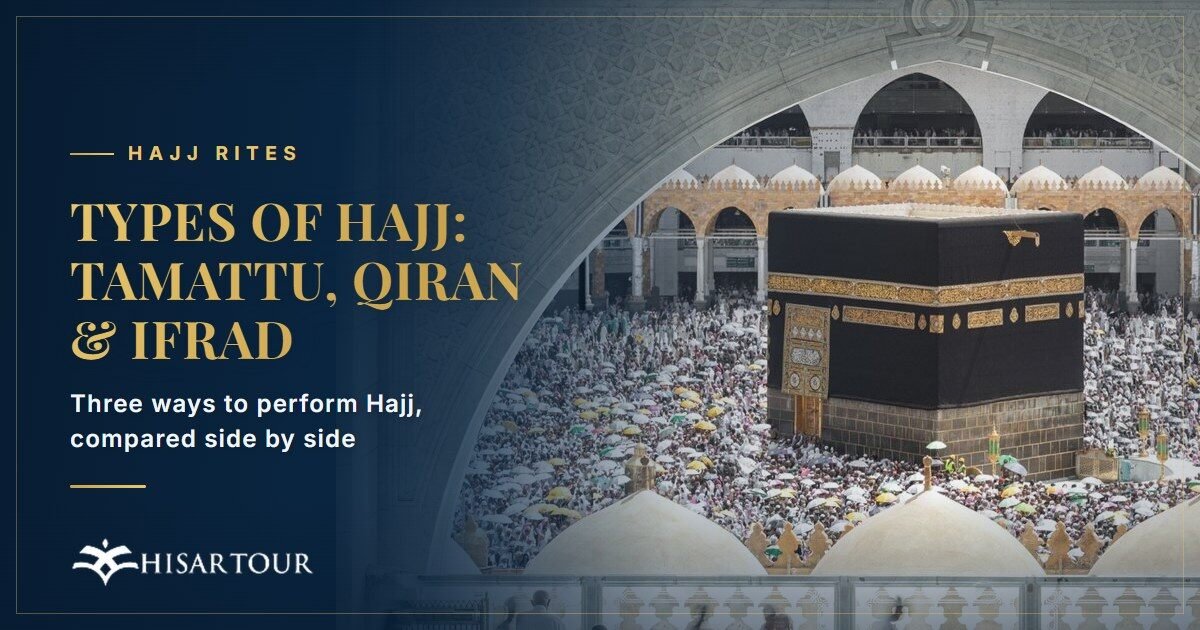
There are three types of Hajj: Tamattu, Qiran and Ifrad. They differ in whether you also perform Umrah, how many times you enter ihram, and whether a Hady sacrifice is required.
In Tamattu you perform Umrah, leave ihram, then enter ihram again for Hajj. In Qiran you perform Umrah and Hajj in one continuous ihram. In Ifrad you perform Hajj alone. Tamattu and Qiran require a Hady for pilgrims who do not live in the area of Al-Masjid Al-Haram; Ifrad does not. The four Sunni schools agree on the three types and differ on which is best and on some details, so confirm your own practice with a scholar.
Qur’an reference · 2:196
Rulings given here · none
This page explains the three types side by side, names the points where the schools of law differ, and shows what each type means in practice for a pilgrim flying from the US or Canada who arrives days or weeks before the days of Hajj. It doesn’t tell you which type to choose. That is a question for your scholar or your group’s imam, and it often depends on your school and your itinerary together. If you’re still at the stage of choosing a group for 2027, our Hajj 2027 page explains how registration through Nusuk works.
What the Qur’an Says
The type of Hajj that combines an Umrah with Hajj in the same season is named in Surah Al-Baqarah, 2:196. In the Saheeh International translation: “whoever performs ʿumrah [during the ḥajj months] followed by ḥajj [offers] what can be obtained with ease of sacrificial animals. And whoever cannot find [or afford such an animal] – then a fast of three days during ḥajj and of seven when you have returned [home]. Those are ten complete [days]. This is for those whose family is not in the area of al-Masjid al-Ḥarām.”
Three practical points come straight from the verse: the combined form carries a sacrifice (the Hady), there is a fasting alternative of three days during Hajj and seven after returning home for someone who cannot obtain one, and the rule is addressed to pilgrims whose families do not live in the area of Al-Masjid Al-Haram. The words in square brackets are the translator’s clarifications. How the verse applies to Qiran, and to people who do live near the Haram, is where scholars of the schools have reached different conclusions, set out below.
The Three Types Compared
| Point | Tamattu | Qiran | Ifrad |
|---|---|---|---|
| What you perform | Umrah, then Hajj | Umrah and Hajj together | Hajj only |
| Ihram | Two: one for Umrah, a new one for Hajj | One, covering both | One, for Hajj |
| Leave ihram before Hajj? | Yes, after completing Umrah | No, until the 10th of Dhul Hijjah | No, until the 10th of Dhul Hijjah |
| Hady required? | Yes, for those not living in the Haram area (2:196) | Yes, for those not living in the Haram area, according to the four schools | Not required |
| If no Hady is possible | Fast 3 days in Hajj and 7 at home | Fast 3 days in Hajj and 7 at home | — |
Swipe the table sideways to see all three types. Details such as the number of Sa’i in Qiran differ between schools; see below.
Tamattu: Umrah, a Break, Then Hajj
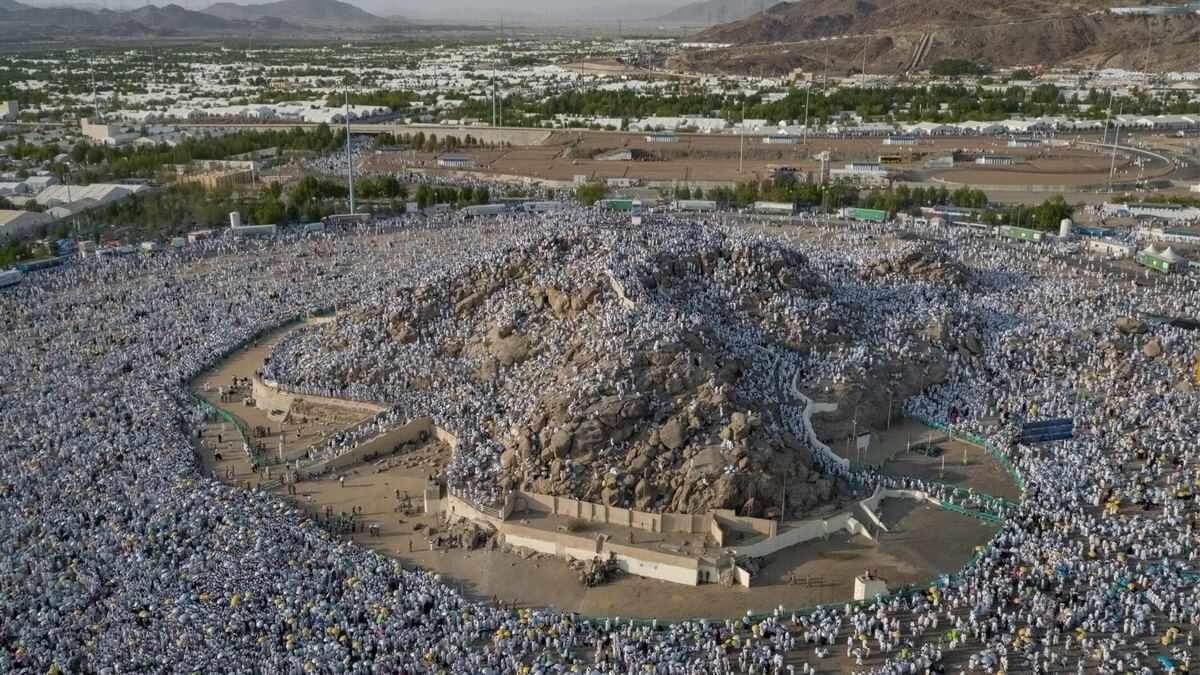
Tamattu means “enjoyment”, a reference to the ordinary life you return to between the two rites. You enter ihram at the miqat with the intention of Umrah, perform the Umrah (Tawaf, Sa’i, then shaving or trimming the hair) and leave ihram. You then live normally in Makkah until the day you set out for Hajj, when you enter ihram again, from where you are staying, with the intention of Hajj.
The Umrah must take place during the months of Hajj, which begin with Shawwal, and in the same season as the Hajj. An Umrah performed earlier, in Ramadan for example, does not make your Hajj Tamattu. A Hady is due; groups normally arrange it for the days of sacrifice that begin on the 10th of Dhul Hijjah. Our page on the Hady sacrifice explains how it is arranged.
The previous version of this page described this sacrifice as a sacrifice of gratitude (shukr). That is how the Hanafi school characterizes it; other schools describe its nature differently, which affects details such as whether the pilgrim may eat from it. Ask your imam which view your group follows.
Qiran: One Ihram for Both
In Qiran you enter ihram at the miqat intending both Umrah and Hajj together, and you stay in ihram until the rites of the 10th of Dhul Hijjah. You don’t leave ihram after the Umrah’s Tawaf and Sa’i. As with Tamattu, a Hady is due from pilgrims who do not live in the area of Al-Masjid Al-Haram.
The schools differ on how many Tawafs and Sa’is Qiran involves. The majority view is that one Tawaf and one Sa’i serve for both the Umrah and the Hajj. The Hanafi school teaches that the pilgrim in Qiran performs a separate Tawaf and Sa’i for the Umrah. If you intend Qiran, ask your imam before you travel exactly which acts your group will perform and when.
Ifrad: Hajj Alone
In Ifrad you enter ihram with the intention of Hajj only. You may perform a Tawaf on arrival (Tawaf al-Qudum) and can perform the Sa’i of Hajj after it; otherwise the Sa’i follows Tawaf al-Ifadah. You stay in ihram until the 10th of Dhul Hijjah. No Hady is required for Ifrad, though a pilgrim may offer one voluntarily.
The original version of this page noted that people living within the boundaries of the Haram area may perform only Ifrad. That is the position of the Hanafi school. The other three schools permit Tamattu and Qiran to residents as well, without the Hady, reading the end of 2:196 as removing the sacrifice rather than the option. This is a difference of interpretation, not a mistake on either side.
Where the Schools Differ
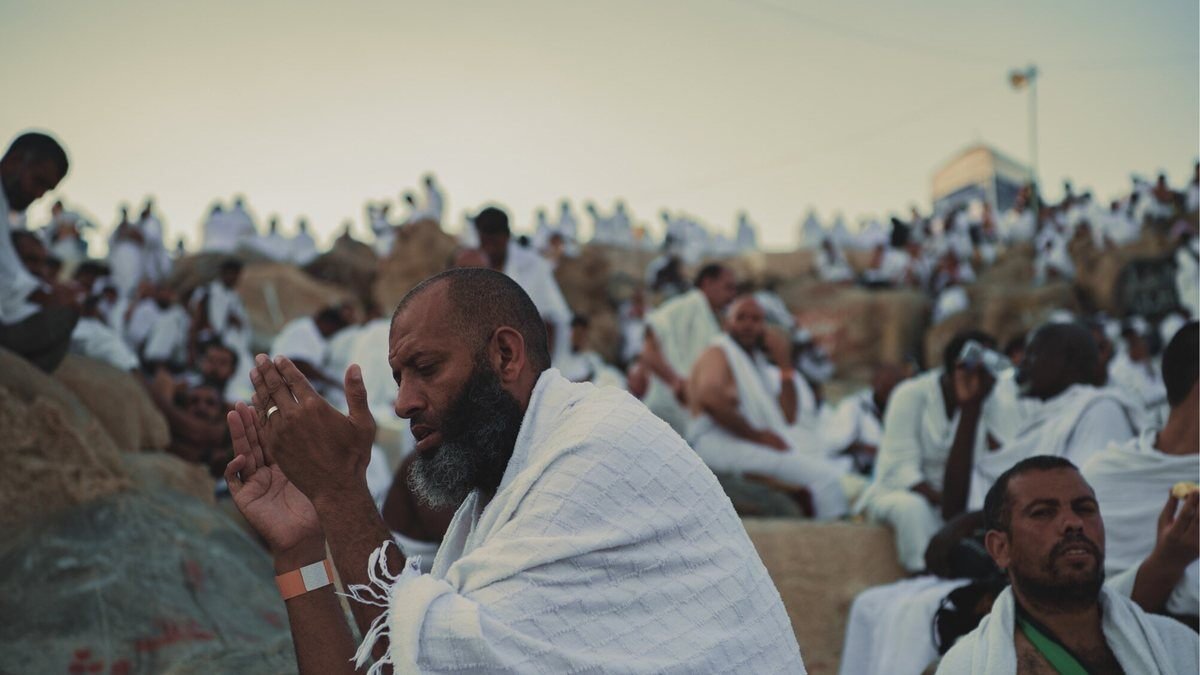
All four Sunni schools accept all three types as valid. Their differences are about preference and detail, and they are set out here so that you recognise them, not so that you choose between them on your own.
| School | Type usually taught as most virtuous | Residents of the Haram area |
|---|---|---|
| Hanafi | Qiran | Taught to perform Ifrad |
| Maliki | Ifrad | All three permitted; no Hady for Tamattu or Qiran |
| Shafi’i | Ifrad, when Umrah is also performed that year | All three permitted; no Hady for Tamattu or Qiran |
| Hanbali | Tamattu | All three permitted; no Hady for Tamattu or Qiran |
Swipe to see the full row. Within each school there are further detailed opinions; ask a scholar for your own case.
What It Means for a Pilgrim From the US
Two facts about Hajj from North America shape the choice in practice. First, you cross a miqat on the way in, by air, and must be in ihram before you do; our guide to the miqat on flights from the USA explains where that happens. Second, Nusuk packages have minimum stays (10 days for non-shifting Luxury and Premium categories, 14 days for the others, in the 1447 categories), so most pilgrims arrive well before the 8th of Dhul Hijjah. Our guide to Nusuk package categories sets those out.
Arriving early in Makkah
With Tamattu, you perform Umrah on arrival, leave ihram, and spend the waiting days out of ihram. With Qiran or Ifrad, you remain in ihram from the miqat until the 10th, which can mean a week or more under its restrictions. Ask your group which type its schedule assumes.
Going to Madinah first
If your itinerary starts in Madinah, you enter ihram later, when you travel from Madinah to Makkah, at the miqat of Dhul-Hulayfah. The same choice of type applies from that point.
Budgeting for the Hady
Tamattu and Qiran require a Hady unless you cannot obtain one, in which case the fasting alternative in 2:196 applies. Check whether your package includes the sacrifice or whether it is arranged separately.
The rules of ihram themselves are the same whichever type you perform; our ihram rules guide covers them. For the order of the days from Mina to the farewell Tawaf, see the month-by-month Hajj timeline from the USA, and for common questions about Hajj as a whole, our Hajj FAQ for US and Canadian pilgrims.
Learn the rites with an imam before you travel
Our Hajj 2027 groups prepare together before departure, including the type of Hajj, ihram and the days of Mina and Arafat. Pre-register to hear about the preparation sessions.
Hajj 2027 pre-registration
WhatsApp +1 201-201-8992
A UAMA community organization
What are the three types of Hajj?
Tamattu (Umrah, then a break from ihram, then Hajj), Qiran (Umrah and Hajj in one continuous ihram) and Ifrad (Hajj only). All four Sunni schools accept all three.
What is the difference between Tamattu and Qiran?
In Tamattu you leave ihram after the Umrah and enter it again for Hajj. In Qiran you stay in a single ihram from the miqat until the 10th of Dhul Hijjah. Both require a Hady for pilgrims who do not live in the area of Al-Masjid Al-Haram.
Which type of Hajj is best?
The schools answer differently: the Hanafi school usually teaches Qiran, the Maliki and Shafi’i schools Ifrad, and the Hanbali school Tamattu. Ask your scholar or your group’s imam which applies to you.
Do I have to offer a sacrifice for Ifrad?
No Hady is required for Ifrad. It is required for Tamattu and Qiran for pilgrims not living in the Haram area, with a fasting alternative of three days during Hajj and seven at home for someone who cannot obtain one (Qur’an 2:196).
Do I choose the type of Hajj on Nusuk?
No. The type of Hajj is your intention at the miqat, not a package option. Your group’s schedule usually assumes a type, so ask before you travel.
This page describes the three types of Hajj and the commonly taught positions of the four Sunni schools. It is not a religious ruling; for your own practice ask a qualified scholar or your group’s imam. The Qur’an translation is Saheeh International, checked on quran.com on 10 October 2026. Nusuk minimum-stay figures are from hajj.nusuk.sa (1447 categories), read on the same date. Last reviewed: October 2026.
Sources: Qur’an 2:196, Quran.com · Nusuk Hajj, the Hajj journey · Nusuk Hajj, Packages & Categories