
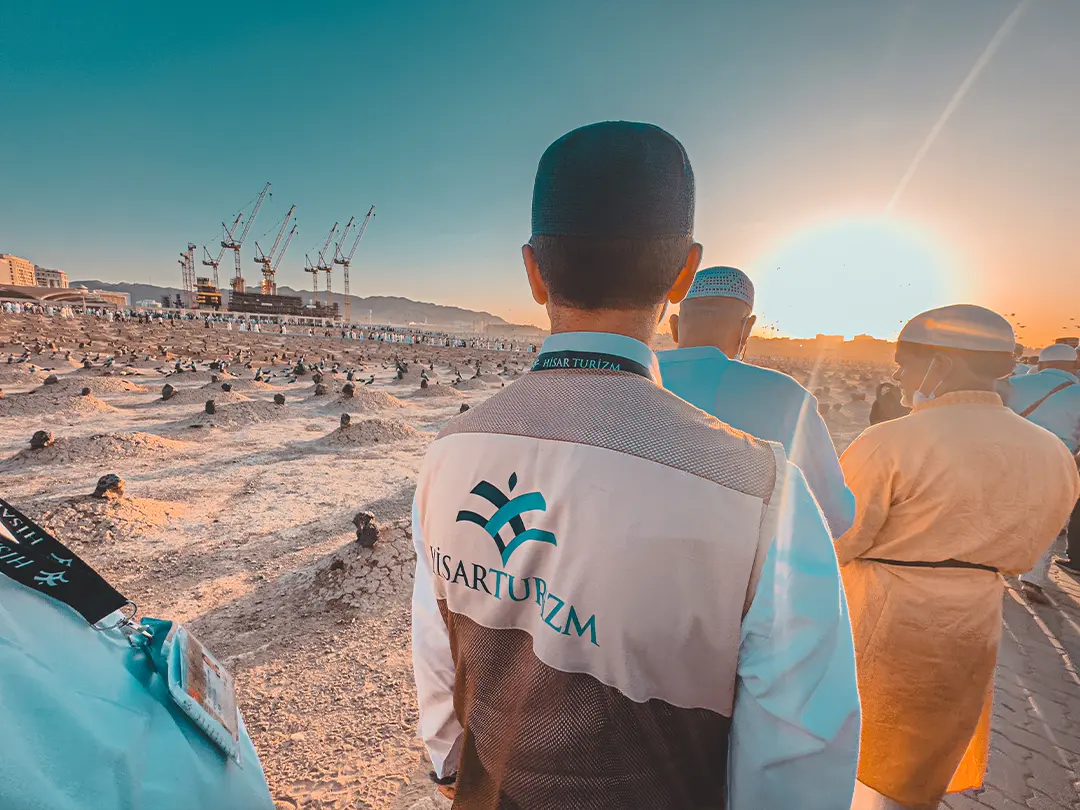
Hajj is the obligatory pilgrimage performed once in a lifetime on fixed days of Dhul Hijjah; Umrah is the shorter pilgrimage you can perform almost any time of year.
Both begin in Ihram and both include Tawaf and Sa’i — but Hajj adds the days at Mina, Arafah, Muzdalifah and the Jamarat, takes five to six days instead of a few hours, and costs several times more. Here is every difference that matters, side by side.
Umrah · Any time of year*
Hajj 2027 · ~May 14–19*
If you are planning your first pilgrimage from the United States or Canada, the first decision is not which hotel or which airline — it is which journey. Many first-time travelers tell us they “want to do Hajj” when what they can realistically do this year is Umrah, and others postpone Umrah for years because they assume it is nearly as demanding as Hajj. It is not. This guide explains the two pilgrimages plainly: what each requires, when each happens, how long each takes, what each costs from North America, and how to decide which one is right for you now.
Hajj vs Umrah at a Glance
| Question | Hajj | Umrah |
|---|---|---|
| Religious status | Fifth pillar of Islam; obligatory once in a lifetime for every adult Muslim who is physically and financially able | Highly recommended; scholars differ on whether it is obligatory once (Shafi’i and Hanbali view) or a strongly emphasized Sunnah (Hanafi and Maliki view) |
| When | Only on fixed days: 8–13 Dhul Hijjah, the last month of the Islamic year | Any time of year, except during the annual pause around the Hajj season when Saudi authorities stop issuing Umrah visas* |
| Where | Makkah plus the holy sites outside the city: Mina, Arafah, Muzdalifah, the Jamarat | Makkah only (the Grand Mosque); a visit to Madinah is customary but not part of the rite |
| Rites | Ihram, Tawaf, Sa’i, day in Mina, standing at Arafah, night at Muzdalifah, stoning the Jamarat, sacrifice (Hady, for Tamattu’ and Qiran), shaving or cutting hair, Tawaf al-Ifadah, farewell Tawaf | Ihram, Tawaf, Sa’i, shaving or cutting hair |
| Duration of the rites | Five to six days (a typical trip from North America is 2–3 weeks including Madinah) | Three to six hours (a typical trip is 7–14 days including Madinah) |
| Sacrifice | Required for Tamattu’ and Qiran pilgrims (Hady); recommended for Ifrad | Not required |
| How to book from the USA/Canada | Only through the official Nusuk Hajj platform, with a US-based group like Hisar Tour supporting you | Directly with a travel company; Umrah or tourist visa |
| Cost from North America | Roughly $10,000–$15,000+ per person all-in* | Roughly $2,000–$4,000 per person for a full-service group package (quad)* |
| Physical demand | High: long walks in heat, crowds of two million, nights in tents | Moderate: the rites themselves are a few hours; the rest of the trip is at your own pace |
*Umrah visa issuance is paused each year from around mid-Shawwal until after Hajj (in 2026, roughly early April to early June). Hajj 2027 dates are expected and depend on the sighting of the Dhul Hijjah moon. Cost ranges are 2026 market figures, quad occupancy; see conditions in the footer.
What Is Hajj?
Hajj is the fifth pillar of Islam — the pilgrimage to Makkah that every adult Muslim who is physically and financially able must perform once in a lifetime. The Qur’an commands it directly (Surah Al-Baqarah 2:196 and Surah Aal ‘Imran 3:97). It takes place only during a fixed window each year: the 8th to the 13th of Dhul Hijjah, the final month of the Islamic calendar.
What makes Hajj different from every other act of worship is that it is bound to specific places and specific days. Standing at Arafah on the 9th of Dhul Hijjah is the heart of Hajj — miss it, and there is no Hajj that year. The pilgrim spends the 8th in Mina, the 9th at Arafah, the night of the 9th at Muzdalifah, and the 10th to 12th (or 13th) back in Mina stoning the Jamarat, offering the sacrifice, and returning to the Grand Mosque for Tawaf al-Ifadah. Roughly two million people move through the same small area on the same days, which is why Hajj is physically demanding and why organization matters so much.
Because Islam follows a lunar calendar, Hajj moves about 10–11 days earlier each year on the Western calendar. Hajj 2027 is expected around May 14–19, 2027, with the Day of Arafah expected on Saturday, May 15 — subject to the official moon sighting in Saudi Arabia.
What Is Umrah?
Umrah is often called the “lesser pilgrimage.” It consists of four acts: entering the state of Ihram at the Miqat, performing Tawaf (seven circuits around the Ka’bah), performing Sa’i (seven passages between Safa and Marwah), and shaving or trimming the hair. A healthy adult completes the rites in three to six hours. There is no Arafah, no Mina, no Muzdalifah, no stoning, and no sacrifice.
Umrah may be performed at any time of year, and many Muslims perform it more than once. The one practical restriction is administrative: each year, Saudi authorities pause Umrah visas from around mid-Shawwal until after Hajj so the country can prepare for the pilgrimage. In 2026 the pause ran roughly from early April to early June. A similar pause is expected in 2027, with exact dates announced by the Ministry of Hajj and Umrah.
Scholars differ on Umrah’s ruling. The Shafi’i and Hanbali schools consider it obligatory once in a lifetime for those able; the Hanafi and Maliki schools consider it a strongly emphasized Sunnah. All four schools agree it is an act of great reward, and none makes it a condition for Hajj. If you follow a particular school, ask your imam — every Hisar Tour group travels with a qualified imam who can answer according to your madhhab.
Seven Differences That Actually Change Your Trip
Hajj happens once a year on days you cannot move. Umrah fits your life: a December school break, Thanksgiving week, Ramadan, or a quiet stretch in October. If you cannot take two to three weeks off work in May 2027, Hajj is not possible this cycle — but Umrah is.
Umrah is Ihram, Tawaf, Sa’i, hair. Hajj contains all of those plus Mina, Arafah, Muzdalifah, the Jamarat, the Hady sacrifice, Tawaf al-Ifadah, and the farewell Tawaf. In practice this means Hajj requires learning far more — which is why our Hajj groups attend a webinar series before departure.
The Umrah rites take an afternoon; the Hajj rites take five to six consecutive days, much of it outdoors. Most first-timers underestimate how tiring the Mina–Arafah–Muzdalifah–Mina sequence is. Umrah is the gentler introduction to the Haramain.
Hajj involves long walks between the holy sites (several kilometers on the days of stoning), nights in tents, and crowds on a scale that exists nowhere else. Umrah is as demanding as you make it — you can perform Tawaf at 3 a.m. when the mataf is quiet and rest in your hotel between prayers. Elderly parents often perform Umrah comfortably with support; Hajj requires honest planning around their strength.
Since 2022, every pilgrim from the USA and Canada books Hajj through the official Saudi Nusuk Hajj platform — you choose a package and pay inside your own Nusuk account, and a US-based group like Hisar Tour provides the imam, preparation and on-the-ground support. Umrah has no such system: you book directly with the company of your choice, on an Umrah or tourist visa.
Hajj from North America runs roughly $10,000–$15,000+ per person when you include the Nusuk package, flights and group services. A full-service Umrah group package — flights, hotels near the Haram, two daily meals, transfers, ziyarah and an imam — typically runs about $2,000–$4,000 per person in a quad room, depending on season and hotel tier.*
Pilgrims performing Hajj Tamattu’ (Umrah first, then Hajj — the most common form for travelers from abroad) or Qiran must offer the Hady sacrifice; Nusuk packages usually arrange this through official coupons. Umrah has no sacrifice.
What Hajj and Umrah Share
- Both begin with Ihram at the Miqat, with the same restrictions (no perfume, no cutting hair or nails, men in two unstitched cloths, no marital relations).
- Both include Tawaf around the Ka’bah and Sa’i between Safa and Marwah.
- Both end with shaving or trimming the hair (women trim a fingertip’s length).
- Both are performed in the Grand Mosque in Makkah, and most travelers add Madinah to either journey.
- Both require sincere intention (niyyah) and, for travelers from abroad, a valid Saudi visa — a Hajj visa via Nusuk, or an Umrah/tourist visa for Umrah.
Which One Should You Do First?
- You have never been to the Haramain and want to learn the rites without Hajj crowds
- You cannot take 2–3 weeks off in May 2027
- You are traveling with young children or elderly parents
- Your budget is $2,000–$4,000 per person right now
- You want to go this December, Ramadan, or Thanksgiving
- You are able (health and finances) and Hajj is your unfulfilled obligation
- You can commit the time and roughly $10,000–$15,000+ per person
- You can register on Nusuk when the 2027 window opens and follow the timeline
- You are prepared to attend pre-departure training — the rites are more complex
Many of our pilgrims perform Umrah first as a “rehearsal” for Hajj. They learn Tawaf and Sa’i, get to know Makkah and Madinah, and arrive at Hajj a year or two later far calmer. There is no religious requirement to do so — but there is real wisdom in it, especially for first-time travelers.
Hajj or Umrah — go with an imam-led group
Hisar Tour, the travel brand of the United American Muslim Association (UAMA), organizes Umrah groups from New York, Washington D.C., Los Angeles and Toronto, and supports Nusuk Hajj pilgrims from registration to return.
See Umrah Packages
WhatsApp +1 201-201-8992
A UAMA community organization · Serving pilgrims across the USA & Canada
Frequently Asked Questions
Is Umrah obligatory like Hajj?
Hajj is obligatory once in a lifetime for every able adult Muslim — it is a pillar of Islam. Umrah is a matter of scholarly difference: the Shafi’i and Hanbali schools hold it obligatory once for those able, while the Hanafi and Maliki schools consider it a strongly recommended Sunnah. All schools agree it carries great reward.
Can I perform Umrah instead of Hajj?
No. Umrah does not replace the obligation of Hajj. If you are physically and financially able, Hajj remains due. Many people perform Umrah first as preparation, then Hajj when their circumstances allow — but Umrah, however many times it is performed, does not fulfill the Hajj obligation.
How long does Umrah take compared to Hajj?
The Umrah rites — Tawaf, Sa’i and cutting the hair — take about three to six hours. The Hajj rites span five to six days (8–13 Dhul Hijjah) across Mina, Arafah, Muzdalifah and Makkah. A typical Umrah trip from North America is 7–14 days including Madinah; a typical Hajj trip is two to three weeks.
Can Umrah be performed at any time of the year?
Yes, with one practical exception: Saudi authorities pause Umrah visas each year from around mid-Shawwal until after Hajj (in 2026, roughly early April to early June). Outside that pause, Umrah is open year-round. Ramadan and the December school break are the busiest windows.
Does a Hajj trip include Umrah?
Usually, yes. Most pilgrims from the USA and Canada perform Hajj Tamattu’: they perform Umrah on arrival, exit Ihram, and re-enter Ihram for Hajj on the 8th of Dhul Hijjah. This form requires the Hady sacrifice, which Nusuk packages normally arrange.
How much more does Hajj cost than Umrah from the USA?
Roughly three to five times more. Hajj from the USA or Canada runs about $10,000–$15,000+ per person all-in (Nusuk package, flights, group services), while a full-service Umrah group package is typically about $2,000–$4,000 per person in a quad room, depending on season and hotel tier. Both are 2026 market ranges.
*Cost ranges are 2026 market figures for quad occupancy and vary by season, hotel distance and airline; Hajj 2027 prices are set only when Nusuk opens sales. Hajj 2027 dates are estimates based on astronomical calculation and are confirmed by the official Saudi moon sighting. Umrah visa pause dates are announced annually by the Saudi Ministry of Hajj and Umrah. Last reviewed: August 2026.