
Saudi Arabia requires every Umrah traveler to be vaccinated against meningococcal disease (ACYW or ACYWX) at least 10 days before arrival: a conjugate vaccine is valid for five years, a polysaccharide vaccine for three.
Everything else for a traveler from the USA or Canada is recommended rather than required: an updated COVID-19 vaccine (required only for people over 65, pregnant women and listed chronic conditions), the current seasonal flu shot, and routine vaccines being up to date. Since November 1, 2025, controlled medicines also need an electronic permit from the Saudi Food and Drug Authority before you fly. Hisar Tour, the Hajj and Umrah brand of the United American Muslim Association (UAMA), includes travel health insurance in every package and covers this checklist in its pre-departure webinar; this page is the written version.
Timing · ≥10 days before
Valid · 5 yrs conjugate / 3 yrs polysaccharide
Controlled meds · SFDA permit
Health questions are quiet in Umrah reviews and loud on the phone: which vaccine, when, what to do about a father’s heart medication, whether the water is safe, how hot it will be. This guide answers them in the order you will meet them, starting six to eight weeks before departure and ending at the Haram, with the Saudi Ministry of Health’s 1447H (2026) requirements and the CDC Yellow Book 2026 as the sources. The advice from our original October 2024 post is kept and expanded; nothing here replaces a conversation with your own doctor.
Vaccines: What Is Required and What Is Recommended
One vaccine is required for Umrah from the USA and Canada, the quadrivalent meningococcal vaccine, and the rest are recommendations from the Saudi Ministry of Health and the CDC. The Ministry’s current document, “Health Requirements and Recommendations for Travelers to Saudi Arabia for Umrah – 1447H (2026),” and the CDC Yellow Book’s Hajj and Umrah chapter (updated April 2, 2026) agree on the list below; the table separates what a border officer can ask for from what a doctor advises.
| Vaccine | Status for US/Canada travelers | Rule or advice | Source |
|---|---|---|---|
| Meningococcal ACYW (or ACYWX) | Required | Conjugate: within the last 5 years; polysaccharide: within 3 years; both at least 10 days before arrival; travelers aged 1 year and older | Saudi MOH 1447H; CDC Yellow Book 2026 |
| COVID-19 | Required for risk groups; recommended for all | Over 65, pregnant, or with listed chronic conditions: one updated 2025–2026 dose, or a completed primary series (2021–2024), or lab-confirmed infection in 2025 | Saudi MOH 1447H; CDC |
| Seasonal influenza | Recommended | The current season’s vaccine before travel; the CDC “strongly recommends” it for pilgrims | Saudi MOH 1447H; CDC |
| Routine vaccines (MMR, Tdap, varicella, hepatitis B) | Recommended | Up to date; hepatitis B for those at risk | CDC Yellow Book 2026 |
| Polio | Not required from the USA/Canada | Required only from listed countries with poliovirus; US adults with a completed series may take a single lifetime IPV booster on a doctor’s advice | Saudi MOH 1447H; CDC |
| Yellow fever | Not required from the USA/Canada | Certificate required only from listed African and South American countries | Saudi MOH 1447H |
Vaccination requirements for Umrah are a visa matter as well as a health matter, and the Ministry’s list is reissued every year, usually in the autumn before Hajj; the 1448H (2027) document had not been published when this page was reviewed. Our Umrah visa guide for US citizens explains which visa type each traveler uses.
The Meningococcal Vaccine: Timing, Certificate and the 2025 Confusion
The meningococcal vaccine must be given at least 10 days before you land in Saudi Arabia, and the certificate must show the vaccine type: if the type is not written on it, the Ministry counts it as valid for only three years from the date of administration. The Ministry’s document states that “all individuals intending to perform Umrah from all countries are required to be vaccinated,” and lists three acceptable forms: a quadrivalent (ACYW) conjugate vaccine or a pentavalent (ACYWX) conjugate vaccine within the last five years, or a quadrivalent polysaccharide vaccine within the last three years. The CDC adds that the conjugate vaccine is preferred because it also reduces carriage of the bacteria in the throat, and that conjugate vaccines are safe and effective for people over 55.
Who checks the certificate is the part that confuses travelers. The Ministry requires proof of vaccination at visa issuance from 26 named African countries; the USA and Canada are not on that list, so most US applicants are never asked to upload it. In January 2025 the Ministry announced the vaccine as mandatory for every Umrah traveler regardless of visa type, airlines began checking at check-in from February 10, and on February 6 the civil aviation authority told airlines to stop enforcing it at check-in. The requirement itself never changed: the Ministry’s documents for 1447H still list the vaccine as required for all Umrah performers. Our advice, and the US State Department’s, is the same: get the vaccine, carry the certificate in your passport, and do not test whether anyone asks.
Medications: Original Packaging and the New SFDA Permit
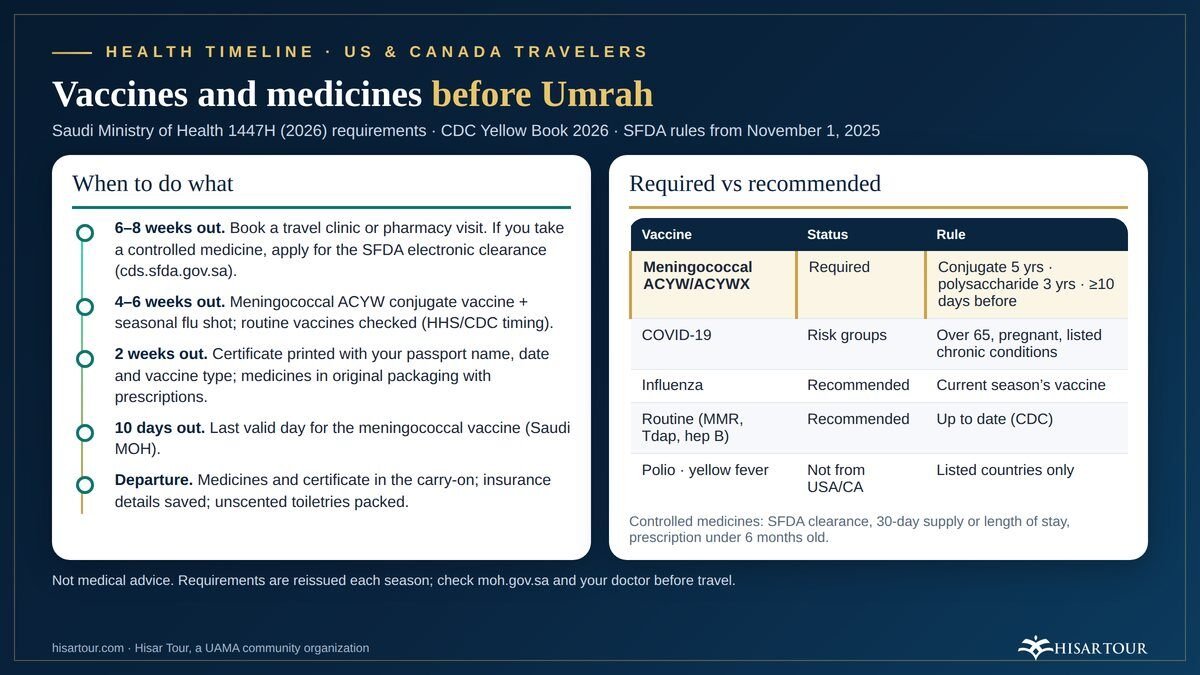
Pilgrims with chronic health conditions should carry their necessary medications, in their original packaging with the pharmacy label, together with documentation of the condition; that is the Ministry of Health’s own wording, and the Nusuk Umrah health guidelines add “along with copies of your prescriptions.” Pack the whole trip’s supply in the carry-on bag, never only in checked luggage, and keep a photograph of every prescription on your phone.
Since November 1, 2025, controlled medicines need something more: an electronic clearance from the Saudi Food and Drug Authority through its Controlled Drug System (cds.sfda.gov.sa), obtained before arrival. The US Embassy in Riyadh warned in October 2025 that travelers without the clearance “may encounter problems at Customs or be prevented from arriving or departing.” The listed medicines are narcotics and psychotropics, which in practice include certain strong painkillers, sleeping pills, anti-anxiety medicines and ADHD stimulants. The SFDA rules allow a quantity for a maximum of 30 days or the length of stay, whichever is shorter; the prescription or medical report must be no more than six months old; medicines without their original packaging, or expired, are prohibited. The application asks for a passport copy, the prescription or report, and photographs of the medicine and its packaging with the trade name, active ingredient, strength and quantity. Processing time is not published, so apply as soon as the trip is booked.
- Every prescription medicine: original container, pharmacy label, a doctor’s letter listing the generic names and doses, full supply plus a few days in the carry-on.
- Controlled medicines (opioid painkillers, benzodiazepines, sleeping tablets, ADHD stimulants and similar): SFDA electronic clearance before departure; 30-day maximum; prescription under six months old.
- Insulin and injectables: a doctor’s letter, a cool bag, and a plan for the eight-hour time difference; the CDC advises diabetics to travel with a written management plan and emergency supplies.
- Over-the-counter basics: pain relief, anti-diarrheal, an antacid, an antihistamine, rehydration salts, blister plasters and a small first-aid kit, all in original packaging; the full list is in our packing list from the USA.
Before Ihram: Grooming and the Full Bath
Before entering Ihram for Umrah it is recommended to trim the nails, remove underarm and pubic hair, groom the hair and beard and trim the moustache, and then to take a full ghusl; where a full bath is not possible, wudu is sufficient. These acts are both hygiene and Sunnah, and the order matters, because none of the grooming is allowed after the intention. In a Madinah-first group the bath happens in the hotel on the morning of the coach to Makkah, and the imam reminds everyone the night before; the rules of the state itself are in our Ihram guide for men and women.
Unscented Products in Ihram
Perfume and scented products are prohibited in Ihram, including perfumed soap, shampoo, wipes and lotion, so bring fragrance-free soap and shampoo from home and read the label for the word “fragrance.” Hotel toiletries in Makkah and Madinah are usually scented. Unscented sunscreen and unscented hand sanitizer are allowed, and hand sanitizer is worth carrying at all times, since the Ministry of Health advises washing hands with soap and water or a disinfectant, especially after coughing or sneezing.
Exiting Ihram: The Haircut
Umrah ends with the haircut: men shave the head or shorten the hair all around, and women trim about a fingertip’s length from the gathered ends, usually done privately in the hotel room. Use a licensed barber shop near the Haram rather than a street razor, ask for a new blade, and watch it being opened; a shared blade is the one hygiene risk of the haircut. Once the hair is cut the restrictions of Ihram end and scented soap, ordinary clothes and a proper shower follow.
Crowds and Physical Safety
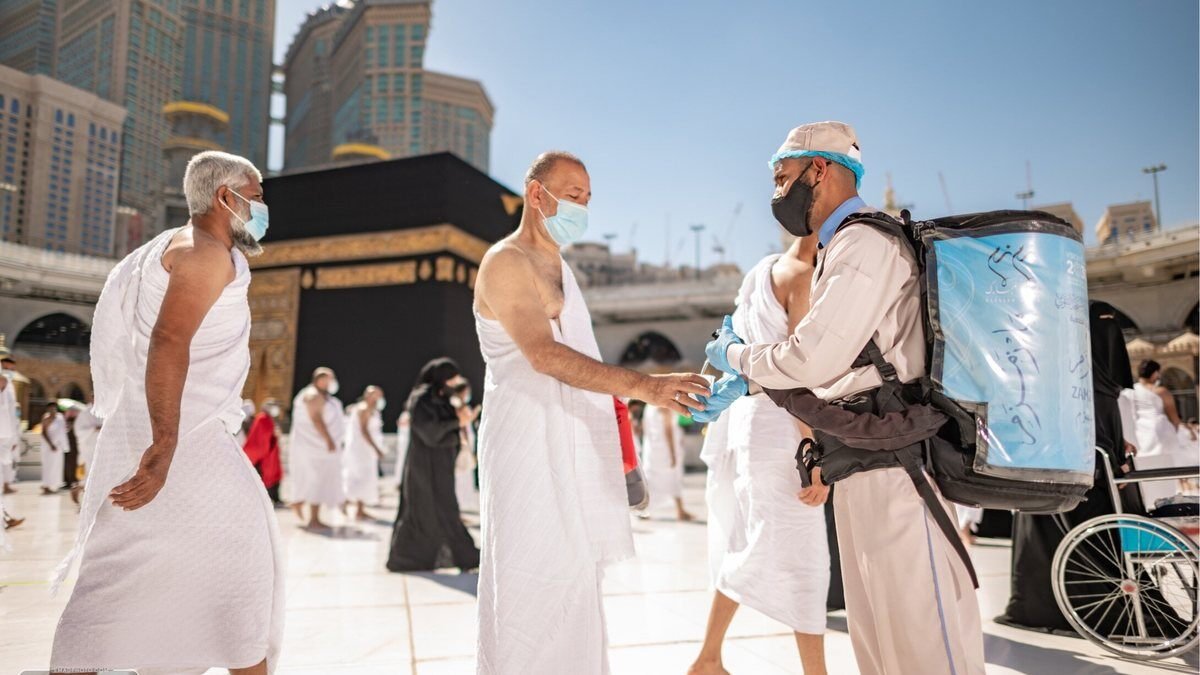
In crowded areas, above all during Tawaf around the Kaaba, women are advised to stay near their mahram or their group and to avoid the crush around Hajar al-Aswad and the Multazam, and everyone is advised to avoid Tawaf at peak times. The Ministry of Hajj and Umrah’s 2025 Ramadan guidance put the lightest crowds between 10 p.m. and 4 a.m. and between 9 a.m. and 4 p.m., and those windows hold in most seasons. Kissing the Black Stone is not part of the obligation of Umrah; pointing toward it from a distance is, and an elderly parent pushed toward the corner by a crowd is the most avoidable injury of the whole trip. The upper floors and the roof of the Mataf are always calmer than the ground floor; ask the imam which level the group will use.
Hydration and Heat
Staying well hydrated is essential on Umrah because Makkah is hot in every season and the rites are performed on foot: the Ministry of Health advises pilgrims, especially older people, to avoid direct sun during the rituals and to drink enough fluids, and the CDC counsels staying hydrated, wearing sunscreen and seeking shade. Makkah’s December afternoons average 85–88°F (29–31°C); March runs 89–94°F; from June to September temperatures reach 43°C (110°F) and above, and the CDC records more than 1,300 heat-related deaths during Hajj 2024. Zamzam water is available free from coolers throughout both mosques; a refillable bottle and an umbrella are the two health items most often forgotten. Our month-by-month guide gives the temperature for each season.
Food, Water and Nutrition
A balanced diet sustains energy and immunity on Umrah, and the practical rule is simple: eat the hotel’s breakfast and dinner, drink bottled or Zamzam water, and treat street food with the same care you would anywhere. The Ministry of Health advises avoiding unpasteurized milk and raw meat, washing fruit and vegetables, cooking food thoroughly and keeping raw and cooked food separate; the CDC adds avoiding food, water and ice from unknown sources. Two hotel meals a day, which every Hisar Tour package includes, remove most of the risk and most of the decisions; the third meal is dates and water in the mosque for most pilgrims.
Respiratory Infections and MERS-CoV
The most common illness on Umrah is a respiratory infection caught in the crowd, and the Ministry’s advice is to wear a regular face mask when performing rituals and in crowded places, wash or sanitize hands often, cover coughs and sneezes, and rest if you are ill. A separate and rarer risk is MERS-CoV, a coronavirus carried by camels: the Ministry advises avoiding visits and contact with camels in farms, markets or barns, and avoiding unpasteurized camel milk and undercooked meat. The World Health Organization has recorded more than 2,600 laboratory-confirmed cases since 2012 with a case fatality rate of about 37 percent, almost all in the Arabian Peninsula. The “camel ride” stop on some Ziyarah tours is exactly what this advice is about. If you develop fever and cough within 14 days of returning home, see a doctor and mention the trip.
Feet, Blisters and Walking
Foot injuries are the most common minor injury on Umrah, and the CDC’s advice is durable, protective footwear, with any open sores and blisters disinfected and kept covered. Marble courtyards are washed and cool; the streets outside are not, and in summer they burn. Carry a shoe bag so that your shoes come into the mosque with you rather than waiting at a gate you may not leave from. Choose the hotel distance with your feet in mind; our guides to Makkah hotels and walking distance and Madinah hotels and the central area turn the meters into minutes.
Older Pilgrims and Chronic Conditions
An older pilgrim or one with a chronic condition can perform Umrah safely with preparation, and the preparation is medical before it is logistical: a check-up four to six weeks out, the vaccines, the documented medication supply, and an honest conversation about walking. The CDC notes that Saudi Arabia advises children, frail older adults, seriously ill people and pregnant women to postpone Hajj and Umrah, and the Ministry publishes its health expectations for pilgrims each season; the decision belongs to your doctor, not to a package brochure. Hisar Tour books hotels 100 to 700 meters from the mosques partly for this group, arranges wheelchairs on request, and keeps the imam and a group leader with the group for exactly the moment when someone needs to sit down.
Everyday Hygiene in the Haramain
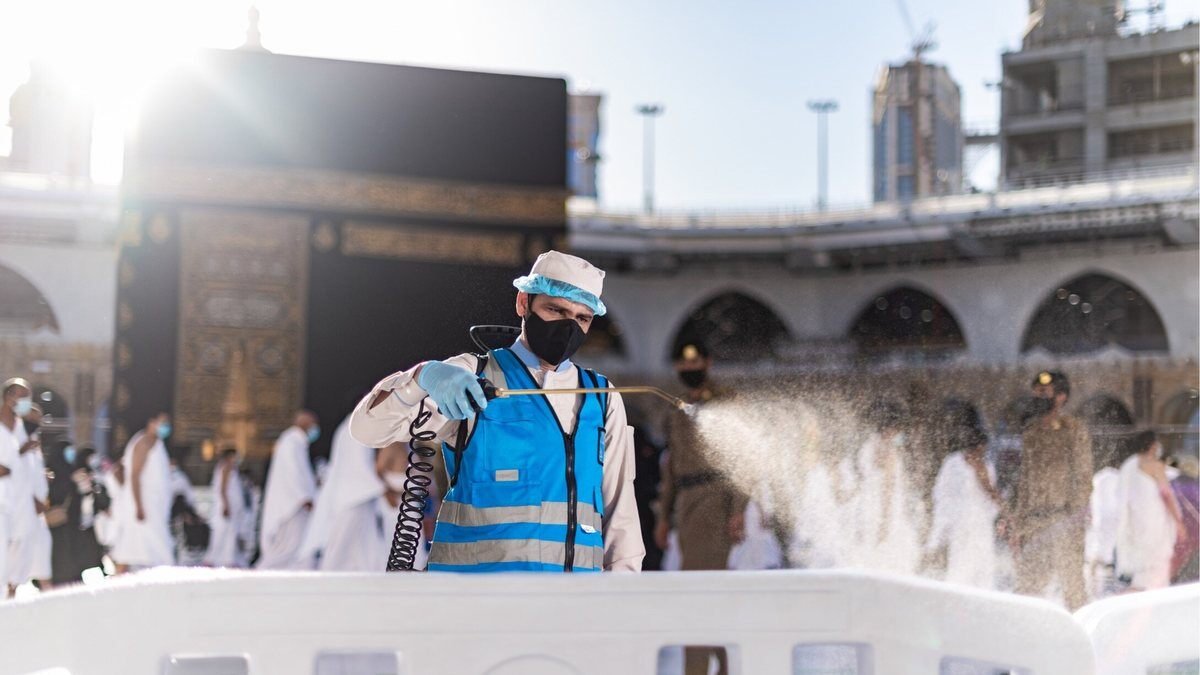
Everyday hygiene on Umrah is the same set of habits as anywhere, applied with more discipline: frequent hand-washing, avoiding close contact with people who are visibly ill, keeping a small distance from the densest gatherings where possible, and sleeping enough. Two hygiene facts specific to the mosques help: the courtyards and floors are washed several times a day, and shared prayer mats are best replaced by your own foldable mat. In a quad room, a bathroom rota and separate towels do more for four people’s health than any supplement; see our guide to room occupancy for how the rooms work.
Insurance, Emergencies and Where to Get Help
Medical insurance for Umrah is bundled into the Saudi visa fee: the Ministry of Hajj and Umrah stated in 2023 that insurance is mandatory for all pilgrims arriving from abroad and is included in the visa fee, covering emergency medical care among other risks, and the Council of Health Insurance confirms that health insurance is issued with the tourist visit visa. Hisar Tour adds travel health insurance to every package. The US State Department reminds travelers that the US government does not pay medical bills abroad and that Medicare and Medicaid do not cover care outside the country, so read what the bundled policy covers before relying on it.
| Need | Number or place | Note |
|---|---|---|
| Any emergency | 911 | Unified emergency number in Saudi Arabia |
| Ambulance | 997 | Saudi Red Crescent |
| Ministry of Health call center | 937 | Health advice and complaints; listed in the Nusuk Umrah guidelines |
| Inside the mosques | First-aid points and Red Crescent teams at the gates | Ask any uniformed staff member; the group imam knows the nearest point |
| App | Sehhaty | The Ministry of Health platform, in Arabic and English, recommended for visitors in the Nusuk guidelines |
What Hisar Tour Provides
Every Hisar Tour package includes travel health insurance, daily breakfast and dinner at the hotel, private coach transfers, hotels within walking distance of both mosques and an imam or trained group leader who stays with the group. The pre-departure webinar walks through this page’s checklist, the packing list and the Ihram rules, and the office answers medication and mobility questions before the deposit rather than at the airport. What we cannot do is replace your doctor; the clinic visit four to six weeks out is yours to book.
Prepare the health checklist with a group behind you
Imam-led Umrah departures from New York, Washington and Toronto, with travel health insurance, two hotel meals a day, walking-distance hotels and a pre-departure webinar that covers vaccines, medicines and heat.
See Umrah Packages
WhatsApp +1 201-201-8992
A UAMA community organization
Continue with the packing list from the USA, the Ihram rules guide and the Umrah visa guide for US citizens.
Frequently Asked Questions
Is the meningitis vaccine mandatory for Umrah?
Yes. The Saudi Ministry of Health’s 1447H (2026) requirements state that all individuals intending to perform Umrah, from all countries, are required to be vaccinated with a quadrivalent (ACYW) or pentavalent (ACYWX) meningococcal vaccine at least 10 days before arrival. A certificate is demanded at visa issuance from 26 listed African countries; US and Canadian travelers should still carry it.
How long is the meningococcal vaccine valid for Umrah?
A conjugate vaccine (ACYW or ACYWX) is valid for five years and a polysaccharide vaccine for three years, counted from the date of the dose. If the certificate does not state the vaccine type, the Ministry treats it as valid for three years only.
Do I need a COVID-19 vaccine for Umrah?
For the 1447H (2026) season the Ministry requires proof only from risk groups: people over 65, pregnant women, and those with listed chronic conditions such as chronic heart, lung or kidney disease, hereditary blood disorders, immunodeficiency, cancer or chronic neurological disease. Proof can be one updated 2025–2026 dose, a completed primary series from 2021–2024, or lab-confirmed infection in 2025. The CDC recommends everyone be up to date.
Can I bring my prescription medication to Saudi Arabia?
Yes, in original packaging with the prescription or a doctor’s letter, in your carry-on. Since November 1, 2025, controlled medicines such as opioid painkillers, sleeping tablets, anti-anxiety medicines and ADHD stimulants also require an electronic clearance from the Saudi FDA’s Controlled Drug System before arrival, limited to a 30-day supply or the length of stay.
How hot is it during Umrah, and how do I avoid heat illness?
Makkah averages 85–88°F in December and reaches 110°F (43°C) and above from June to September. Drink before you are thirsty, carry water and an umbrella, use the shaded routes and the upper floors, and avoid Tawaf in the early afternoon in summer. The Ministry of Health specifically advises older pilgrims to avoid direct sun during the rituals.
Is Zamzam water safe to drink?
Yes. Zamzam water is supplied by the mosque authorities through coolers throughout both mosques, and it is the water most pilgrims drink all day. Use the paper cups provided or your own bottle. The bottled Zamzam sold for the flight home is factory-sealed.
Do I need travel insurance for Umrah?
Medical insurance is bundled into the Saudi Umrah and tourist visa fee and covers emergency care in the Kingdom; Hisar Tour adds travel health insurance to every package. US Medicare and Medicaid do not cover care abroad, so check what the bundled policy covers and consider your own trip-cancellation cover as well.
These hygiene and health recommendations aim to make your Umrah journey safer and more comfortable. They are not a substitute for medical advice; for any specific health concern, consult a healthcare professional before your pilgrimage. Requirements are quoted from the Saudi Ministry of Health’s 1447H (2026) documents and the CDC Yellow Book 2026 and are reissued each season; check the Ministry’s page and your visa provider before you travel. Temperatures are monthly averages. Last reviewed: September 2026.
Sources: Saudi Ministry of Health: Health Requirements for Umrah, 1447H (2026) · CDC Yellow Book 2026: Saudi Arabia, Hajj and Umrah Pilgrimages · US Department of State: Saudi Arabia country information · US Embassy Riyadh health alert, Oct 2025 (SFDA controlled-medicine clearance) · Saudi Press Agency, Aug 2025 (SFDA guideline for travelers’ medicines) · Nusuk: health guidelines for Umrah visitors · WHO: MERS-CoV fact sheet · HHS: travel vaccines, timing.