
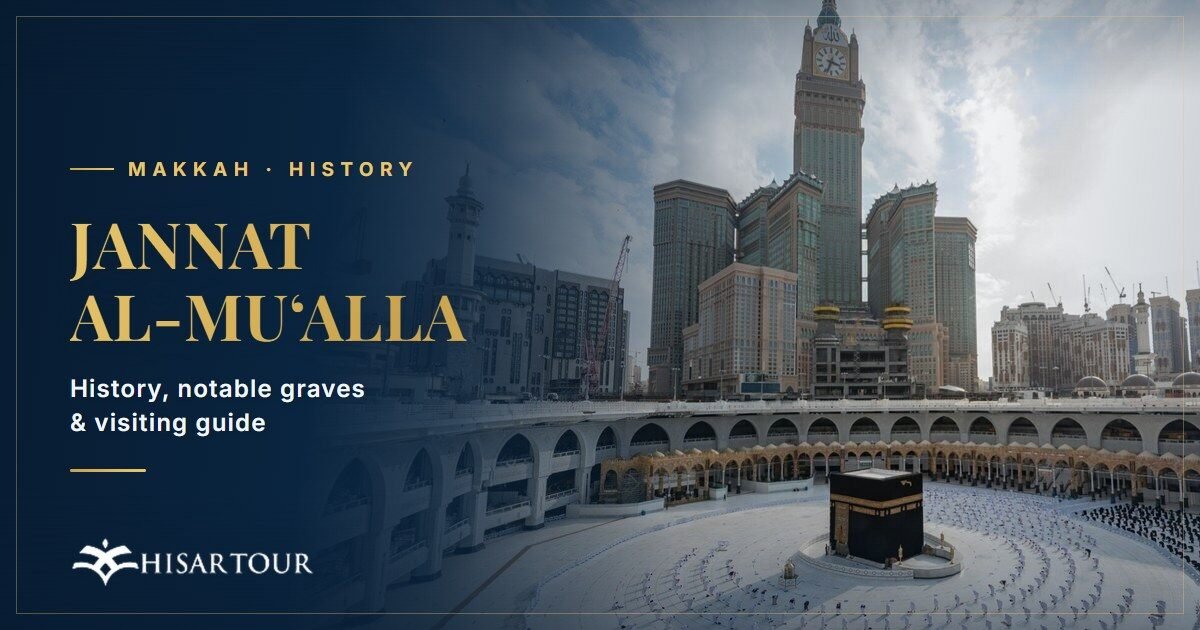
Jannat al-Mu‘alla is Makkah’s historic cemetery, north of the Sacred Mosque in the al-Hajun area, and the resting place of Khadijah bint Khuwaylid, the first wife of the Prophet ﷺ.
Classical and Saudi sources also name his son al-Qasim, Asma bint Abi Bakr, and members of the Prophet’s family from before Islam, including his grandfather Abd al-Muttalib and his uncle Abu Talib. The old domed tombs are gone and the graves are unmarked. It is still a working cemetery, and visiting it means greeting the dead and praying for them, with a real difference among the schools on whether women should visit.
Most pilgrims who visit al-Mu‘alla do it on a ziyarah morning in Makkah, often in a few minutes at the gate, and leave knowing only that Khadijah is buried there. This page sets out what the sources actually say about who rests in the cemetery, how it has changed over the centuries, and how to visit with the right adab. If you are planning the trip itself, our Umrah packages page lists departures with guided ziyarah in Makkah and Madinah.
Where It Is, and Why It Has Three Names
The cemetery lies a short way north of the Sacred Mosque, at the foot of a hill that Saudipedia calls Jabal al-Sayyidah, “the Lady’s mountain”, after Khadijah. The Saudi Press Agency describes al-Hajun as one of Makkah’s oldest districts, “encompassing prominent historical landmarks, most notably Al-Mualla Cemetery”. Saudipedia dates the cemetery to the pre-Islamic era.
The three names each come from somewhere. Al-Hajun is the old name of the hill and the area in early Islamic histories. Al-Ma‘la (“the upper part”) is what the upper quarter of old Makkah, and so its cemetery, came to be called. Jannat al-Mu‘alla, “the garden of al-Mu‘alla”, is the form that spread among Turkish-speaking pilgrims: the TDV Encyclopedia of Islam explains that Turks read the name as “Muallâ” and probably called it a jannah by analogy with Madinah’s Jannat al-Baqi. The same entry notes that during the conquest of Makkah the Prophet ﷺ had his tent pitched at al-Hajun.
The Notable Figures Buried in Jannat al-Mu‘alla
Only a handful of people are named by the sources with any confidence. The table separates what each source says, because the claims you will hear at the gate are often wider than the evidence.
| Name | Who they were | Named by |
|---|---|---|
| Khadijah bint Khuwaylid | First wife of the Prophet ﷺ, first to accept Islam | Saudipedia; TDV Encyclopedia of Islam |
| Al-Qasim | Son of the Prophet ﷺ and Khadijah | Saudipedia |
| Asma bint Abi Bakr | Companion; daughter of Abu Bakr | Saudipedia |
| Abd al-Muttalib | The Prophet’s grandfather | TDV Encyclopedia of Islam |
| Abu Talib | The Prophet’s uncle and protector | TDV Encyclopedia of Islam |
| Qusayy ibn Kilab | An ancestor of the Prophet ﷺ; reportedly the first buried there | TDV, citing Ibn Hajar |
Swipe the table sideways to see every column.
1. Khadijah
Khadijah, the first wife of the Prophet Muhammad ﷺ, is buried in Jannat al-Mu‘alla. According to the TDV Encyclopedia of Islam, the exact location of her grave was unknown until the year 729 AH (1328–29). It is said that a dream led to its discovery, after which a tomb was built over it; the same source reports that the Ottoman sultan Suleiman built a high-domed tomb over the grave in 950 AH (1543–44) and appointed a caretaker. Treat the dream account as a report, which is how the source presents it.
2. The Ahl al-Bayt of the Prophet
In addition to Khadijah and al-Qasim, it is noted that members of the Prophet’s family are buried in Jannat al-Mu‘alla, including, according to TDV, his grandfather Abd al-Muttalib and his uncle Abu Talib. Beyond those names, the sources do not provide detailed information on the exact individuals interred there.
3. The Companions (Sahabah)
The cemetery is known to contain the graves of various Companions of the Prophet ﷺ. Saudipedia names Asma bint Abi Bakr. Otherwise, the sources do not specify which Sahabah are buried in this sacred ground, and with the graves now unmarked, no one can point to them with certainty.
4. Scholars and the people of Makkah
In addition to the Companions and the Ahl al-Bayt, Saudipedia mentions “imams and leading scholars” among those buried there, and the cemetery has long been associated with the awliya, the friends of Allah. This indicates that notable Islamic scholars from different periods also rest here, alongside fourteen centuries of ordinary Makkans and pilgrims who died in the city.
How the Cemetery Has Changed

According to Evliya Çelebi’s observations from the 17th century, as summarised by TDV, there were seventy-five domed graves in Jannat al-Mu‘alla, including those of the Prophet’s grandfather and uncle. These tombs were noted to be less ornate compared to others, and they did not have caretakers.
TDV records that after Makkah came under Saudi rule in 1925, all the domed tombs in the cemetery were demolished in 1926 on the order of Abd al-Aziz ibn Saud and the gravestones removed, and that the cemetery has continued in use with no tombs or headstones since. Saudipedia adds that the old inscribed stones “were dispersed and reused in different graves”, and that 24 pieces with Arabic calligraphy, some dated to 655 AH, were found there and handed to the Ministry of Tourism.
Whatever view a visitor holds on that history, the practical result is the same: you will see plain graves and paths, not monuments, and no one can show you exactly where a named person lies apart from the area associated with Khadijah.
Visiting Today
Jannat al-Mu‘alla is a working cemetery, not a museum. Burials still take place here, and they take priority over visitors.
- Avoid the time just after the congregational prayers if you can, since that is when funerals are most likely to arrive.
- Dress and behave as you would at a burial. Keep voices low and do not photograph a funeral or a grieving family.
- Stay on the paths. Graves are unmarked, so walking between them risks stepping on one.
- If you cannot go in, make the greeting and du‘a from where you are. A du‘a for the dead does not depend on standing at the grave.
The Etiquette of a Grave Visit
Visiting graves was at first forbidden and then permitted: “I forbade you to visit graves, but you may now visit them” (Sahih Muslim 977). The Prophet ﷺ taught his Companions a greeting for the people of the graves, beginning “Peace be upon you, the inhabitants of the city, among the believers, and Muslims, and God willing we shall join you” (Sahih Muslim 975). When Aisha asked him what she should say, he taught her a similar greeting (Sahih Muslim 974).
He also said, “Do not sit on the graves and do not pray facing towards them” (Sahih Muslim 972). Beyond the greeting and du‘a, some practices differ by school and region, such as reciting the Qur’an at the grave, which many Hanafi teachers encourage and many scholars in Saudi Arabia do not. Our Madinah ziyarah guide sets these differences out in more detail; for your own practice, ask a scholar you trust.
Women Visiting Cemeteries: What the Schools Say
This is one of the questions pilgrims ask most at al-Mu‘alla and Al-Baqi, and the honest answer is that qualified scholars disagree. The positions below are summarised from the Dorar al-Saniyyah fiqh encyclopaedia, which sets out all three; we give them so you can ask your own scholar an informed question, not to decide it for you.
| Position | Held by (as summarised by Dorar) | Conditions often attached |
|---|---|---|
| Permitted | The Hanafis; a position among the Malikis and the Shafi‘is; a narration from Imam Ahmad; chosen by al-Qurtubi and al-Shawkani | Modest dress, no mixing with men, no wailing |
| Disliked (makruh) | The Shafi‘is and Hanbalis; a position among the Hanafis and the Malikis | Disliked rather than sinful |
| Not permitted | A position among the Hanafis and the Shafi‘is; Ibn Taymiyyah, Ibn Baz and Ibn Uthaymin | — |
Swipe the table sideways to see every column.
The texts behind the difference
The narration at the centre of it reads: “Indeed the Messenger of Allah cursed the women who visit the graves” (Jami‘ at-Tirmidhi 1056, graded hasan by Darussalam on sunnah.com; also Sunan Ibn Majah 1576). A similar narration in Sunan Abi Dawud 3236 is graded da‘if by al-Albani. Imam al-Tirmidhi himself records two readings under the hadith: some scholars held that it came before the Prophet ﷺ permitted grave visits, and that once he did, the permission covered both men and women; others held that visiting was disliked for women because of the grief it can bring.
Scholars who permit the visit also point to the Prophet ﷺ passing a woman weeping at a grave and telling her to fear Allah and be patient, without telling her to leave (Sahih al-Bukhari 1283), and to his teaching Aisha what to say at the graves (Sahih Muslim 974). A report of Aisha visiting her brother Abd al-Rahman’s grave in Makkah is also cited (Jami‘ at-Tirmidhi 1055), though it is graded da‘if by Darussalam.
Why It Is Worth the Visit
Jannat al-Mu‘alla holds great significance for Muslims as the resting place of prominent figures in Islamic history, above all Khadijah, who believed in the Prophet ﷺ before anyone else. Visiting this cemetery can provide a deeper understanding of the early Islamic community and its foundational figures, and of how short a walk it is from the Kaaba to the graves of the people who stood by him first.
The cemetery fits naturally into a ziyarah morning; our guide to ziyarat places in Makkah covers the other sites, and why an imam-led group changes your Umrah explains what a guide adds at places like this one.
Visit Makkah’s historic sites with an imam who can explain them
Our Umrah departures include guided ziyarah in Makkah and Madinah. Each package lists its hotels, nights in each city and what is included.
View Umrah packages WhatsApp +1 201-201-8992A UAMA community organization
Who is buried in Jannat al-Mu‘alla?
Khadijah bint Khuwaylid, the first wife of the Prophet ﷺ, is the best documented. Saudipedia also names his son al-Qasim and Asma bint Abi Bakr; the TDV Encyclopedia of Islam names his grandfather Abd al-Muttalib, his uncle Abu Talib and his ancestor Qusayy. Many Companions and scholars are said to be buried there without being named.
Where is Jannat al-Mu‘alla?
In Makkah, a short way north of the Sacred Mosque in the al-Hajun area, at the foot of the hill Saudipedia calls Jabal al-Sayyidah. It is also known as al-Ma‘la cemetery.
Can women visit Jannat al-Mu‘alla?
The schools differ: the Hanafis permit it with conditions, the Shafi‘is and Hanbalis generally regard it as disliked, and some scholars, including Ibn Baz and Ibn Uthaymin, do not permit it. Separately, entry is controlled at the gate, and we could not find a published official rule, so ask on the day.
What should I say when visiting the graves?
The greeting the Prophet ﷺ taught begins: “Peace be upon you, the inhabitants of the city, among the believers, and Muslims, and God willing we shall join you” (Sahih Muslim 975). Then make du‘a for the person you came for and for everyone buried there.
Why are there no tombs or headstones?
According to the TDV Encyclopedia of Islam, the domed tombs were demolished in 1926 and the gravestones removed; the cemetery has remained in use without them. Graves today are plain and unmarked.
Historical details are as given by the TDV Encyclopedia of Islam (entry “Cennetü’l-Muallâ”, Mustafa Fayda, 1993), Saudipedia and the Saudi Press Agency, read on 10 October 2026. Hadith references and grades are as displayed on sunnah.com on the same date. The table of scholarly positions summarises Dorar al-Saniyyah’s fiqh encyclopaedia and is not a ruling; ask a qualified scholar about your own situation. Visiting arrangements at the cemetery are set locally and change. Last reviewed: October 2026.
Sources: TDV Encyclopedia of Islam, Cennetü’l-Muallâ · Saudipedia, Al-Ma’alah Cemetery · Saudipedia, Islamic historical sites in Makkah · SPA, Al-Hajun (January 2026) · Dorar al-Saniyyah, visiting the graves · Sahih Muslim 977 · Sahih Muslim 975 · Jami‘ at-Tirmidhi 1056 · Sunan Abi Dawud 3236 · Sahih al-Bukhari 1283 · Jami‘ at-Tirmidhi 1055