
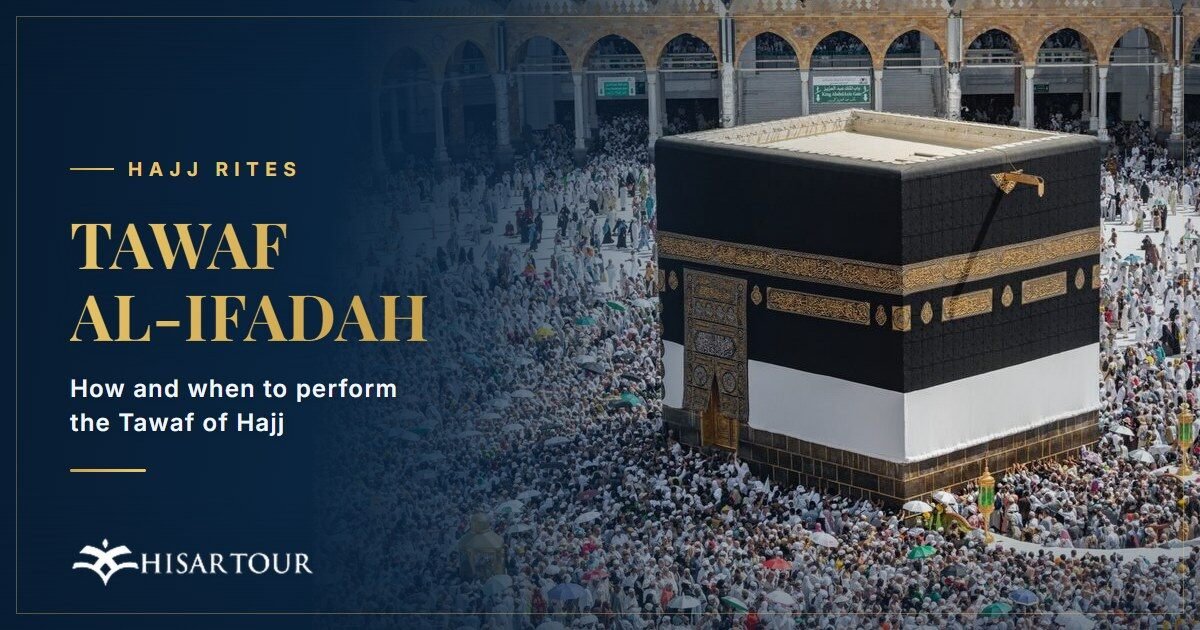
Tawaf al-Ifadah is the Tawaf of Hajj itself. It is one of the pillars of Hajj, it is performed after Arafat from 10 Dhul Hijjah, and until it is completed the pilgrim is not fully released from ihram.
It is also called Tawaf al-Ziyarah, the “visiting” Tawaf, which is why older pages, including an earlier version of this one, call it the Visit Tawaf. It is the same rite: seven circuits of the Kaaba, two rak‘ahs, and for most pilgrims the Sa’i that follows. The best time is the day of Eid al-Adha. The latest acceptable time is where the schools of law differ, and this page sets those differences out without ruling between them.
The Qur’an refers to it in the verse on the closing rites of Hajj: “Then let them end their untidiness and fulfill their vows and perform ṭawāf around the ancient House” (Qur’an 22:29). In practice it is the moment Hajj turns from the open plains back to the Haram. If you are still preparing for Hajj 2027, the Hajj 2027 page explains how registration and groups work, and the preparation page walks through the five days in order.
Where Tawaf al-Ifadah Falls on 10 Dhul Hijjah
The day of Eid al-Adha is the busiest day of Hajj, and Tawaf al-Ifadah is the last of four acts usually done that day. The Prophet ﷺ performed it on the Day of Nahr, then returned and prayed the noon prayer at Mina (Sahih Muslim 1308). Aisha described the same: “We performed Hajj with the Prophet ﷺ and performed Tawaf-al-ifada on the Day of Nahr” (Sahih al-Bukhari 1733).

- Stoning Jamrat al-Aqabah, the large pillar, with seven pebbles.
- The sacrifice (Hady), for pilgrims performing Tamattu‘ or Qiran. The difference between this and the Eid sacrifice is set out in our guide to Hady vs Udhiyah.
- Shaving or trimming the hair (Halq or Taqsir). Women trim a small length.
- Tawaf al-Ifadah, then Sa’i if it is due, then back to Mina for the night.
On the order of the first three, the Sunnah is gentle. When pilgrims told the Prophet ﷺ they had shaved before slaughtering or slaughtered before stoning, he answered, “Do it (now) and there is no harm,” and the narrator adds that whatever he was asked about that day, done before or after its time, received the same reply (Sahih al-Bukhari 1736). Most scholars read this as making the order a Sunnah. The Hanafi school holds the order of stoning, sacrifice and shaving obligatory for Tamattu‘ and Qiran pilgrims, which is why Hanafi pilgrims wait for confirmation that their Hady has been slaughtered before they shave. If someone else is arranging your sacrifice, find out how and when you will be told it is done, and ask your scholar what to do if the confirmation is late.
When to Perform It: the Schools Compared
Every school agrees that the most virtuous time is the day of Eid al-Adha, the first day of Eid, and that Tawaf al-Ifadah cannot be skipped. The schools differ on when the time begins and whether there is a deadline after which a penalty is due.
| School | Earliest | Latest without a penalty | If delayed beyond it |
|---|---|---|---|
| Hanafi | Dawn of 10 Dhul Hijjah | Before sunset on the third day of Eid (12 Dhul Hijjah) | A penalty sacrifice; Hajj remains valid once it is performed |
| Maliki | Dawn of 10 Dhul Hijjah | By the end of Dhul Hijjah | A penalty sacrifice |
| Shafi’i | After midnight of the night before 10 Dhul Hijjah | No fixed end | No penalty; the pilgrim stays bound by the remaining restriction until it is done |
| Hanbali | After midnight of the night before 10 Dhul Hijjah | No fixed end | No penalty; the same remaining restriction |
Swipe the table sideways to see every column. These are summaries of the main position in each school; ask your scholar for the detail that applies to you.
The earlier version of this page gave the Hanafi position as if it were the only one: that the Tawaf can be performed from the dawn of the first day of Eid al-Adha until the end of one’s life, that it is essential to perform it during the days of Eid before sunset on the third day, that delaying it beyond this point requires a penalty sacrifice, and that completely neglecting it leaves the Hajj incomplete. That remains an accurate summary of the Hanafi school. It is not the only view, and pilgrims who follow another school should not assume a penalty they may not owe, or a deadline they may not have.
How to Perform Tawaf al-Ifadah, Step by Step
The movements are those of any Tawaf. What differs is the intention: this is the Tawaf of Hajj.
Be in a state of ritual purity: perform ghusl if you are in a state of janabah, otherwise wudu. Cover your awrah properly. A woman whose period has started waits until she is pure; the details are in our guide for women at Hajj.
Intend Tawaf al-Ifadah, the Tawaf of Hajj. By this point most pilgrims are already out of their ihram clothes, having shaved or trimmed, so it is usually performed in ordinary clothes.
The Tawaf begins from the corner where the Hajar al-Aswad is located, or from its alignment if you cannot get close. Face it, raise your hand towards it, and begin.
Keep the Kaaba on your left, progressing towards the Rukn al-Iraqi corner, and walk outside the Hatim, the low curved wall of Hijr Ismail. Each complete circuit is a shawt; seven shawts make one Tawaf. Walk unless you have a valid excuse.
After the seventh circuit, offer the two rak‘ahs of Tawaf, behind Maqam Ibrahim if there is room and anywhere in the mosque if there is not.
Then walk the seven laps between Safa and Marwah, if you have not already done the Sa’i of Hajj. The next section explains who has.
The Essential Components of Tawaf
The earlier version of this page listed the essential components of Tawaf as they are taught in the Hanafi school, where most of them are obligatory (wajib) acts rather than pillars. The list is kept here because it is a useful checklist for anyone, with that label attached:
- Purification: being in a state of ritual purity.
- Covering the awrah: being properly covered.
- Walking: performing Tawaf on foot unless one has a valid excuse.
- Starting point: beginning at the Hajar al-Aswad or its alignment.
- Direction: keeping the Kaaba on the left.
- Circumference: walking outside the Hatim.
- The Tawaf prayer: two rak‘ahs after completing the Tawaf.
- Completion: seven shawts.
- Timing: performing Tawaf al-Ifadah during the days of Eid.
In the Hanafi school, if any of these essential components is neglected, a penalty is required, and if the Tawaf is repeated correctly, the penalty is lifted. The other three schools treat several of these, purity in particular, as conditions without which the Tawaf does not count at all. Either way the safe course is the same: perform it in purity, properly covered, on foot if you can, for seven full circuits.
After Tawaf al-Ifadah: Sa’i and the Final Release
Whether Sa’i is still due depends on the type of Hajj you are performing. Pilgrims on Tamattu‘ perform the Sa’i of Hajj now, after Tawaf al-Ifadah, because their earlier Sa’i belonged to their Umrah. Pilgrims on Qiran or Ifrad who performed Sa’i after their arrival Tawaf (Tawaf al-Qudum) do not repeat it; those who did not, perform it now. If you are not sure which type you are on, our explainer on Tamattu‘ and Qiran Hajj sets out the difference.
Release from ihram happens in two stages. After the first, which follows the stoning and shaving (the schools define it slightly differently), everything restricted by ihram becomes permitted again except relations between spouses. Pilgrims who have entered ihram must refrain from approaching their spouses until Tawaf al-Ifadah, and the Sa’i where it is due, are completed. That is the second, full release. After it, the pilgrim returns to Mina for the nights and the remaining days of stoning.
Crowds, Wheelchairs and Timing in Practice
Because so many pilgrims aim for the most virtuous day, the mataf on 10 Dhul Hijjah is at its fullest. A few things help. For the pattern through an ordinary day, see when Tawaf is least crowded.
- Use the upper floors if the ground floor is closed or packed. The route is longer and the Tawaf takes more time, but it is calmer, and it is a common choice for elderly pilgrims and families.
- Use a wheelchair if you need one. Nusuk’s health guidance advises pilgrims who need it to use a wheelchair for Tawaf and Sa’i rather than overexert themselves, and notes that wheelchairs can be bought at pharmacies in Makkah.
- Follow your group’s timing. Groups often go late at night on the 10th or on the following day. For a Hanafi pilgrim, the deadline in the table still applies; for others, there is less pressure, but the return flight is the real deadline.
- Ask before combining it with the farewell Tawaf. Some scholars allow a pilgrim who delays Tawaf al-Ifadah until just before leaving Makkah to have it count for the farewell Tawaf too; others require two separate Tawafs. This is a question for your scholar, not a shortcut to assume.
Tawaf al-Ifadah is the last major rite of Hajj, and for many pilgrims it is the moment the days on the plains come together with the House they were travelling towards. Perform it with presence and without hurry where you can. What to carry through the days that lead up to it is on our Hajj packing list.
Preparing for the days of Hajj 2027?
Pre-register with us and we will go through your Nusuk steps, your documents and your group with you before the season opens.
Hajj 2027 pre-registration WhatsApp +1 201-201-8992A UAMA community organization
What is Tawaf al-Ifadah?
It is the Tawaf of Hajj, one of its pillars: seven circuits of the Kaaba followed by two rak‘ahs, performed after the standing at Arafat, from 10 Dhul Hijjah. It is also called Tawaf al-Ziyarah. Hajj is not complete without it.
Is Tawaf al-Ziyarah the same as Tawaf al-Ifadah?
Yes. Tawaf al-Ziyarah, the “visiting” Tawaf, is another name for the same rite. Some older English pages call it the Visit Tawaf.
What is the last day for Tawaf al-Ifadah?
The schools differ. In the Hanafi school it should be performed before sunset on 12 Dhul Hijjah, and delaying it requires a penalty sacrifice. The Maliki school sets the end of Dhul Hijjah. The Shafi’i and Hanbali schools set no fixed end, but the pilgrim remains bound by the restriction on marital relations until it is done. In every school it must be performed before you leave.
Do I need to do Sa’i after Tawaf al-Ifadah?
On Tamattu‘, yes. On Qiran or Ifrad, only if you did not perform Sa’i after your arrival Tawaf.
What if my period starts before Tawaf al-Ifadah?
Every other rite continues as normal, and Tawaf al-Ifadah waits until you are pure. If your return flight may come first, ask your provider about changing it and ask a scholar in advance what to do, because the schools differ. Our guide for women at Hajj covers this in detail.
This page explains a rite of worship and summarises the main position of each Sunni school where they differ; it does not give individual rulings. Ask a qualified scholar, or your group’s imam, for guidance on your own situation. Qur’an and hadith references were checked on quran.com and sunnah.com in October 2026. Last reviewed: October 2026.
Sources: Qur’an 22:29 · Sahih Muslim 1308 · Sahih al-Bukhari 1733 · Sahih al-Bukhari 1736 · Sahih al-Bukhari 1757 · Nusuk Hajj rituals · Nusuk Hajj health guidelines