
Ihram is the state a pilgrim enters, by intention at the Miqat, in which nine everyday things become forbidden until the Umrah is finished with a haircut. Men wear two unstitched white sheets; women wear their ordinary modest clothing.
The state of Ihram usually lasts four to seven hours for a group coming from Madinah, and longer if you fly straight into Jeddah.* The rules are fewer than most first-timers fear, the compensation for a slip is clearly defined in the Qur’an, and the mistakes are predictable. Hisar Tour, the Hajj and Umrah brand of the United American Muslim Association (UAMA), hands every traveler an Ihram kit before departure and has the group imam check garments the night before the Miqat; this page is what he teaches.
Men · 2 sheets
Women · no special dress
Ends with · the haircut
Almost every worry a first-time pilgrim has about Ihram comes down to three questions: how do I get into it, what can I not do while I am in it, and what happens if I slip. This guide answers all three in order, for men and for women, with the hadith and Qur’an references our imams use. Then it lists the twelve mistakes we see most often on the coach to Makkah. If you want the whole Umrah sequence, read how to perform Umrah; if you are unsure where your Ihram begins on a flight from the USA, read Miqat explained.
What Ihram Is, and What It Is Not
Ihram is a state, not a set of clothes: a pilgrim enters it by making the intention for Umrah, and the garments are simply what the state requires of men. A man wrapped in two white sheets who has not yet made the intention is not in Ihram; a woman in her usual abaya who has made the intention is. The word comes from the root meaning “to make forbidden,” because the intention makes forbidden what was permitted an hour earlier.
Ihram begins at or before the Miqat with the intention and the Talbiyah, and ends after Sa’i with shaving or trimming the hair. Between those two moments every prohibition below applies, whether you are on a coach, in a hotel lift, or asleep. The only way out of Ihram is to complete the Umrah (or, if something prevents you, the release the Prophet taught for those who made a conditional intention).
How to Enter Ihram, Step by Step
Entering Ihram takes five steps: a full bath, grooming before the bath, perfume on the body, the garments, and then the intention with the Talbiyah at the Miqat. In a Madinah-first group all five happen at your hotel and at the Miqat mosque, with the imam beside you.
Cut your nails, trim the moustache, remove unwanted body hair and tidy the beard before the bath, because none of this is allowed after the intention. Then take a full bath. Ghusl is recommended for everyone entering Ihram, including women who are menstruating.
Men may apply scent to the body before the intention. Aisha reported that she perfumed the Messenger of Allah (peace be upon him) for his Ihram before he entered it (Sahih al-Bukhari 1539). The Ihram sheets themselves must not be perfumed, and no scent may be applied after the intention.
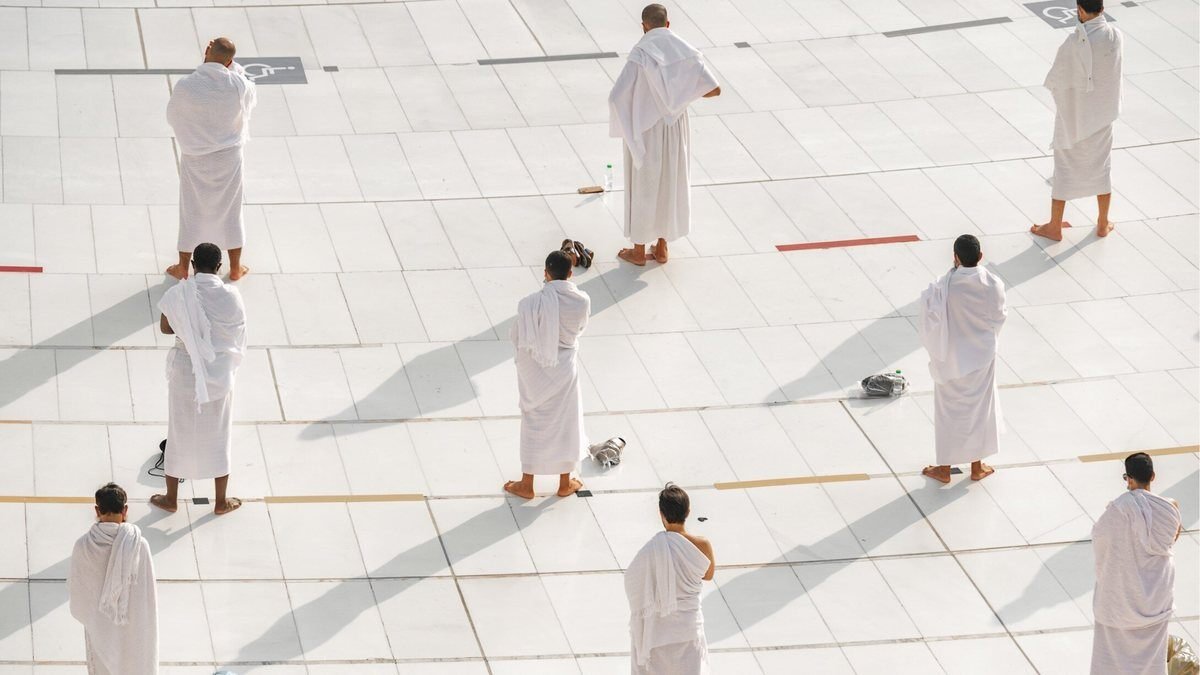
Men: the lower sheet (izar) wrapped around the waist, the upper sheet (rida’) over the shoulders, sandals on the feet, head uncovered. Women: their ordinary modest clothing. Details for each are in the two sections below.
Two units of prayer before the intention are Sunnah, ideally after an obligatory prayer. At Dhul-Hulayfah the coach stops at the Miqat mosque for exactly this. Do not make the intention yet.
Say “Labbayka Allahumma ‘Umratan” (Here I am, O Allah, for Umrah) and begin: Labbayk Allahumma labbayk. Labbayka la sharika laka labbayk. Innal-hamda wan-ni’mata laka wal-mulk. La sharika lak. Men raise their voices; women say it quietly. From this moment you are in Ihram. If illness or a flight might stop you from completing the Umrah, add the condition the Prophet (peace be upon him) taught: “and if something prevents me, my place of release is wherever You hold me” (Sahih al-Bukhari 5089).
Ihram Clothing for Men
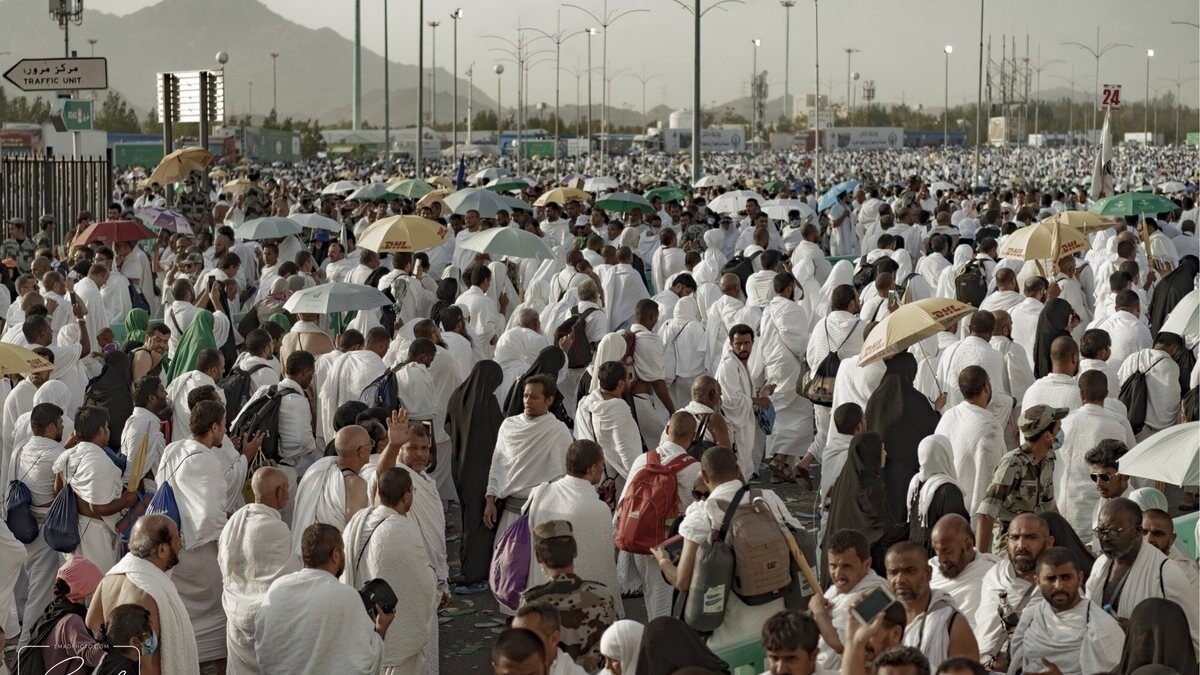
Men in Ihram wear two plain, unstitched sheets, sandals that leave the ankles uncovered, and nothing on the head. The Prophet (peace be upon him) was asked what a person in Ihram may wear and answered by listing what he may not: “He should not wear a shirt, a turban, trousers, a hooded cloak or leather socks, except if he can find no sandals, then he may wear leather socks after cutting them below the ankles; and he should not wear clothes scented with saffron or wars” (Sahih al-Bukhari 1542).
- Two unstitched sheets, any plain color (white is the custom)
- A belt or money pouch, even a stitched one, to hold the izar and your passport
- Sandals or slides that leave the ankle bones uncovered; flip-flops are fine
- A wristwatch, glasses, a hearing aid, a wedding ring, a face mask
- An umbrella, or shade from a roof, bus or tent
- A blanket over the body on a cold flight or coach, not over the head
- A second, clean set of sheets to change into
- Shirts, T-shirts, trousers, underwear, or anything sewn to fit the body
- Socks, closed shoes or boots (khuffs cut below the ankle are the only exception if sandals cannot be found)
- Caps, hoods, turbans, or a towel draped over the head
- Scented sheets, or sheets washed with perfumed detergent
- Gloves
Ihram Clothing for Women
Women have no special Ihram garment: any loose, non-transparent clothing in any color is Ihram, and white is a custom, not a rule. The two things a woman in Ihram does not wear are a face veil fastened over the face (niqab) and gloves; the same hadith that lists the men’s garments ends with “and a woman in Ihram should not cover her face or wear gloves” (Sahih al-Bukhari 1838).
- Any modest outfit works: an abaya, a long dress with a scarf, or a loose tunic and trousers. Stitched clothing, socks, closed shoes and jewelry are all permitted for women.
- Screening the face is allowed without a tied veil. Aisha reported that when riders passed the women in Ihram, each would let her head-cover hang down over her face and lift it again when they had passed (Sunan Abi Dawud 1833; the chain of this report is graded weak by some hadith scholars, but the ruling that a loose drape is permitted is held by all four schools). A loose drape from the head is permitted; a niqab tied across the face is not.
- Perfume, nails and hair rules apply equally. Unscented soap, no nail cutting, no hair removal, no scented lotion until the trim at the end.
- Menstruation does not prevent Ihram. A woman enters Ihram, says the Talbiyah and does everything except Tawaf, which she performs after purity (Sahih al-Bukhari 305). If the departure date makes waiting impossible, tell the imam early; the scholarly options should be discussed calmly in advance.
- Practical: choose dark or mid-tone fabrics that hide marble dust, a scarf that stays in place without pins near the face, and shoes you can slip off at the mosque entrance.
The Nine Prohibitions of Ihram
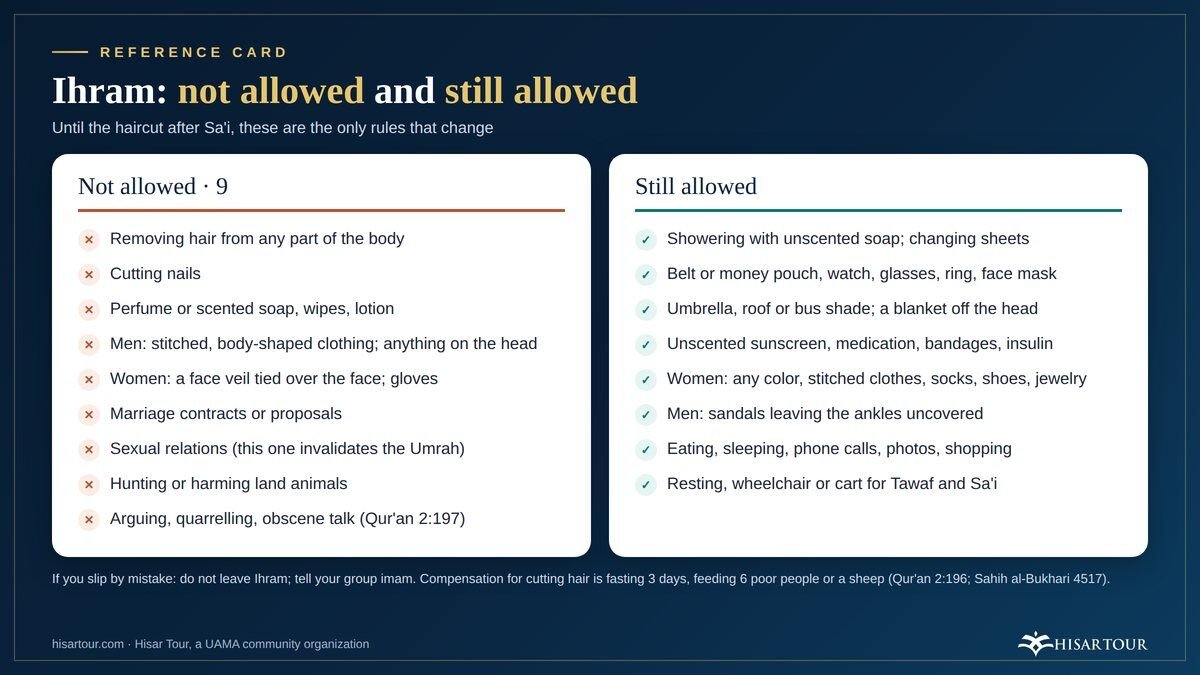
Nine things are prohibited in Ihram: removing hair, cutting nails, using perfume, stitched garments and head coverings for men, a fastened face veil and gloves for women, marriage contracts, sexual relations, hunting land animals, and arguing or obscene speech. The Qur’an sets the tone for the last one: “Whoever undertakes the pilgrimage therein, there is to be no sexual relations, no disobedience and no disputing during Hajj” (Qur’an 2:197).
| # | Prohibited in Ihram | Applies to | What first-timers get wrong |
|---|---|---|---|
| 1 | Removing hair from any part of the body | Men and women | Combing hard, scratching the scalp, shaving “just the neck” at the barber before Sa’i is finished |
| 2 | Cutting nails | Men and women | A broken nail may be removed if it is causing harm; ask the imam |
| 3 | Perfume or scented products | Men and women | Hotel soap, scented wipes, lotion, lip balm with fragrance, scented laundry on the sheets |
| 4 | Stitched, body-shaped clothing and head coverings | Men only | A cap “just for the sun,” a towel over the head while sleeping, underwear “for the flight” |
| 5 | A face veil fastened over the face, and gloves | Women only | Pinning the drape to the face; a loose fall of cloth is fine |
| 6 | Marriage contracts and proposals | Men and women | Rare, but a nikah cannot be contracted in Ihram |
| 7 | Sexual relations and everything leading to them | Men and women | This is the one act that invalidates the Umrah; the others require compensation |
| 8 | Hunting or harming land animals | Men and women | Not relevant to a modern Umrah beyond not chasing the Haram’s pigeons |
| 9 | Arguing, quarrelling and obscene talk | Men and women | The crowd at the Black Stone, the hotel check-in queue, a tired spouse at 2 a.m. |
What Is Still Allowed in Ihram
Everything not on the list of nine remains allowed in Ihram, including showering, changing sheets, eating, sleeping, phone calls, medication and shade. The list below settles the questions we hear most.
- Showering with unscented soap, and changing into a clean set of Ihram sheets
- Washing the sheets, as long as the detergent is unscented
- Unscented sunscreen, unscented moisturizer, insulin, bandages, any medication without fragrance
- A belt, money pouch, backpack strap, watch, glasses, hearing aids, a wedding ring, a face mask
- An umbrella, the shade of a bus or building, a hand fan
- Sleeping under a blanket (men: keep it off the head)
- For women: socks, closed shoes, stitched clothes of any color, jewelry
- Eating, drinking, ordinary conversation, taking photographs, shopping for water and dates
What Happens If You Break a Rule: Fidya Explained
Breaking a rule of Ihram, other than sexual relations, does not invalidate the Umrah; it requires a compensation called fidya, and the Qur’an fixes the compensation for cutting hair as a choice of three: fasting, charity or sacrifice (Qur’an 2:196). Ka’b ibn ‘Ujrah, who had lice in his hair during Ihram, was told by the Prophet (peace be upon him) to shave and then “fast three days, or feed six poor persons half a sa’ each, or sacrifice a sheep” (Sahih al-Bukhari 4517). Scholars apply the same three options to perfume, nail cutting and men’s stitched clothing.
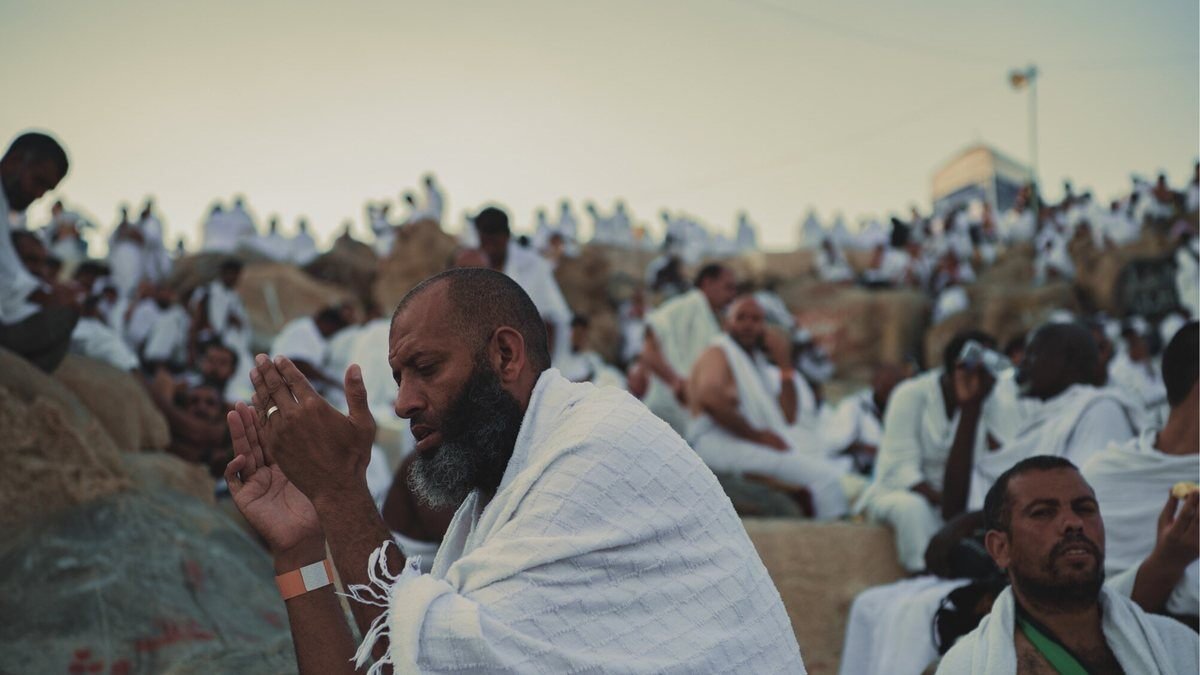
Twelve Ihram Mistakes We See on Every Trip
The mistakes below account for nearly every Ihram question our imams answer between Madinah and Makkah, and each one has a one-line prevention.
- Wearing underwear under the izar “for the flight.” Stitched, body-shaped, not allowed for men. Wrap the sheet properly and belt it.
- Trimming nails or a beard after the bath. Do all grooming before ghusl, never after.
- Using the hotel’s scented soap or wet wipes. Pack unscented soap and wipes; check the label for “fragrance.”
- A cap or hood on the head because the sun is strong. Use an umbrella. Men’s heads stay uncovered.
- Putting the sheets on and thinking that is Ihram. Ihram begins with the intention at the Miqat, not with dressing.
- Making the intention at the hotel in Madinah “to be safe.” Valid, but the Sunnah is at Dhul-Hulayfah; the coach stops there for a reason.
- Crossing the Miqat on the plane without Ihram when Makkah is the first stop. See the Miqat guide before you fly.
- Women pinning the face drape to the scarf. Let it hang loose; do not fasten it.
- Sleeping with the blanket over the head (men). Shoulders yes, head no.
- Arguing with a porter, a driver or a spouse. Qur’an 2:197 counts this among the prohibitions. Let the group leader handle disputes.
- Changing into normal clothes at the hotel “to rest” before the haircut. You are in Ihram until Halq or Taqsir is done. Finish, then rest.
- Trimming one lock of hair and calling it Taqsir. Men trim from the whole head (the Hanafi school requires at least a quarter) or shave; women trim a fingertip’s length from the gathered ends.
Ihram on the Plane or at Dhul-Hulayfah?
Where you enter Ihram depends on which city you visit first: a Madinah-first itinerary enters Ihram at Dhul-Hulayfah by coach, while a Makkah-first itinerary requires Ihram on the aircraft before it crosses the Miqat line on approach to Jeddah. On a Madinah-first trip you shower in your hotel, dress in the room, and make the intention at the Miqat mosque about twenty minutes down the road; the whole group does it together. On a Makkah-first trip you must board the last flight already wearing the sheets, and make the intention when the crew announces the Miqat or a little earlier. Jeddah is inside the boundary, so Ihram cannot be “put on at the airport.” This is the main reason twelve of Hisar Tour’s fourteen current departures begin in Madinah. The full explanation, route by route, is in Miqat explained for flights from the USA.
How Ihram Works in a Hisar Tour Group
Every Hisar Tour traveler receives an Ihram kit before departure, and the imam walks the men through wrapping and belting the sheets in the hotel the night before the Miqat, sheets in hand. Women in the group have a discreet channel for the questions they would rather not ask a man, and the imam’s answer on any slip is available on the coach within minutes rather than after a search online at midnight. On the day, the group prays the two rak’ahs at the Miqat mosque, makes the intention together and starts the Talbiyah as the coach pulls away toward Makkah. Our reviews mention this moment more than any other: the sound of forty people beginning the Talbiyah at once.
Enter Ihram with an imam beside you
Imam-led Umrah departures from New York, Washington, Los Angeles and Toronto, Madinah first, with an Ihram kit and pre-departure webinars included.
See Umrah Packages
WhatsApp +1 201-201-8992
A UAMA community organization
Continue with what Umrah is, the step-by-step Umrah guide, the packing list from the USA, and what your first Umrah looks like day by day.
Frequently Asked Questions
Can I wear a belt or a money pouch in Ihram?
Yes. A belt or waist pouch, even a stitched one, is allowed for men to hold the lower sheet and carry a passport and money. The prohibition is on garments sewn to fit the body, such as shirts, trousers and underwear, not on accessories.
Can women wear stitched clothes and socks in Ihram?
Yes. Women have no special Ihram dress. Any loose, non-transparent clothing in any color, with socks and closed shoes, is Ihram. The two things a woman does not wear are a face veil fastened over the face and gloves (Sahih al-Bukhari 1838).
Can I shower or change my Ihram sheets?
Yes. Showering with unscented soap is allowed, and you may change into a clean set of sheets at any time. Only scented soap, hair removal and nail cutting are prohibited during the wash.
What if I forgot and used scented soap in Ihram?
Do not leave Ihram. The Shafi’i, Hanbali and many Maliki scholars hold that no compensation is owed for a forgetful act; the Hanafi school holds that compensation applies regardless of intent. Tell your group imam what happened and follow his instruction for your school.
Can men cover their head in Ihram if it is cold or sunny?
No. A cap, hood, turban or towel resting on the head is not allowed for men. Shade held above the head, such as an umbrella, a roof or a bus, is allowed, and a blanket may cover the body as long as it stays off the head.
What is fidya in Ihram?
Fidya is the compensation for breaking a rule of Ihram. For cutting hair, the Qur’an (2:196) gives a choice of three: fasting three days, feeding six poor people, or sacrificing a sheep (Sahih al-Bukhari 4517). Scholars apply the same options to perfume, nail cutting and men’s stitched clothing.
When does Ihram end?
Ihram ends when you shave or trim your hair after completing Sa’i. Men shave the head or trim all around; women trim a fingertip’s length. Until that haircut, every restriction remains in force, even if you are back at the hotel.
*Time in Ihram depends on the route: about four to seven hours from Dhul-Hulayfah to the haircut for a coach group; longer when Ihram is entered on an aircraft. Rulings are summarized from the four Sunni schools; where they differ, each position is stated. Hadith references are to Sahih al-Bukhari and Sunan Abi Dawud by number. For your personal situation, ask your group imam. Last reviewed: September 2026.
Sources: Sahih al-Bukhari 1542 (what a muhrim wears) · Sahih al-Bukhari 1838 (women in Ihram) · Sahih al-Bukhari 1539 (perfume before Ihram) · Sahih al-Bukhari 4517 (Ka’b ibn ‘Ujrah and the fidya) · Sunan Abi Dawud 1833 (women screening the face) · Qur’an 2:196 · Saudi Ministry of Hajj & Umrah.
Last Updated on September 9, 2026