
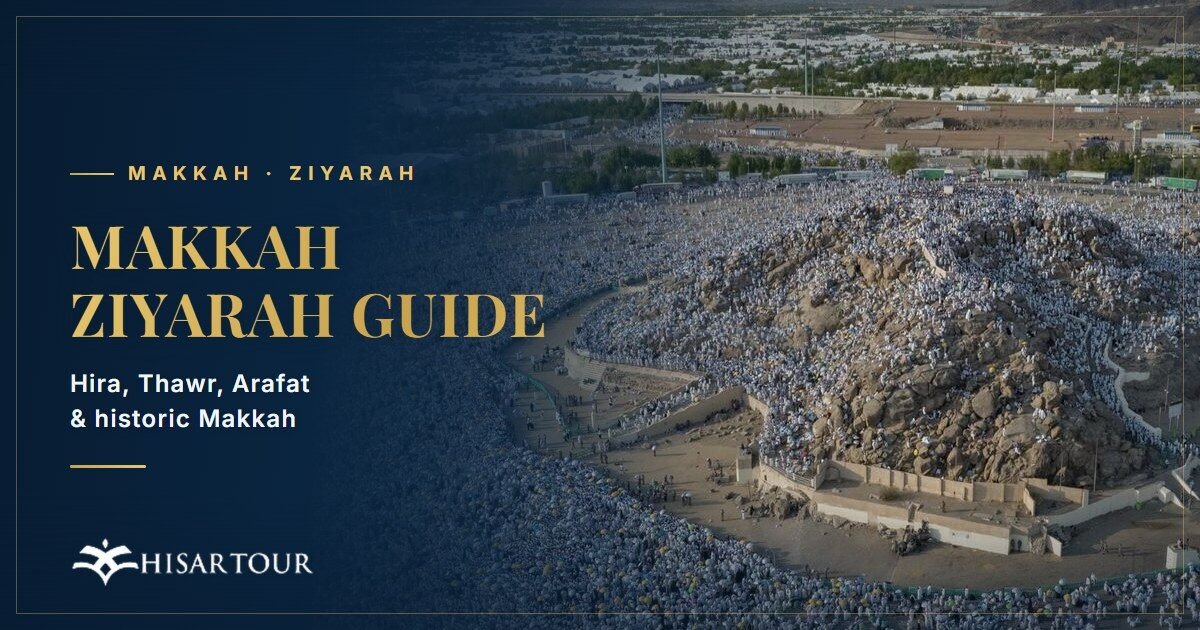
The historical sites most pilgrims visit in Makkah are Jabal al-Nour and the Cave of Hira, Jabal Thawr, Arafat and Jabal al-Rahmah, Mina and Muzdalifah, Masjid Aisha at al-Tan‘im and the Jannat al-Mu‘alla cemetery.
None of them is a rite of Umrah, and in Makkah the act of worship that outweighs every outing is prayer in the Sacred Mosque itself. The sites are worth seeing for what happened there. This guide sets out what each one is, what is official about visiting it today, and what is only custom.
On a typical US Umrah itinerary, Makkah gets four or five nights, and most of that time belongs to the Haram. A ziyarah outing usually takes one morning. It is worth planning, because the sites are spread out around the city’s valleys and two of them involve steep climbs. Our Umrah packages list guided ziyarah in Makkah among the inclusions for each departure; if you are travelling independently, the same advice applies.
Ziyarah in Makkah: Official and Customary
Three different kinds of claim get mixed together on ziyarah outings, and it helps to keep them apart. Religious: what the Qur’an and Sunnah say about a place. Administrative: what the Saudi authorities have built, opened, closed or regulated there. Custom: what visitors have long done there, which may or may not have any basis in either.
In Makkah, the religious weight sits almost entirely inside the Haram. The outlying sites are where events of the Seerah took place, and visiting them is historical rather than devotional. We know of no prayer or du‘a that the Sunnah prescribes at the Cave of Hira or the Cave of Thawr. If a guide or a fellow pilgrim tells you otherwise, ask for the source.
| Site | What it is | Visitor facilities (official) | Check before you go |
|---|---|---|---|
| Jabal al-Nour / Hira | Cave of the first revelation | Hira Cultural District at the foot: Revelation Exhibition, Holy Quran Museum | Exhibition hours and tickets |
| Jabal Thawr | Cave of the Hijrah refuge | Cultural district project with a visitor centre | Whether it is open |
| Arafat & Jabal al-Rahmah | Plain of the Hajj standing | Hajj infrastructure; open ground outside the season | Heat, time, transport |
| Muzdalifah & Mina | Hajj sites; Masjid al-Bay‘ah near the Jamarat | Hajj infrastructure | Usually seen from the bus |
| Masjid Aisha (al-Tan‘im) | Mosque at the edge of the Haram boundary | Open mosque, used for ihram | Your imam’s advice on extra Umrahs |
| Jannat al-Mu‘alla | Makkah’s historic cemetery | Working cemetery | Access on the day |
Swipe the table sideways to see every column.
Where the Sites Are
Makkah sits in a ring of rocky hills, and most of the sites are on or between them. The orientation below uses the directions Saudi sources give; it is a schematic, not a map, and it shows no distances because the routes you will actually drive depend on traffic and road closures.

Jabal al-Nour and the Cave of Hira
Jabal al-Nour, “the mountain of light”, is the mountain in which the Cave of Hira sits. Saudipedia places it northeast of Makkah and gives its height as 642 m. Aisha’s account of the beginning of revelation describes the Prophet ﷺ going into seclusion in the cave “where he used to worship (Allah alone) continuously for many days”, until the angel came to him there (Sahih al-Bukhari 3). The first words revealed were “Recite in the name of your Lord who created” (Qur’an 96:1).
The Hira Cultural District
At the foot of the mountain is the Hira Cultural District. The Saudi Press Agency described it in May 2026 as housing the Holy Quran Museum and the Revelation Exhibition, “which offers an interactive experience illustrating the stages of revelation through visual and audio presentations that recreate the historical setting of the Cave of Hira.” Visit Saudi lists the exhibition as a ticketed attraction. Published opening hours differ between official listings, so check them on the day rather than trusting any single figure.
For many families, the exhibition is the better choice than the climb. It explains the event, it is accessible to older parents, and it does not take half a day.
The climb
The path to the cave is a long, steep climb on rough steps. We could not find an official Saudi page that regulates it or publishes hours, so treat it as an informal hike rather than a managed attraction: go early, carry water, wear proper shoes, and do not attempt it with knee, heart or breathing problems. Climbing is not an act of worship and nothing is lost by watching from below.
Jabal Thawr
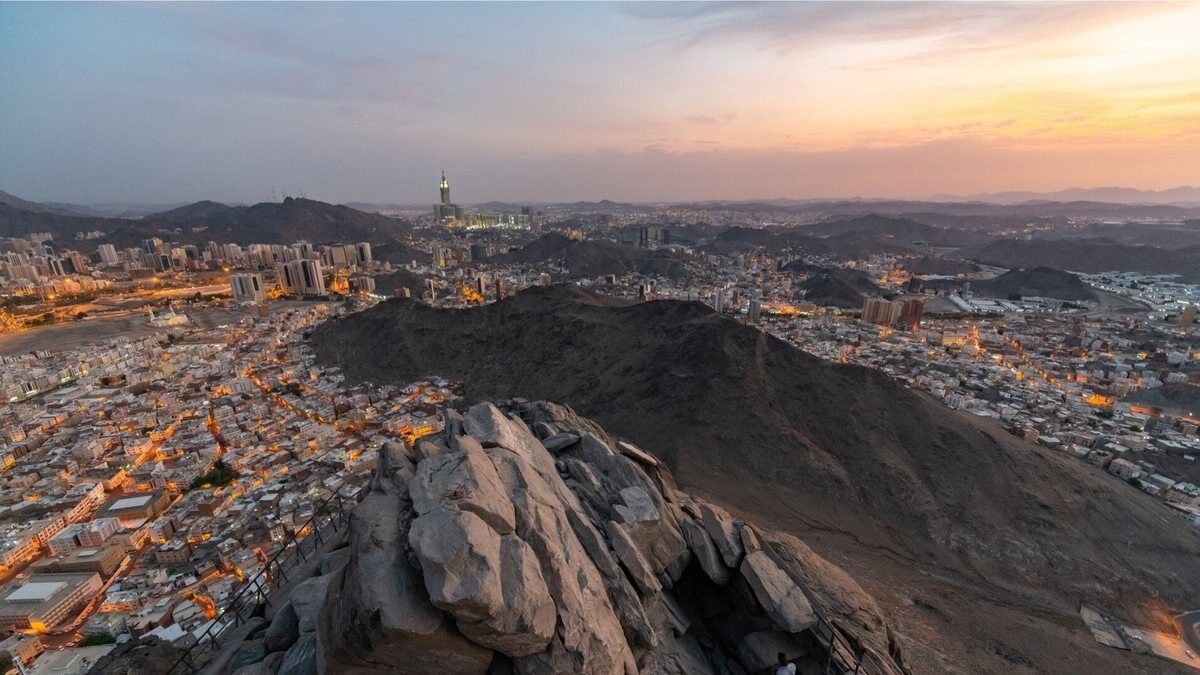
Jabal Thawr lies south of the Sacred Mosque. Saudipedia gives its height as 755 m and describes the cave near its summit as the place where the Prophet ﷺ and Abu Bakr sheltered from the Quraysh before migrating secretly to Madinah. The Qur’an refers to it: “when they were in the cave and he said to his companion, ‘Do not grieve; indeed Allah is with us’” (Qur’an 9:40).
Saudipedia describes a Jabal Thawr Cultural District, supervised by the Royal Commission for Makkah City and Holy Sites, with a visitor reception centre and a Hijrah Exhibition. We could not confirm from an official source whether it is open to visitors as of October 2026, so ask locally. The climb itself is higher and harder than Hira’s, and the same cautions apply.
Arafat, Muzdalifah and Mina
Outside the Hajj season, a ziyarah drive often passes through the three sites of the Hajj: Mina, Muzdalifah and Arafat. Seeing them empty is useful for anyone who hopes to make Hajj later, because the scale of the tent city and the distances between the sites are hard to picture from a book.
At Arafat, most visitors stop at Jabal al-Rahmah, the small hill sometimes called the Mount of Mercy. It helps to know what the Sunnah says about it. On the Day of Arafah during his Hajj, the Prophet ﷺ said, “I have stayed here (near these rocks), and the whole of Arafat is a place for stay” (Sahih Muslim 1218). Standing anywhere within Arafat fulfils that rite of Hajj; climbing the hill is not part of it, and outside Hajj there is no rite at Arafat at all.
In Mina, Saudipedia records Masjid al-Bay‘ah near Jamrat al-Aqabah, marking where the people of Madinah pledged allegiance to the Prophet ﷺ before the Hijrah, and dates the mosque to 761. If your interest is the Hajj itself, our Hajj 2027 page explains how US pilgrims book through Nusuk.
Masjid Aisha at al-Tan‘im
Masjid al-Tan‘im, widely called Masjid Aisha, stands on the north-western side of Makkah, just outside the Haram boundary. Saudipedia records that it was built where Aisha entered ihram for Umrah during the Farewell Pilgrimage, and that it is also called Masjid Umrah “since many of the people of Makkah and visitors enter Ihram in this place.” It lists shaded courtyards and shops selling ihram garments among the facilities nearby.
This is the one stop on a Makkah ziyarah outing with a practical purpose: pilgrims who want to perform an additional Umrah during their stay often go there to enter ihram. Scholars differ on how often an additional Umrah should be repeated within one trip, so ask the imam with your group before you plan one. The rules of ihram are the same as on your first Umrah; our ihram guide covers them, and miqat for flights from the USA explains the boundaries for arriving pilgrims.
Jannat al-Mu‘alla
Makkah’s historic cemetery lies north of the Sacred Mosque in the al-Hajun area, at the foot of a hill Saudipedia calls Jabal al-Sayyidah after Khadijah bint Khuwaylid, the Prophet’s first wife, who is buried there. It is a working cemetery, and the visit follows the etiquette of any grave visit. Our Jannat al-Mu‘alla history and visiting guide covers who rests there according to the sources and the scholarly positions on women visiting cemeteries.
Planning and Etiquette
- Protect your prayers in the Haram first. Schedule ziyarah between prayers, and be back in good time. The outing is optional; the congregation is the reason you are in Makkah.
- Choose, do not collect. One climb or one exhibition done calmly is better than four stops in the heat. With older parents, the Hira exhibition and a drive through the Hajj sites is a full morning. Our guide to Umrah with elderly parents has more on pacing.
- Treat stories with care. You will hear claims at these sites that are custom rather than Sunnah, such as special du‘as for particular rocks or wiping hands on cave walls. If a practice matters to you, ask your imam for its source.
- Leave nothing and take nothing. No writing on rocks, no stones as souvenirs, no litter on the paths.
For Madinah, the companion guide to ziyarat places in Madinah covers Quba, Uhud, Qiblatayn and Al-Baqi, and why an imam-led group changes your Umrah looks at what a guide adds on days like these.
Plan an Umrah with guided ziyarah in Makkah and Madinah
Every departure on our Umrah packages page lists its hotels, nights in each city and inclusions, with an imam travelling with the group.
View Umrah packages WhatsApp +1 201-201-8992A UAMA community organization
What are the main ziyarat places in Makkah?
Jabal al-Nour and the Cave of Hira, Jabal Thawr, Arafat with Jabal al-Rahmah, Muzdalifah and Mina, Masjid Aisha at al-Tan‘im and the Jannat al-Mu‘alla cemetery. The Hira Cultural District at the foot of Jabal al-Nour adds the Revelation Exhibition and the Holy Quran Museum.
Is climbing to the Cave of Hira part of Umrah or Sunnah?
No. It is not a rite of Umrah, and we know of no prayer or du‘a the Sunnah prescribes there. People climb for the history. We could not find an official page regulating the climb, so treat it as a demanding hike and skip it if your health is in doubt.
Can I visit Arafat outside Hajj?
Many groups drive through Arafat, Muzdalifah and Mina on a ziyarah outing outside the Hajj season. There is no rite to perform there outside Hajj. Even during Hajj, the whole of Arafat is a place of standing (Sahih Muslim 1218), so climbing Jabal al-Rahmah is not required.
Why do pilgrims go to Masjid Aisha?
It sits just outside the Haram boundary, and people staying in Makkah go there to enter ihram for an additional Umrah. Scholars differ on how often to repeat Umrah in one trip, so ask your group’s imam first.
Are the Hira and Thawr exhibitions open every day?
Official listings give different opening hours for the Hira Cultural District, and we could not confirm the current status of the Jabal Thawr district. Check on the day, at the venue or with your group leader.
Site descriptions and heights are as given by Saudipedia and the Saudi Press Agency, read on 10 October 2026. Opening hours, ticketing and access at the cultural districts change and were not consistent between official listings, so confirm them locally. Hadith references were checked on sunnah.com and Qur’an references on quran.com on the same date. This page describes historical and practical information and does not issue religious rulings. Last reviewed: October 2026.
Sources: Saudipedia, Islamic historical sites in Makkah · SPA, Hira Cultural District (May 2026) · Visit Saudi, Revelation Exhibition · Saudipedia, Jabal Thawr Cultural District · Saudipedia, Masjid al-Taneem · Saudipedia, Al-Ma’alah Cemetery · Sahih al-Bukhari 3 · Sahih Muslim 1218 · Qur’an 96:1 · Qur’an 9:40