
At Masjid al-Haram the toilets are in the courtyards around the mosque, with wudu areas inside as well. At the Prophet’s Mosque, restrooms and wudu areas are in 21 service complexes under the courtyards, marked with numbers starting at 200.
At both mosques the restrooms are out in the courtyards, so a restroom break means leaving your place and finding your way back. Knowing where the facilities are, how they are numbered and when to make wudu saves a lot of worry, especially for older parents, children and anyone with a medical need. Everything below comes from the official guides of the Saudi Ministry of Hajj and Umrah and the authority that runs both mosques.
This page is for a first-time pilgrim, a woman traveling with her mother, or a son planning for a father with a medical condition, who wants to know before the trip what the bathrooms and wudu areas at the two mosques are like. It sits alongside our hygiene and health tips for Umrah; for dates and hotels close enough to walk back to your room when you need to, see the Umrah packages page.
The Two Mosques at a Glance
The two mosques are organized differently, and the difference shapes how you plan a long stay inside.
- Toilets in the courtyards around the mosque
- Wudu areas inside the mosque as well, marked on the Ministry’s map
- Restroom blocks carry numbers the Ministry uses as landmarks
- Not for showering or changing Ihram
- 21 service complexes, restrooms and wudu areas underground
- Numbers starting at 200, symbols and codes such as 3A or 3B
- Wudu areas at street level next to each complex
- Accessible restrooms in every men’s and women’s area

Masjid al-Haram: Courtyards, Numbers and Wudu
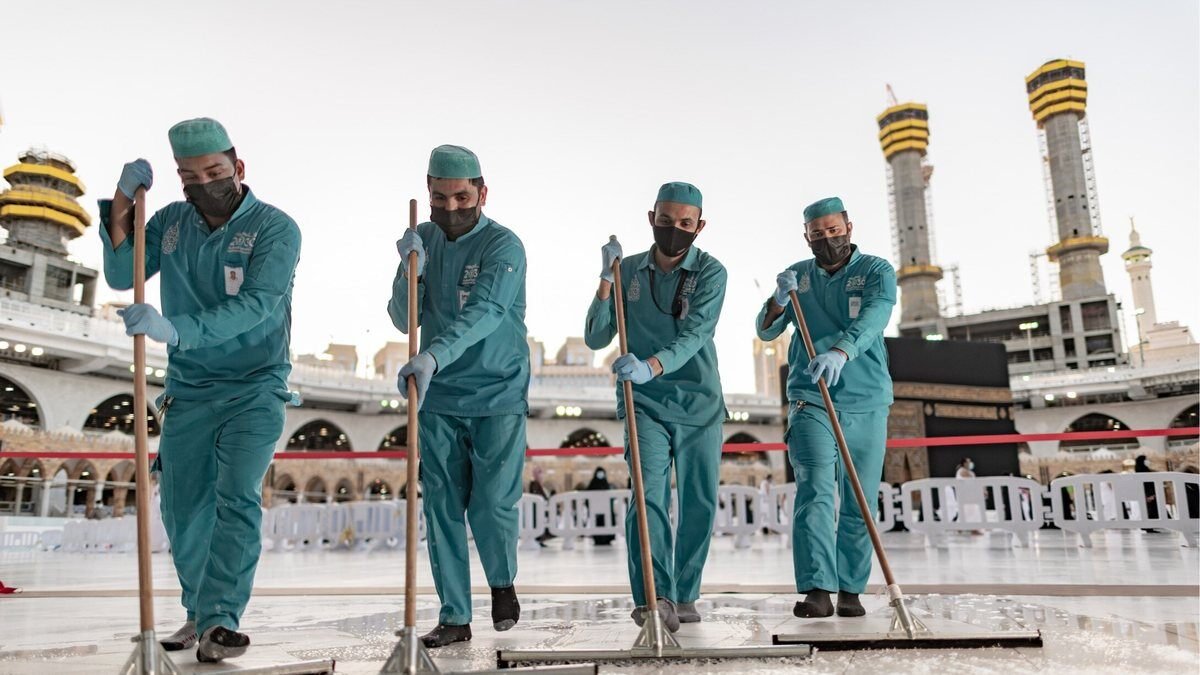
The toilets at Masjid al-Haram are in the courtyards around the mosque. Ahead of Ramadan in March 2024, the spokesman for the authority that runs the two mosques said there were 3,000 toilets in the courtyards and 50 ablution sites inside the mosque (Arab News, March 11, 2024). The Ministry of Hajj and Umrah’s 2026 map of the mosque marks the ablution areas inside, alongside the escalators, elevators, first aid centers and wheelchair points.
The restroom buildings are numbered, and the Ministry’s own guides use those numbers to give directions: one of the deposit and collection points for bags is on Ajyad Street “near Restrooms No. 1”, another is “behind Restrooms No. 6”, and a wheelchair point in the southern courtyard is “next to Restroom 2”. That tells you how to find your way back. Note the restroom number and the nearest gate number when you go out, and you can describe exactly where you are to anyone looking for you.
Plan for the distance. From a place deep inside the mosque, a restroom visit means walking out to the courtyard and back in, and at prayer times the way back to your spot may be full. If you are in a group, tell someone where you are going, agree a gate number to meet at, and keep your phone with you. The Ministry’s own advice to groups is to set a meeting point, such as a door number, before you start.
The Prophet’s Mosque: The Service Complexes
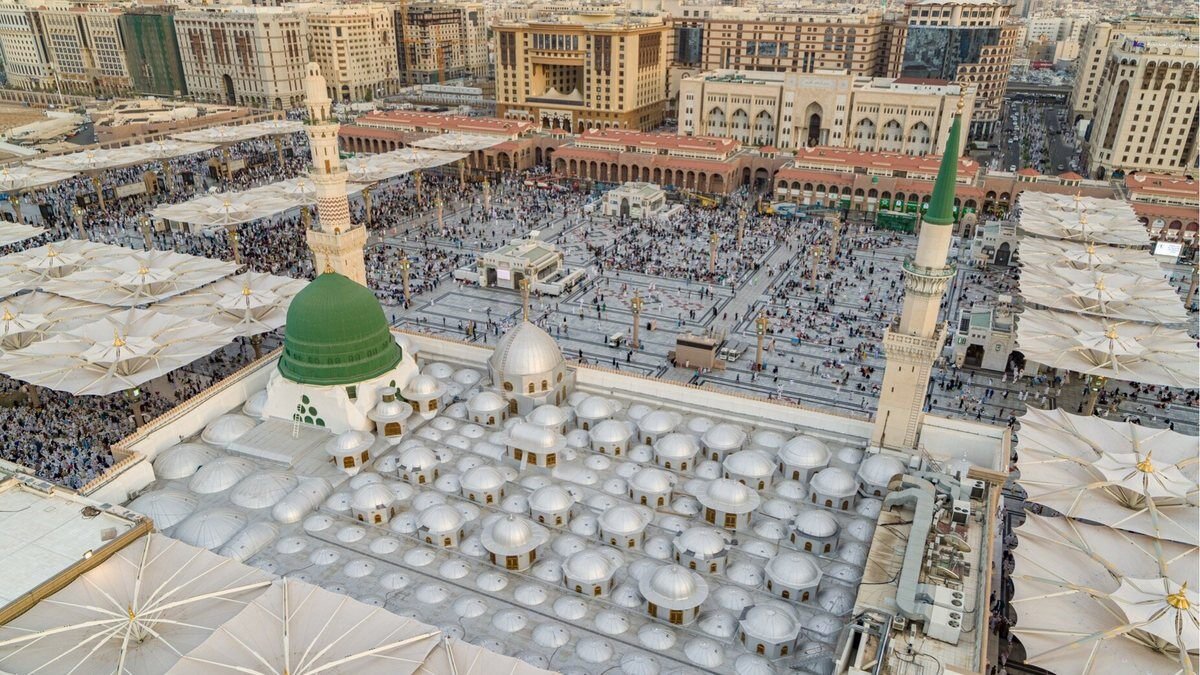
The Prophet’s Mosque organizes its facilities around the courtyards. According to the Ministry’s services guide, 21 service complexes are spread across the courtyards on all four sides. Their underground levels hold the restrooms and ablution areas, together with underground parking, and from the courtyard they look like stand-alone buildings.
- How to recognize them: numbers starting with 200, pictorial signs showing men and women or women only, and letter-number codes such as 3A or 3B.
- Wudu without the stairs: upper ablution areas sit next to each complex, so you do not have to go down to the lower floors, with water stations beside them.
- Accessible restrooms: the guide says special restrooms for elderly people and people with special needs are available in all men’s and women’s restroom areas.
For Women
At the Prophet’s Mosque, the Ministry’s guide says women reach the restrooms and ablution areas through service facilities across the courtyards, identified by the same 200-series numbers, the women-only or men-and-women symbols and the letter codes. Because the women’s prayer areas have their own gates, it helps to make wudu at the complex nearest your gate. The guide lists the northeastern women’s area as reached through northern internal gates 23 to 27 and eastern gates 28 to 31, and the northwestern area through northern gates 15 to 17 and western gates 11 to 14. The authority also says it has installed shelves in women’s restrooms to make caring for small children easier.
At Masjid al-Haram, the Ministry asks men and women to keep to the prayer areas designated for each, but we did not find an official list of women’s restroom locations. Ask the staff at the guidance points; the Ministry’s guide to the mosque says there are 38 of them inside the mosque and its courtyards, set up to help visitors find services. Our women’s guide to Umrah covers the rest of a woman’s visit, including periods.
For Older and Disabled Visitors
Every men’s and women’s restroom area at the Prophet’s Mosque includes facilities for elderly people and people with special needs, according to both the Ministry’s guide and the authority. At Masjid al-Haram, the Ministry’s guide lists tayammum tools among the aids provided for people with disabilities, together with wheelchairs. When tayammum is permitted in place of wudu is a fiqh question for your imam, not a facilities question.
If a parent cannot walk far, the restroom is often the deciding factor in how long they can stay. Choose the prayer spot near the edge of the mosque, close to a gate and a restroom block, rather than deep inside. Our guide to Umrah with elderly parents has more on pacing the day.
Wudu: At the Hotel or at the Mosque
For the obligatory prayers, especially Jumu’ah and the crowded prayers of Ramadan, making wudu at the hotel before you leave is the simplest plan. You arrive ready, and you do not have to leave your place to find an ablution area. Ramadan 1448 is expected to begin on February 8, 2027, depending on the moon sighting, and the Ministry’s Ramadan guide expects the heaviest crowds in the last ten nights.
If you need the restroom during Tawaf or Sa’i, step out of the flow carefully and go. What happens to the circuits you have already completed, and whether you restart or continue after renewing wudu, is a question on which the schools of fiqh differ. Ask your imam before you begin, so you know what to do if it happens. Our guide to common Umrah mistakes covers other questions to settle in advance.
Rules and Etiquette
- No wudu with Zamzam. The Ministry asks visitors not to use Zamzam water containers for ablution, and the Prophet’s Mosque guide says the coolers are for drinking only.
- No showering in the mosque restrooms. The Ministry’s guide says the public restrooms at the Haram are not designated for showering; go back to your hotel to bathe and change out of Ihram.
- Don’t reserve your place with belongings. The Ministry asks visitors not to leave things to hold a spot while they step away.
- Keep the areas clean. The Ministry asks visitors to dispose of waste only in the designated places.
Stay close enough to walk back when you need to
See our upcoming Umrah departures with each hotel’s distance from the Haram, then ask us about the trip you are planning for your family.
See Umrah Packages WhatsApp +1 201-201-8992A UAMA community organization
Are there bathrooms inside Masjid al-Haram?
The toilets are in the courtyards around the mosque; the authority’s spokesman gave the figure as 3,000 in 2024. Wudu areas are inside the mosque as well. Allow time to walk out to the courtyard and back.
Where do I make wudu at the Prophet’s Mosque?
At the 21 service complexes in the courtyards. The restrooms and ablution areas are underground, and upper ablution areas next to each complex let you make wudu without going down. Look for numbers starting at 200.
Can I shower or change out of Ihram in the Haram restrooms?
No. The Ministry of Hajj and Umrah’s guide says the public restrooms at the Haram are not designated for showering; return to your accommodation to bathe and change.
Can I use Zamzam water for wudu?
Not from the mosque’s Zamzam coolers. The Ministry asks visitors not to perform ablution with Zamzam containers, and the Prophet’s Mosque guide says the coolers are for drinking.
Are there accessible restrooms for wheelchair users?
At the Prophet’s Mosque, every men’s and women’s restroom area includes facilities for elderly people and people with special needs. At Masjid al-Haram, ask a guidance point or the staff for the nearest accessible facility.
Facility figures and locations are from the Ministry of Hajj and Umrah’s guides (2026 editions), the General Authority for the Care of the Grand Mosque and the Prophet’s Mosque, and the authority spokesman’s figures reported by Arab News in March 2024; numbers and layouts change with expansion work and seasons. Ramadan dates are expected dates from the Umm al-Qura calendar and depend on the moon sighting. Questions of fiqh about wudu, tayammum and interruptions in Tawaf belong with your imam. Last reviewed: October 2026.
Sources: Ministry of Hajj and Umrah, Umrah and Visit Guide (2026) · Ministry of Hajj and Umrah, Al-Masjid Al-Haram information guide · Ministry of Hajj and Umrah, Prophet’s Mosque services guide · General Authority, services for people with disabilities at the Prophet’s Mosque · Arab News, Grand Mosque facilities for Ramadan (March 11, 2024)