

A traveler may break the Ramadan fast and make the days up later. The permission is in the Qur’an itself. Where scholars differ is the day you fly.
If you set out before dawn, all four schools agree you may skip that day’s fast. If you leave after dawn having intended to fast, the majority (Hanafi, Maliki and Shafi’i) say you complete it, while the relied-upon Hanbali view lets you break it once you have left your city. On the plane, you break the fast at sunset where you are, not at your departure city’s time. This page sets out each point with its source so you can take it to your imam.
This guide is for a family flying from the US or Canada to Saudi Arabia during Ramadan, perhaps with a parent who takes daily medication, and wondering how the fast, the flight and the Umrah fit together. It separates three things that are easy to blur: what the Qur’an and Sunnah say, where the schools of law differ, and practical planning. It is not a fatwa and it is not medical advice. If you are traveling with a group, the Umrah packages page shows how each departure handles meals; on our own Ramadan tours, suhoor and iftar replace breakfast and dinner (as listed in October 2026*).
What the Qur’an and Sunnah Say
The traveler’s concession is stated twice in the passage that prescribes the fast. Qur’an 2:184 says: “So whoever among you is ill or on a journey [during them] – then an equal number of other days [are to be made up].” The next verse repeats it and gives the reason: “Allah intends for you ease and does not intend for you hardship” (Qur’an 2:185, Saheeh International translation).
The Sunnah shows both choices practised side by side:
- Either choice is allowed. Hamzah ibn ‘Amr al-Aslami asked the Prophet ﷺ whether he should fast while traveling, and he replied, “You may fast if you wish, and you may not fast if you wish” (Sahih al-Bukhari 1943; also Sahih Muslim 1121a).
- No one blamed anyone. Anas ibn Malik said that when they traveled with the Prophet ﷺ, “neither did the fasting persons criticize those who were not fasting, nor did those who were not fasting criticize the fasting ones” (Sahih al-Bukhari 1947).
- The Prophet ﷺ himself broke the fast on a journey to Makkah. He set out in Ramadan fasting, and when he reached al-Kadid he broke his fast, and the people with him did too (Sahih al-Bukhari 1944).
- Hardship changes the picture. Seeing a man so exhausted that people were shading him, the Prophet ﷺ said, “It is not righteousness that you fast on a journey” (Sahih al-Bukhari 1946).
Read together, the texts make the permission clear and leave the decision to the traveler’s circumstances. Scholars discuss which is better when there is no hardship; that is one of the questions to bring to your imam.
Your Flight Day, School by School
A flight from North America to Saudi Arabia is far beyond the minimum travel distance the schools use. The General Iftaa’ Department of Jordan, in a fatwa on airline crews, puts the majority threshold at “more than 81 kms”. The open question is timing: did your journey begin before dawn or after it?
| Your situation | Majority: Hanafi, Maliki, Shafi’i | Hanbali (relied-upon view) |
|---|---|---|
| You left home before dawn (Fajr) | You may choose not to fast that day | You may choose not to fast that day |
| You intended to fast and leave after dawn | Complete that day’s fast | You may break it once you have left your city |
| You have not left yet (still at home) | No breaking the fast before setting out | No breaking the fast before setting out |
| Severe hardship once traveling | You may break it and make the day up | You may break it and make the day up |
Swipe the table sideways to see every column. Sources: General Iftaa’ Department of Jordan, Fatwa 947; hardship row also Dar al-Ifta al-Misriyyah.
The same fatwa adds a recommendation worth knowing: for someone who travels during the day having intended to fast, “it is better … not to break his fast”, to stay clear of the disagreement. When you leave matters as much as where you go. An evening departure from New York or Chicago puts most of the journey in the night, which some families find easier than a morning flight.
Breaking the Fast on the Plane
If you are fasting in the air, you break the fast when the sun has set where you are. Egypt’s Dar al-Ifta states that “the precept for breaking the fast for someone traveling by plane is by seeing the sun set at their location”, and that passengers “must break their fast when they see that the whole disk of the sun has set.” It goes further: in-flight announcements that time iftar by the departure city’s clock are, in its words, “legally invalid”.
Two practical consequences follow. At cruising altitude you can often still see the sun after it has set on the ground below, so iftar in the air can come later than on your phone’s prayer app. And the same fatwa allows a traveler to break the fast earlier “due to the excessive hardship posed by travel”, with the day made up later. Pack a few dates and buy water after security so you are not dependent on the meal service.
After You Land: Are You Still a Traveler?
The concession belongs to the traveler, and the schools end traveler status at different points once you settle in one place. This is the question that most affects a ten-day Umrah:
- The majority view uses four days. A widely cited fatwa from Islamweb states: “If he intends to stay four days or more, he is not allowed to shorten prayers combine them or break the fast in Ramadan.” Shafi’i teachers note that the days of arrival and departure are not counted toward the four.
- The Hanafi school treats you as a traveler while you intend to stay in a single place for less than fifteen days.
So a group that spends four nights in Madinah and five in Makkah may be travelers for the whole trip under one view and residents in each city under another. We are not going to settle that here, and you should not settle it from a blog. Give your imam your exact itinerary, city by city, and ask before Ramadan.
Performing Umrah While Fasting
Nothing in the rites of Umrah conflicts with the fast; you can enter Ihram, perform Tawaf and Sa’i, and cut your hair while fasting. The difficulty is practical: the Umrah involves a lot of walking, often in daylight, after a long flight. Many pilgrims plan the Umrah itself after iftar or late at night, outside the busiest hours around Isha and Taraweeh. If you are flying into Jeddah, the rules for entering Ihram before the Miqat apply exactly as they do outside Ramadan; our Miqat guide for flights from the USA explains how.
Once there, the Saudi Ministry of Health’s Ramadan advice is simple and worth following on a pilgrimage: drink “at least 10 cups” of water spread between iftar and suhoor, limit tea and coffee because they are diuretic, and avoid sun exposure as much as possible. In practice that means a bottle with you from Maghrib onward and a shaded route back from the Haram. Our same-week guide to Taraweeh in the Haramain shows how the night is structured, which is when most of that drinking has to happen.
Medicines, Chronic Conditions and Elderly Parents
This section points you to the right conversations; it does not replace them. A Ramadan trip combines three things that each affect medication: fasting hours, a time difference of eight to eleven hours from the continental US, and long walks in the heat.
- Diabetes. The Saudi Ministry of Health advises that a person with diabetes visit their healthcare provider “at least 6 to 8 weeks before Ramadan” to decide whether they can fast and to adjust the treatment plan. For Ramadan 1448, expected to begin around February 8, 2027, that appointment falls in mid-December 2026. The International Diabetes Federation likewise says people with diabetes should consult a healthcare professional before fasting “to determine if it is safe to fast”.
- Other daily medicines. Ask your doctor or pharmacist how to time each dose around suhoor and iftar and across the time change, and get the answer in writing for the trip.
- Pregnancy and breastfeeding. The Ministry of Health advises talking to your doctor about the possibility of fasting before Ramadan, to ensure there is no risk to mother or child.
- Elderly parents. Illness is the other concession in the same verse. For those who cannot fast at all, the Qur’an mentions “a ransom [as substitute] of feeding a poor person [each day]” (2:184); who qualifies is a question for a scholar, together with the parent’s doctor.
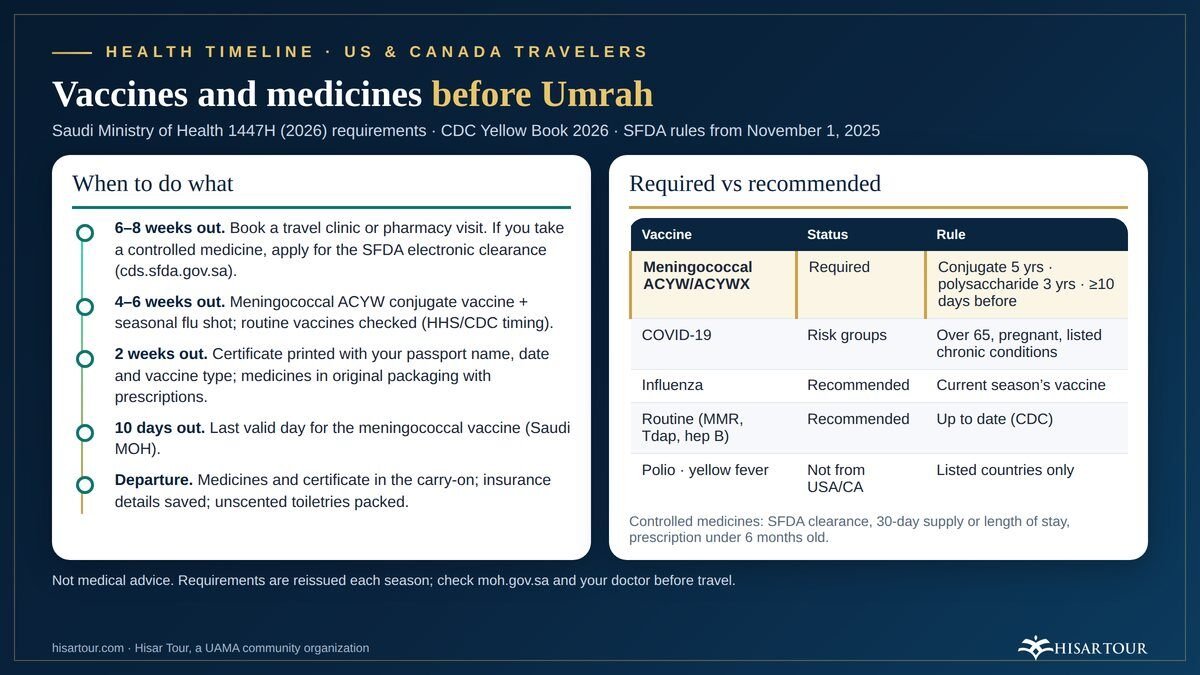
Our Umrah health guide covers the Saudi vaccine requirements and carrying medicines, and the guide to Umrah with elderly parents covers pacing and wheelchairs.
Making Up the Days
A day not fasted because of travel is made up later: “an equal number of other days” (Qur’an 2:184). The Jordanian fatwa puts it plainly for travelers who break the fast: “he must make up for each missed day after the month of Ramadan ends.” Write down the dates you did not fast while you are still on the trip; after a busy Umrah and Eid, families forget.
A Practical Plan for a Fasting Traveler
For the wider picture, our Ramadan Umrah 2027 planning guide covers dates and Saudi rules for the month, and our same-week guide to why Ramadan Umrah costs more explains what changes in a Ramadan package, including meals.
Travel in Ramadan with a group that plans around the fast
See our Umrah departures, then tell us your city, your dates and who is traveling. We will tell you how suhoor, iftar and the Umrah itself are scheduled.
See Umrah Packages WhatsApp +1 201-201-8992A UAMA community organization
Do I have to fast while traveling for Umrah in Ramadan?
No. A traveler may break the Ramadan fast and make up the days later (Qur’an 2:184–185), and the Prophet ﷺ told a Companion, “You may fast if you wish, and you may not fast if you wish” (Sahih al-Bukhari 1943). Scholars differ on details such as the day you set out and how long the concession lasts after you arrive.
Can I break my fast if my flight leaves in the afternoon?
The majority of Hanafi, Maliki and Shafi’i scholars say that if you intended to fast and set out after dawn, you complete that day’s fast. The relied-upon Hanbali view allows breaking it once you have left your city. All agree you may not break it before setting out, and that real hardship on the way allows breaking it with a make-up day. Ask your imam which view to follow.
When do I break my fast on a plane?
At sunset where you are. Egypt’s Dar al-Ifta states that a passenger breaks the fast on seeing the sun set at their location, not by the departure city’s time, and calls announcements based on the departure time legally invalid. At altitude this can be later than sunset on the ground.
Do I fast once I reach Makkah?
It depends on how long you stay in one place and which school you follow. The majority view ends traveler status with an intended stay of four days or more; Hanafi scholars treat you as a traveler while you intend to stay less than fifteen days. Take your exact itinerary to your imam.
Can I do Umrah while fasting?
Yes. Ihram, Tawaf, Sa’i and cutting the hair are all compatible with the fast. Many pilgrims perform the Umrah after iftar or late at night to avoid walking in daytime heat while fasting.
This page summarizes published scholarly positions and official health advice. It is not a religious ruling and not medical advice: confirm the rulings with a qualified scholar or your group’s imam, and medication plans with your own doctor. *Ramadan 1448 dates are expected dates from the Umm al-Qura calendar and depend on the moon sighting. Hisar Tour meal arrangements are as listed on hisartour.com/umrah-packages/ in October 2026. Last reviewed: October 2026.
Sources: Qur’an 2:184 · Qur’an 2:185 · Sahih al-Bukhari 1943 · Sahih al-Bukhari 1944 · Sahih al-Bukhari 1946 · Sahih al-Bukhari 1947 · Sahih Muslim 1121a · General Iftaa’ Department of Jordan, Fatwa 947 · Dar al-Ifta al-Misriyyah, breaking the fast on a plane · Islamweb, staying four days or more · SeekersGuidance, Hanafi travel rule · SeekersGuidance, Shafi’i four-day rule · Saudi Ministry of Health, Ramadan fasting and dehydration · Saudi Ministry of Health, pre-Ramadan advice for diabetics · Saudi Ministry of Health, pregnant and breastfeeding women in Ramadan · International Diabetes Federation, diabetes and fasting