

Umrah in December means warm days in Makkah, around 90°F (32°C) on average, and nights near 69°F (20°C). Madinah is noticeably cooler, and a few days of rain each month are normal.
Pack for both: breathable clothes for midday Tawaf, a warm layer for Fajr in Madinah and for air-conditioned halls, and sandals that cope with wet marble. Men in Ihram can’t put on a jacket, so the warm layer has to be something draped, not worn. The figures below are long-term averages from official meteorological sources, not a forecast.
Winter is the season most North American families choose for Umrah, and the weather is a large part of the reason: it’s the one time of year when walking from the hotel to the Haram at two in the afternoon is pleasant rather than punishing. It also catches people out, because “Saudi Arabia” suggests desert heat and the suitcase gets packed accordingly. This guide gives the actual climate numbers for November to February, what they mean for each part of the day, and what to wear, including the rules for men in Ihram. For dates and hotels, see the current group departures on our Umrah packages page.
The Numbers: November to February
For Makkah, the climate normals published through the World Meteorological Organization’s World Weather Information Service (1982 to 2011 data) give the average daily high and low below. For Madinah we use the Japan Meteorological Agency’s published normals, which give a monthly mean temperature rather than a high and low.
| Month | Makkah avg high | Makkah avg low | Makkah rain days | Madinah mean |
|---|---|---|---|---|
| November | 95.5°F (35.3°C) | 73.4°F (23.0°C) | 3.8 | 75.7°F (24.3°C) |
| December | 89.8°F (32.1°C) | 68.5°F (20.3°C) | 3.4 | 68.0°F (20.0°C) |
| January | 86.9°F (30.5°C) | 65.8°F (18.8°C) | 4.0 | 64.9°F (18.3°C) |
| February | 89.2°F (31.8°C) | 66.4°F (19.1°C) | 0.9 | 69.3°F (20.7°C) |
Swipe the table sideways to see every column. A rain day is a day with at least 0.1 mm of rain. Averages, not a forecast.
Two things stand out. In Makkah, “winter” means the summer heat has gone; an average December high of 90°F is still a warm day by American standards. And Madinah’s December mean of 68°F (20°C) is a full six degrees Celsius below Makkah’s mean for the same month, which the JMA gives as 26.2°C (79°F). Madinah sits inland, and the JMA records its station at 654 m above sea level. A mean of 20°C means the nights there run well below that.

What the Weather Feels Like Across a Day
Averages hide the daily swing, and the daily swing is what you’ll actually dress for.
- Fajr. The coolest part of the day. In Makkah, a long-sleeved layer is enough. In Madinah, when you walk to the Prophet’s Mosque in the dark, you’ll want a proper sweater or light jacket.
- Late morning to mid-afternoon. Warm and bright in Makkah. A December Tawaf in the open Mataf at noon is comfortable for most people, which isn’t true from May to September, but the sun is still strong on white marble. You’ll be glad of sunglasses and a water bottle.
- Inside the mosques. The prayer halls are air-conditioned. After an hour sitting still, many people feel cold even when it’s warm outside, which is one more reason for a layer you can take on and off.
- Evening and Isha. Pleasant in Makkah, cool in Madinah. This is when families with children and older parents tend to do Tawaf.
Late November is the warm end of the season, with Makkah averaging 95.5°F (35.3°C) at the daily high. If you’re travelling at Thanksgiving, our Thanksgiving Umrah guide covers that week in detail.
Rain in Makkah and Madinah
Rain isn’t frequent, but it’s a normal part of winter. Makkah averages about 3 to 4 rain days a month from November to January, and under one in February. When it comes it can be heavy, and the marble floors of the courtyards become slippery when wet. Three practical points:
- Sandals with grip rather than smooth-soled slides. A second pair in the hotel means you aren’t walking in wet ones all day.
- A compact umbrella. It shades you at noon and keeps the rain off. Holding an umbrella is permitted for men in Ihram; covering the head with a cap is not.
- Follow official alerts. When heavy rain is forecast, the Saudi National Center for Meteorology issues warnings, and your group leader can change the day’s plan. Don’t try to reach the Haram through flooded streets.
What to Wear in Ihram When It Is Cool
If you’re a man, this is the question that matters most, because the Ihram rules limit what you can wear exactly when you’d want a jacket. The rules below are the ones set out in our Ihram rules guide, with the hadith references our imams use. Details differ between the schools of law, so ask your group’s imam about your own case.
- Two unstitched sheets; no shirt, jacket, sweater or anything sewn to fit the body.
- Nothing that rests on the head. An umbrella is fine.
- Sandals that leave the ankles uncovered; no socks or closed shoes.
- A blanket or shawl over the body on a cold coach or flight is fine, as long as it does not cover the head.
- Ordinary modest clothing in any colour, including warm layers.
- Socks and closed shoes are permitted.
- No face veil fastened over the face, and no gloves.
- A cardigan or coat over the abaya is fine.
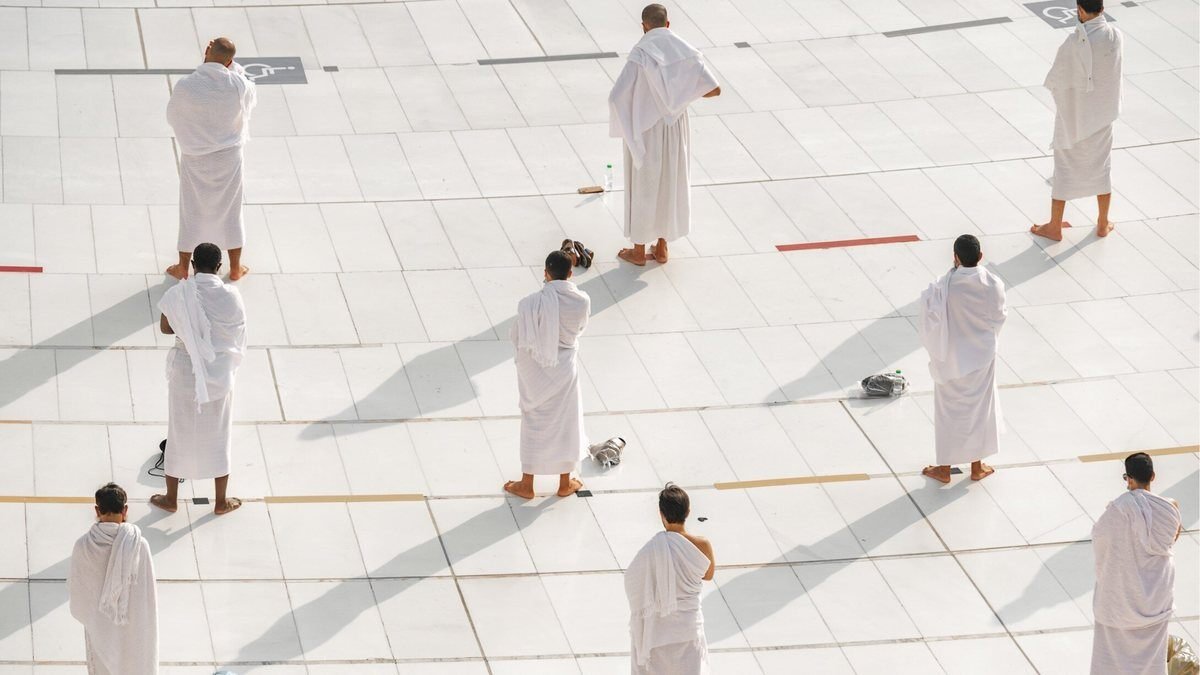
On Madinah-first trips, men usually enter Ihram on the road to Makkah, often in the morning; on Makkah-first trips it may be on the plane. Either way, a large shawl in your cabin bag solves most of the winter problem. Once the Umrah is complete and you have left Ihram, normal clothing, including a jacket, is fine again.
A Winter Packing List
These are only the items the season changes. You’ll find the full list in our Umrah packing list from the USA.
- Light, breathable clothes for daytime in Makkah, and a long-sleeved layer for evenings.
- One warm sweater or light jacket for Madinah, especially for Fajr.
- For men: a large unstitched shawl or light blanket for the Ihram days, and a thicker pair of Ihram sheets.
- For women: socks, and a cardigan that works over an abaya.
- Sandals with grip, plus a spare pair.
- A compact umbrella, sunglasses and sunscreen.
- A refillable water bottle; Zamzam is available throughout the Haram.
- For children: layers, and closed shoes for the Ziyarah days.
Winter Crowds
Winter is not one season for crowds. In our planning, November is among the quieter months, while the December school-break weeks are among the busiest outside Ramadan, because so many families travel in the same holiday window. Expect fuller Mataf floors after Isha and on Fridays, and plan Jumu’ah at Masjid al-Haram well ahead; on a Friday you leave the hotel much earlier than usual to find a place. If you want a quieter Tawaf, after Fajr and late at night are the usual windows our imams suggest. December 2026 also falls mostly within Rajab 1448, expected from about December 10 depending on the moon sighting. If you’re still choosing dates, our best time for Umrah, month by month compares the seasons, and our December school-break guide covers the holiday window.
Staying Well in Winter
Cooler weather brings crowds indoors and colds around. The Saudi Ministry of Health’s current health document for Umrah travellers advises wearing a regular face mask when performing the rituals and in crowded places, and recommends the updated seasonal flu vaccine; the meningococcal ACYW vaccine is a requirement, at least 10 days before arrival. Keep drinking even when you don’t feel hot. The air is dry and you’ll walk a lot more than you do at home. Our Umrah health preparation guide has the full list.
If you’re planning the length of a winter trip, our sister guide on how many days to plan for Umrah works through the time difference and the Makkah and Madinah split.
Plan a winter Umrah around the weather that suits your family
Our packages page lists every current winter departure, with the hotels, the walking distance to the Haram and the price.
See winter Umrah departures WhatsApp +1 201-201-8992A UAMA community organization
What is the weather like for Umrah in December?
Warm in Makkah, with an average high of about 90°F (32°C) and an average low of about 69°F (20°C), and cooler in Madinah, where the December mean temperature is about 68°F (20°C). Makkah averages three to four rain days in December.
Is it cold in Madinah in winter?
Cooler than Makkah, and cool enough at night and before dawn that most visitors want a sweater or light jacket. The Japan Meteorological Agency gives Madinah’s December and January mean temperatures as 20.0°C (68°F) and 18.3°C (65°F).
Can men wear a jacket in Ihram?
No. Men in Ihram do not wear stitched garments shaped to the body, which includes jackets and sweaters. A shawl or blanket draped over the body, not covering the head, is the usual solution. Ask your group’s imam if you are unsure about a particular garment.
Does it rain in Makkah in winter?
Yes, a few days a month from November to January on average, and rarely in February. Showers can be heavy and the marble floors get slippery, so pack sandals with grip and follow official weather alerts.
Is winter the best time for Umrah?
For the weather, yes: December to February are the coolest months in Makkah. For crowds and prices it depends on the dates. The December and January school holidays are busy, while November and February are usually quieter.
Climate figures are long-term averages, not forecasts: Makkah highs, lows and rain days from the WMO World Weather Information Service (data supplied by Saudi Arabia’s National Center for Meteorology, 1982 to 2011); mean temperatures for Madinah, Makkah and Jeddah from the Japan Meteorological Agency’s climate normals. Ihram guidance summarises our Ihram rules guide; schools of law differ on details, so ask a qualified scholar or your group’s imam. Health rules are set by the Saudi Ministry of Health and re-issued each season. Last reviewed: October 2026.
Sources: WMO World Weather Information Service, Makkah climate · Japan Meteorological Agency, Madinah normals · Japan Meteorological Agency, Makkah normals · Saudi National Center for Meteorology · Saudi Ministry of Health, Umrah health requirements 1447H (2026)