
The places most pilgrims visit in Madinah are Masjid Quba, Mount Uhud and its martyrs’ cemetery, Masjid al-Qiblatayn, Al-Baqi and the Seven Mosques, around the Prophet’s Mosque itself.
Only one of them, Quba, comes with a specific Prophetic encouragement to go and pray there. The others are visited for what happened at them: a battle, a change of qiblah, the graves of the Prophet’s family and Companions. This guide covers where each site is, what Saudi sources say about it today, and the etiquette questions on which scholars genuinely differ.
Most US and Canadian Umrah groups spend three or four nights in Madinah, and one morning of that is usually set aside for ziyarah. That is enough time for the main sites if you know in advance what each one is for. It is also short enough that a family arriving without a plan tends to spend it in a taxi queue. If you are still choosing dates, our Umrah packages page shows which departures start in Madinah and lists guided ziyarah in both cities among the inclusions; the rest of this page applies however you travel.
What Ziyarah Is, and What It Is Not
Ziyarah simply means “visit”. In a pilgrimage context it covers two different things that are easy to blur. The first is an act of worship with a clear basis in the Sunnah: praying in the Prophet’s Mosque, greeting the Prophet ﷺ, praying in Masjid Quba, and visiting graves to greet and pray for the dead. The second is historical visiting: standing where the Battle of Uhud was fought or where the qiblah changed, so that the Seerah you have read becomes a place you have seen.
Both are good, and neither is part of Umrah. Umrah is complete once you have done its rites in Makkah. Nothing you do or skip on a Madinah ziyarah morning affects its validity.
One hadith frames how scholars talk about this. The Prophet ﷺ said: “Do not set out on a journey except for three Mosques,” naming the Sacred Mosque in Makkah, his own mosque in Madinah and Al-Aqsa (Sahih al-Bukhari 1189). Your journey to Madinah is to his mosque. The sites below are places you visit once you are there.
The Six Sites at a Glance
| Site | What it is | Why pilgrims go | Basis |
|---|---|---|---|
| Prophet’s Mosque | The Prophet’s mosque and resting place | Prayer, Rawdah, greeting the Prophet ﷺ | Sunnah |
| Masjid Quba | The first mosque built in Islam | Two rak‘ahs, following his practice | Sunnah (specific hadith) |
| Uhud & martyrs’ cemetery | Site of the Battle of Uhud | Greeting the martyrs, including Hamzah | Visiting graves (general) |
| Masjid al-Qiblatayn | Where a congregation turned to the Kaaba mid-prayer | History; prayer as in any mosque | Historical |
| Al-Baqi | Madinah’s main cemetery | Greeting the Prophet’s family and Companions | Visiting graves (general) |
| Seven Mosques | Small mosques by the Trench battlefield | History of the Battle of the Trench | Historical |
Swipe the table sideways to see every column.
The Prophet’s Mosque and the Greeting
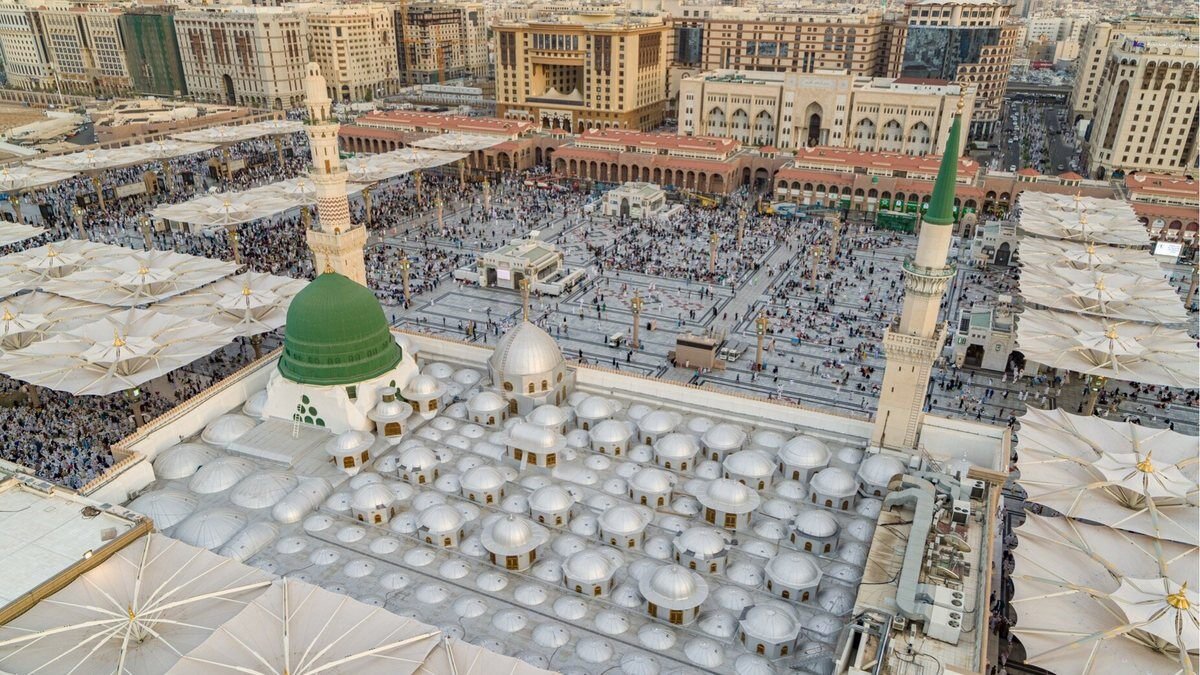
The ziyarah that matters most happens inside the city’s central mosque, not on a bus. Two things are worth separating before you arrive. Praying in the Rawdah, the area between the Prophet’s house and his pulpit, requires a time-slot permit booked through the Nusuk app; our step-by-step guide to Rawdah permits on Nusuk walks through it. Greeting the Prophet ﷺ and his two Companions buried beside him, Abu Bakr and Umar, is done while walking past the grave area along a managed route, and the arrangements for men and women differ. Our women’s guide to Umrah covers the sisters’ side.
The guidance most often quoted for this moment is short. The Prophet ﷺ said: “Do not make my grave a place of festivity. But invoke blessings on me, for your blessings reach me wherever you may be” (Sunan Abi Dawud 2042, graded sahih by al-Albani on sunnah.com). In practice that means a calm greeting, salawat, and moving on so others can do the same. Staff will keep the line moving, and pushing against it is the commonest way pilgrims get hurt or upset here.
Masjid Quba
Quba is the one site in Madinah where the visit itself is a Sunnah, and that is why it belongs at the top of any list. Saudipedia describes it as “the first mosque built in Islam”, built in 622 when the Prophet ﷺ arrived from Makkah, and places it about 3.5 km from the Prophet’s Mosque on the Hijrah Road side of the city.
What the hadith actually say
Ibn Umar reported that “The Prophet ﷺ used to go to the Mosque of Quba every Saturday (sometimes) walking and (sometimes) riding,” and that he would pray two rak‘ahs there (Sahih al-Bukhari 1193 and 1194; also Sahih Muslim 1399). A further narration gives the reward: “Whoever purifies himself in his house, then comes to the Quba’ Mosque and offers one prayer therein, will have a reward like that for ‘Umrah” (Sunan Ibn Majah 1412; with similar wording in Jami‘ at-Tirmidhi 324 and Sunan an-Nasa’i 699, each graded hasan by Darussalam on sunnah.com).
Two practical consequences follow from the wording. Make wudu at your hotel before you set out rather than at the mosque, and pray once you are there, even if the group stop is short. The Saturday detail describes the Prophet’s habit; Quba is open to visitors on other days too.
Getting there
Saudipedia describes the Quba Front project as a three-kilometre pedestrian pathway from Quba Mosque to the vicinity of the Prophet’s Mosque, which lets you follow the Prophet’s habit of walking if your health and the weather allow it. For older parents, a car or the group bus is the realistic choice. The mosque is also in the middle of a major expansion: Saudipedia puts the planned area at about 50,000 m² with room for around 66,000 worshippers, so expect construction hoardings and changed entrances for some time.
Mount Uhud and the Martyrs
Mount Uhud is the reddish mountain on Madinah’s northern edge where the Battle of Uhud was fought in the third year after the Hijrah. Qur’an 3:121 opens the long passage about it. Saudipedia lists it as about four kilometres north of the Prophet’s Mosque. The Prophet ﷺ said of it, “This is a mountain that loves us and is loved by us” (Sahih al-Bukhari 4083; also 2889).
At its foot is the Uhud Martyrs’ Cemetery, which Saudipedia places “between Mount Uhud and Jabal al-Rumat”, the low hill where the archers were stationed during the battle. Among those buried there is Hamzah ibn Abd al-Muttalib, the Prophet’s uncle. Standing between the archers’ hill and the mountain is the clearest way to understand what happened that day: the archers left their position, and the battle turned.
The visit here is a grave visit. The greeting the Prophet ﷺ taught for cemeteries begins “Peace be upon you, the inhabitants of the city, among the believers, and Muslims, and God willing we shall join you” (Sahih Muslim 975). Your imam or group leader will usually lead it aloud.
Masjid al-Qiblatayn
The name means “the mosque of the two qiblahs”. Saudipedia records that a group of Muslims was praying here towards Jerusalem when revelation came “instructing them to turn their prayer direction towards al-Kaaba”, and dates the mosque to 623. The verse is Qur’an 2:144: “So turn your face toward al-Masjid al-Haram.”
Today it is a working mosque. There is no special rite attached to it, so pray as you would in any mosque you enter and take a moment with the story. If your group arrives near a prayer time, it is a good place to pray in congregation before moving on.
Al-Baqi
Al-Baqi, also called Baqi al-Gharqad, is Madinah’s main cemetery and sits directly against the south-eastern wall of the Prophet’s Mosque. Saudipedia lists among those buried there the Prophet’s wives, apart from Khadijah and Maymunah; his daughters; his son Ibrahim; his uncle al-Abbas; his aunt Safiyyah; his grandson al-Hasan ibn Ali; and the third caliph, Uthman ibn Affan. Khadijah is buried in Makkah, at Jannat al-Mu‘alla.
Aisha described the Prophet ﷺ going out to Al-Baqi towards the end of the night to greet its people and ask forgiveness for them (Sahih Muslim 974). That narration is the model for the visit: greet, pray for them, reflect, and leave.
The Seven Mosques and the Trench
On the western side of Mount Sala’ are a cluster of small mosques connected with the Battle of the Trench (al-Khandaq) in 627, when the Muslims dug a trench to defend the city. Saudipedia describes them as “six small mosques”, though the area is still commonly called the Seven Mosques, with Masjid al-Fath, “the highest mosque”, set on the mountain slope. Saudipedia also notes Qiblatayn is about a kilometre away, so the two are often visited together.
This is a history stop. It suits groups with teenagers who have studied the Seerah, because the scale of the trench defence only makes sense on the ground. Nothing here is a required or recommended act of worship.
Etiquette, and Where Scholars Differ
Some of the etiquette is agreed. The Prophet ﷺ said, “Do not sit on the graves and do not pray facing towards them” (Sahih Muslim 972). Greeting the dead and praying for them is recommended, and visiting graves is encouraged as a reminder of the Hereafter: “I forbade you to visit graves, but you may now visit them” (Sahih Muslim 977).
Other questions have more than one answer among qualified scholars, and pilgrims from different backgrounds bring different habits with them:
- Women visiting cemeteries. The four schools differ, from permitted with conditions to disliked to not permitted. Our Jannat al-Mu‘alla guide sets out each position with its source.
- Reciting Qur’an at a grave. Many Hanafi teachers recommend reciting short surahs or Ya-Sin for the deceased. Scholars whose views shape practice in Saudi Arabia generally regard reciting or praying at graves as something not legislated. If you sit down at a grave to recite, you may be asked to move on.
- Which way to face when making du‘a, and whether to ask through the Prophet ﷺ. Schools and teachers answer this differently. This is a question for a scholar you trust, not for a travel company.
- Touching walls, railings or taking soil. Site staff may ask you to stop, at the Prophet’s Mosque and at the cemeteries alike. Whatever your own tradition says, it is not worth an argument at a cemetery gate.
Planning the Morning
A few things decide whether a ziyarah morning works. Go early, because the outlying sites are open ground and the sun is strong for much of the year. Carry water and wear shoes you can slip off and on quickly at each mosque. If you have a Rawdah permit, plan around its time slot, not the other way round. And if you are travelling with older parents, choose two sites done properly over five done in a rush; our guide to Umrah with elderly parents has more on pacing.
If you are deciding which city to start in, Makkah or Madinah first explains the trade-off. The companion guide to ziyarah places in Makkah covers Hira, Thawr, Arafat and the rest, and why an imam-led group changes your Umrah describes what a guide adds at sites like these.
See which departures include guided ziyarah in Madinah
Our Umrah packages list the hotels, nights in each city and what is included for every departure, with an imam travelling with the group.
View Umrah packages WhatsApp +1 201-201-8992A UAMA community organization
What are the main ziyarat places in Madinah?
The Prophet’s Mosque itself, including the Rawdah and the greeting at the Prophet’s grave, then Masjid Quba, Mount Uhud and the martyrs’ cemetery, Masjid al-Qiblatayn, the Al-Baqi cemetery and the Seven Mosques area by the site of the Battle of the Trench.
Is visiting Masjid Quba a Sunnah?
Yes. The Prophet ﷺ visited Quba regularly, walking or riding, and prayed two rak‘ahs there (Sahih al-Bukhari 1193 and 1194). A hadith in Sunan Ibn Majah 1412, graded hasan by Darussalam, gives the reward of an Umrah to someone who purifies himself at home and then prays in Quba.
Do I need a permit for ziyarah in Madinah?
You need a Nusuk permit for a time slot in the Rawdah inside the Prophet’s Mosque. We are not aware of a permit requirement for Quba, Qiblatayn or Uhud, which are open mosques and public sites, but rules can change, so check on arrival. Al-Baqi’s access is managed at the gate.
Can women visit Al-Baqi and the Uhud cemetery?
On the religious question, the four schools differ, and our Jannat al-Mu‘alla guide sets out each position. On the practical question, we could not find a current official rule on women’s entry to Al-Baqi, so ask at the gate or ask your group leader on the day.
Is ziyarah part of Umrah?
No. Umrah is complete once its rites are done in Makkah. Visiting Madinah and its sites is a separate act, and none of it affects whether your Umrah is valid.
Site descriptions, distances and capacity figures are as given by Saudipedia and read on 10 October 2026; Madinah’s historic areas are being redeveloped and access arrangements change, so confirm on arrival. Hadith references were checked on sunnah.com and Qur’an references on quran.com on the same date; grades are those displayed on sunnah.com. This page describes scholarly positions without issuing rulings. Last reviewed: October 2026.
Sources: Saudipedia, Quba Mosque · Saudipedia, Islamic historical sites in Madinah · Saudipedia, Al-Baqi Cemetery · Sahih al-Bukhari 1193 · Sunan Ibn Majah 1412 · Sahih Muslim 1398 · Sahih al-Bukhari 4083 · Sahih Muslim 975 · Sahih Muslim 974 · Sunan Abi Dawud 2042 · Qur’an 9:108 · Qur’an 2:144