
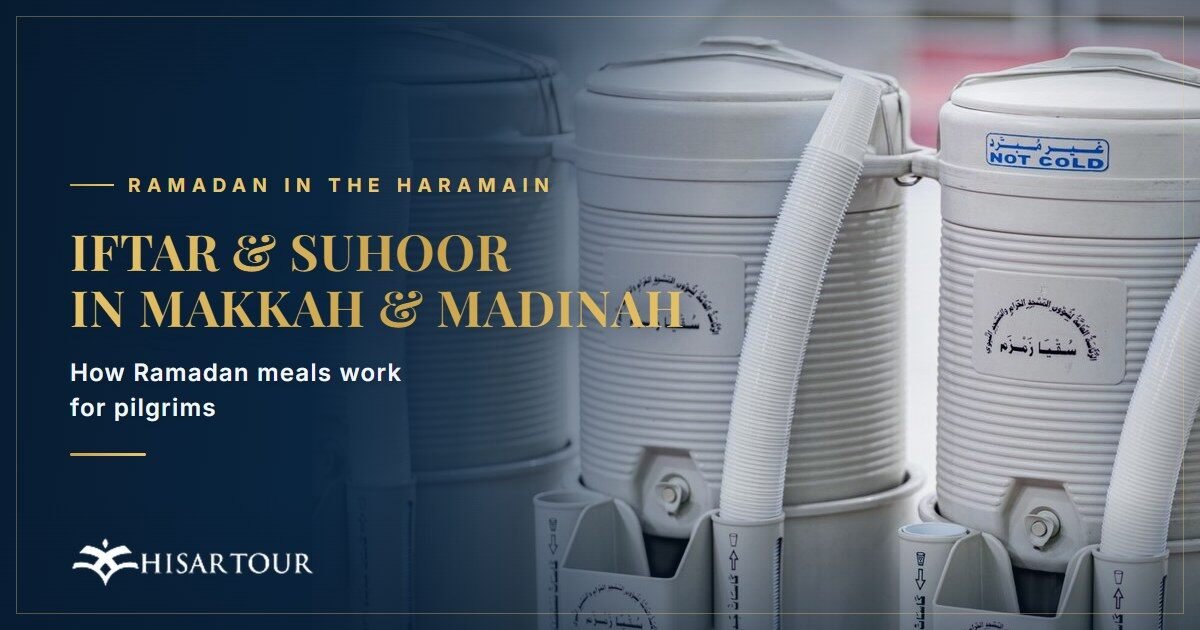
In Ramadan, pilgrims break the fast in one of two places: inside or around the Haram, where free iftar is handed out before Maghrib, or back at the hotel. Suhoor is almost always a hotel meal.
The choice is not about food. Breaking your fast in the mosque keeps your place for Maghrib, Isha and Taraweeh; breaking it at the hotel gives you a full meal but costs you that place. This guide explains how each works in Makkah and Madinah, what the Sunnah says about the two meals, and how to plan a family’s day around them.
This page is for a family from the US or Canada going for Umrah in Ramadan 1448, expected from February 8, 2027 to March 8, 2027 (Umm al-Qura calendar; the moon sighting decides the first and last day). It covers the practical side of the two daily meals. For dates, crowds and prices, start with our Ramadan Umrah 2027 guide; to compare departures, see our Umrah packages.
How Iftar Works at the Haram
Free iftar is distributed at both mosques every evening of Ramadan. In Ramadan 1447 (2026), more than 33.8 million iftar meals were distributed at the Grand Mosque in Makkah and the Prophet’s Mosque in Madinah, under a system run by the General Authority for the Care of the Affairs of the Grand Mosque and the Prophet’s Mosque, with “organised locations and health standards” (Saudi Press Agency via Bernama, March 23, 2026). In Madinah alone, the Authority reported 9,015,322 free iftar meals, distributed “within the Prophet’s Mosque and its courtyards” (March 26, 2026).
Three things follow for a pilgrim:
- You do not need to bring a meal. Iftar is handed out where people sit, in the areas set aside for it. Follow the staff’s directions on where food may be eaten.
- The crowd peaks before Maghrib. The Authority’s own report names the “peak periods before the Maghrib prayer.” Arrive well before sunset if you want a place inside.
- It is a light iftar, not dinner. What is in the meal varies, so plan on a proper meal later at the hotel or outside.
Prayer at the Haram does not need a permit; the Ministry of Hajj and Umrah states there is no prayer permit. You can go for iftar and Maghrib on any evening, and keep your Nusuk Umrah permit for the Umrah itself. Our same-week guide to the Nusuk Umrah permit covers that booking.
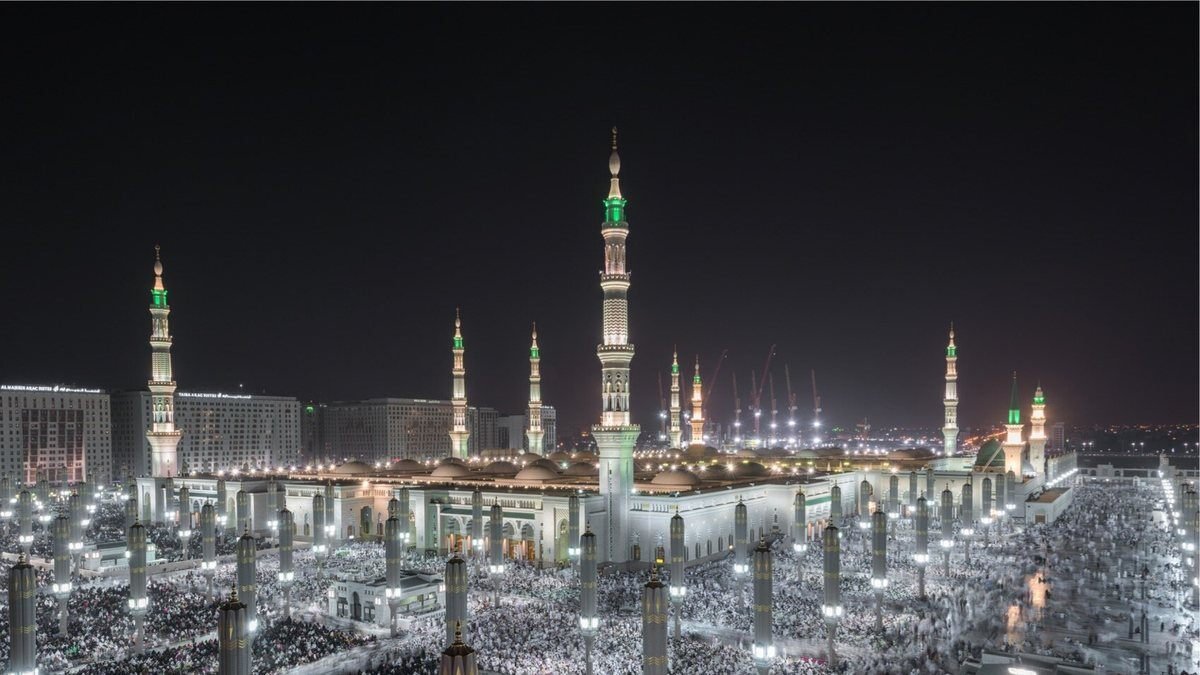
Mosque, Hotel or Restaurant: What Each Costs You
Every evening comes down to one decision: where to be when the Maghrib adhan sounds. Here is the trade-off as it usually works for a group traveler.
| Where you break the fast | What you get | What it costs you |
|---|---|---|
| In the mosque or courtyard | Iftar with the whole congregation; your place for Maghrib, Isha and Taraweeh | A light meal only; a long wait from Asr; a hard place for small children |
| At the hotel | A full meal, a seat, a bathroom, rest before Taraweeh | Your place in the mosque; the walk back in the busiest hour |
| At a restaurant | Choice of food | Queues at the same minute as everyone else, and a cost you pay yourself |
Swipe the table sideways to see every column.
Hotel distance changes this decision more than anything else. A hotel you can walk from in a few minutes lets you eat at the hotel and still return for Isha; a shuttle hotel usually means choosing one or the other. Our guide to Makkah hotels near the Haram explains how to read the distance, and our guide to Madinah’s central area does the same for Madinah.
Suhoor: A Hotel Meal at the Hardest Hour
Suhoor is the pre-dawn meal, eaten before the Fajr adhan. For pilgrims it is nearly always eaten at the hotel, in the hour before the walk to Fajr. It is the meal people skip when they are tired, and in Ramadan, with Taraweeh late and night prayers in the last ten, tiredness is the norm.
- Eat, even a little. The Sunnah encourages it (see below), and a long day of walking at the Haram on no suhoor is hard on anyone.
- Drink through the night, not all at suhoor. Spread water between iftar and suhoor instead of drinking a large amount just before Fajr.
- Stop by your mosque’s Fajr adhan. Some printed timetables show an earlier “imsak” time as a margin of caution. Whether to follow it is a question for your imam; the Haram’s own adhan is the reference on the ground.

What the Sunnah Says About the Two Meals
Four narrations are quoted often in the Haramain in Ramadan. We give them with their references so you can read them in full; for rulings on your own fast, ask your imam or a scholar.
- Suhoor. The Prophet ﷺ said, “Take Suhur as there is a blessing in it” (Sahih al-Bukhari 1923).
- Not delaying iftar. “The people will remain on the right path as long as they hasten the breaking of the fast” (Sahih al-Bukhari 1957).
- Dates and water. The Prophet ﷺ used to break his fast before praying with fresh dates, or dry dates if there were none, or a few sips of water if there were no dates (Sunan Abi Dawud 2356, graded hasan sahih by al-Albani).
- Zamzam. “The water of Zamzam is for whatever it is drunk for” (Sunan Ibn Majah 3062, graded hasan by Darussalam). Scholars differ on the strength of this narration’s chain.
Travelers also ask whether they must fast on the day they fly. The traveler’s concession and the differences between the schools on the day of departure are a fiqh question with more than one answer; your imam is the right person to ask before the trip.
A Ramadan Day Planned Around the Meals
This is a sample shape for a day in Makkah in the first twenty nights. Prayer times move a little each day; follow the Haram’s adhan.
Eat and drink, then walk to Fajr. If your hotel is on a shuttle, leave time for the first shuttles to fill.
Sleep after Fajr or before Dhuhr. This is the rest block that carries you through the night.
On mosque-iftar nights, leave after Asr. Take a small prayer mat, a refillable bottle for later and nothing you cannot carry for hours.
Iftar comes at the adhan and Maghrib follows soon after, so iftar in the mosque is short by design.
Stay for Isha and Taraweeh, then eat a full meal at the hotel or outside. In the last ten nights, add the late-night prayers and move rest to the afternoon.
Our guide to the last 10 nights in Makkah describes how those nights change the day.
Children, Elderly Parents and Health
A three-hour wait for iftar inside the mosque is a lot to ask of a child or an elderly parent. Plan the evenings by who is traveling, not by what the most energetic adult wants.
- Children: hotel iftar on most nights, the mosque on one or two chosen nights, and a meeting point set before you go in.
- Elderly parents: keep them out of the pre-Maghrib crush; break the fast at the hotel or in a quieter courtyard area and walk in after the crowd has settled. Our guide to Umrah with elderly parents covers walking distances and rest.
- Medical conditions: anyone with diabetes, kidney disease, a heart condition or pregnancy should talk to their doctor about fasting and travel before they book, and carry medicines in hand luggage. Our health tips for Umrah cover the basics.
How Meals Work on Our Ramadan Departures
Outside Ramadan, our packages include breakfast and dinner at the group’s own hotel in Makkah and Madinah. On our Ramadan tours, suhoor and iftar are included instead (as listed on our Umrah packages page, October 2026*). The departure card names the hotels and the walking distance or shuttle, which is what decides how often a family can eat at the hotel and still return for Taraweeh. Anything we charge you for is set out in writing before you pay it.
Ramadan Umrah with suhoor and iftar included
Compare our Umrah departures by hotel distance and dates, and tell us which part of Ramadan 2027 suits your family.
See Umrah Packages WhatsApp +1 201-201-8992A UAMA community organization
Is iftar free at Masjid al-Haram and the Prophet’s Mosque?
Yes. Free iftar meals are distributed at both mosques during Ramadan. In Ramadan 1447 (2026) more than 33.8 million were distributed across the two mosques, under the General Authority for the Care of the Affairs of the Grand Mosque and the Prophet’s Mosque.
What time should I arrive for iftar at the Haram?
Well before Maghrib. The Authority describes the period before the Maghrib prayer as the peak, and the closer you want to sit, the earlier you need to come. Many families go after Asr on the nights they choose to break the fast inside.
Where do pilgrims eat suhoor in Makkah and Madinah?
Almost always at the hotel or at a nearby restaurant, before walking to Fajr. On our Ramadan departures, suhoor is included with the package.
Do I need a Nusuk permit to go to the Haram for iftar?
No. The Ministry of Hajj and Umrah states there is no prayer permit. The Nusuk permit is for performing Umrah.
Should I break my fast with Zamzam?
The Sunnah is to break the fast with dates, or water if there are none (Sunan Abi Dawud 2356). Zamzam is water, and many pilgrims choose it in the Haram; the narration “The water of Zamzam is for whatever it is drunk for” is in Sunan Ibn Majah 3062.
*Ramadan 1448 dates are expected dates from the Umm al-Qura calendar and depend on the moon sighting. Iftar figures are for Ramadan 1447 (2026) as reported by the Saudi Press Agency via Bernama; arrangements for 1448 are set by the General Authority for the Care of the Affairs of the Grand Mosque and the Prophet’s Mosque. Hisar Tour meal inclusions are as listed on hisartour.com/umrah-packages/ on October 11, 2026; your departure’s written terms are the binding reference. Religious points are given with their references; for rulings on your own fast, ask a scholar. Nothing here is medical advice. Last reviewed: October 2026.
Sources: Bernama-SPA, iftar meals at the Two Holy Mosques, Ramadan 1447 · Bernama-SPA, iftar meals at the Prophet’s Mosque, Ramadan 1447 · Ministry of Hajj and Umrah, FAQ · Sahih al-Bukhari 1923 · Sahih al-Bukhari 1957 · Sunan Abi Dawud 2356 · Sunan Ibn Majah 3062