
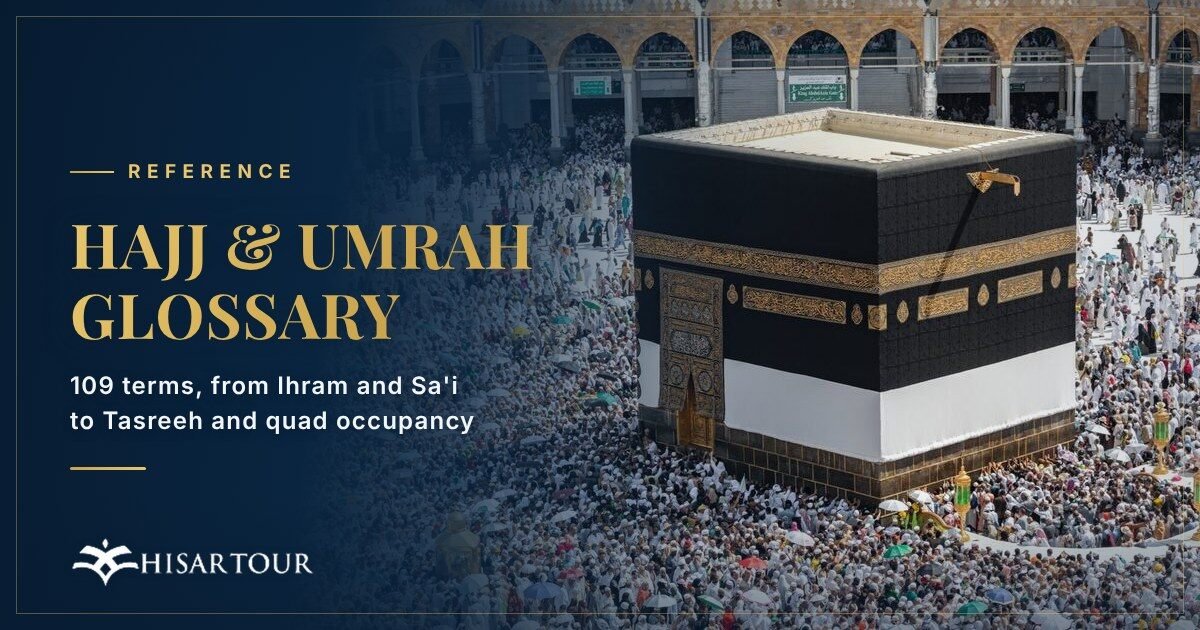
109 words you will meet before, during and after a pilgrimage — including the ones that are not religious terms at all.
Most glossaries explain the rites and stop. The words that actually trip people up are the administrative ones, like Tasreeh, shifting and e-wallet, and the commercial ones, like quad occupancy and land only. This page covers all three vocabularies and keeps them clearly apart, because a Saudi regulation and a point of Islamic jurisprudence are not the same kind of fact. Bookmark it and come back to it; if you are at the planning stage, our Umrah packages page uses most of these terms in context.
Sections · 7
Religious vs administrative · kept separate
One habit is worth adopting before you read any further. When you hear a term on this journey, ask yourself which of three boxes it belongs in: an act of worship defined by Islamic law, a rule set by the Saudi authorities, or a commercial description written by a travel company. The first changes slowly and is a matter for scholars. The second changes most years and is a matter for official sources. The third is a matter for your contract. Treating all three as the same kind of statement is how people end up surprised.
- The two pilgrimages and the state of Ihram — 14 terms
- The rites, in the order you perform them — 18 terms
- Places in Makkah you will hear named — 14 terms
- Madinah and ziyarah — 10 terms
- The Mashair: Hajj’s five hardest days — 15 terms
- The Saudi system: Nusuk, visas and permits — 18 terms
- The words on your invoice — 20 terms
- Eight pairs people mix up
The Two Pilgrimages and the State of Ihram
Start here. Almost every other word on this page hangs off one of these.
- Hajj
- The major pilgrimage, performed on fixed days of Dhul Hijjah, the twelfth month of the Hijri calendar. It is one of the five pillars of Islam and is obligatory once in a lifetime on those who are able (Qur’an 3:97). Because the dates are fixed, Hajj cannot be moved to suit a holiday calendar.
- Umrah
- The lesser pilgrimage: Ihram, Tawaf, Sa’i and cutting the hair. It can be performed at almost any time of year, takes a few hours in the Haram itself, and is not obligatory in the way Hajj is. See what Umrah is.
- Ihram (the state)
- The condition a pilgrim enters before crossing the Miqat, in which certain normally permitted acts are restricted. It is a state of worship, not a garment.
- Ihram (the garments)
- For men, two unstitched white cloths. For women there is no special garment; ordinary modest clothing is worn, with the face and hands treated differently by different schools. Our Ihram guide covers both.
- Miqat
- The boundary at which Ihram must be assumed. Travellers flying from North America usually enter Ihram before boarding or in the air above their route’s Miqat; see Miqat for flights from the USA.
- Dhul-Hulayfah
- Also called Abyar Ali. The Miqat for those travelling to Makkah from Madinah, a short distance outside Madinah.
- Niyyah
- Intention. The inward resolve to perform the rite, made as Ihram is assumed. It is not a fixed formula that must be recited aloud in a particular language.
- Talbiyah
- The declaration recited after entering Ihram, beginning Labbayk Allahumma labbayk. For Umrah it is discontinued once Tawaf begins.
- Muhrim
- A person currently in the state of Ihram.
- Tahallul
- Release from Ihram, which occurs after the prescribed acts are completed and the hair is cut. In Hajj it happens in two stages rather than one.
- Tamattu’
- The most common form of Hajj for pilgrims from abroad: Umrah first, release from Ihram, then a second Ihram for Hajj. A Hady is required.
- Qiran
- Combining Umrah and Hajj in a single Ihram, without release in between. A Hady is required.
- Ifrad
- Hajj alone, without a preceding Umrah. No Hady is required on this account. The differences between the three are set out in Tamattu’ and Qiran compared.
- Badal Hajj
- Hajj performed on behalf of someone who cannot perform it themselves, typically because of age, permanent illness or death. The conditions are a matter of jurisprudence and differ between schools; Hisar Tour’s own arrangement is described on the Hajj Badal page.
The Rites, in the Order You Perform Them
These are the words a group leader will actually use in the Haram.
- Tawaf
- Circling the Kaaba seven times, counter-clockwise, beginning and ending at the line of the Black Stone.
- Shawt
- One single circuit. Seven shawts make one Tawaf. The same word is used for one length of the Sa’i.
- Tawaf al-Qudum
- The arrival Tawaf, performed on reaching Makkah.
- Tawaf al-Ifadah
- The Tawaf of Hajj itself, performed after returning from Mina. It is an essential element of Hajj.
- Tawaf al-Wida
- The farewell Tawaf, performed as the last act before leaving Makkah at the end of Hajj.
- Istilam
- Greeting the Black Stone at the start of each circuit, by touching or kissing it if possible, or by raising the hand towards it from a distance. In crowds the second is the normal practice.
- Idtiba’
- For men, wearing the upper Ihram cloth under the right arm and over the left shoulder during certain Tawafs.
- Ramal
- For men, a brisk walk in the first three circuits of certain Tawafs where the crowd allows it.
- Sa’i
- Walking seven lengths between Safa and Marwah. The lengths are counted one way, so the Sa’i ends at Marwah. The two hills are named in Qur’an 2:158.
- Hijr Isma’il
- The semicircular low wall on one side of the Kaaba. The area inside it is treated as part of the Kaaba, which is why Tawaf is performed outside it.
- Maqam Ibrahim
- The glass and metal enclosure near the Kaaba containing the stone associated with Prophet Ibrahim. Two units of prayer after Tawaf are offered behind it where possible, and anywhere in the mosque when it is not.
- Multazam
- The area of the Kaaba’s wall between the Black Stone and the door, where supplication is traditionally made. Access depends entirely on crowd conditions.
- Halq
- Shaving the head. For men this is one of the two ways of completing the rite.
- Taqsir
- Trimming the hair rather than shaving. Women trim a short length; they do not shave.
- Hady
- The sacrificial animal required of a pilgrim performing Tamattu’ or Qiran (Qur’an 2:196). It is a Hajj obligation and is distinct from Udhiyah.
- Udhiyah
- The sacrifice offered at Eid al-Adha, which is not tied to being on Hajj. Mixing the two up is one of the most common errors; Hisar Tour’s Hady page explains the distinction.
- Fidyah
- A compensatory payment or act for an omitted or improperly performed obligation. What is due depends on what was missed and on the school followed, which is a question for a scholar rather than an operator.
- Dam
- Literally blood; used in jurisprudence for a required sacrifice arising from a breach or omission during the rites.
Places in Makkah You Will Hear Named
Useful because itineraries and group announcements use these names without explaining them.
- Al-Masjid al-Haram
- The Grand Mosque in Makkah, which surrounds the Kaaba.
- Kaaba
- The cubic structure at the centre of the Grand Mosque, towards which Muslims pray worldwide.
- Hajar al-Aswad
- The Black Stone, set into one corner of the Kaaba, marking the start and end of each Tawaf circuit.
- Rukn al-Yamani
- The Yemeni corner of the Kaaba, the corner before the Black Stone in the direction of Tawaf.
- Mataf
- The open marble floor immediately around the Kaaba where Tawaf is performed. For the 1446 AH Hajj season the General Authority stated the Mataf was equipped for up to 107,000 circumambulators per hour, with total worshipper capacity across all levels reaching 203,000.
- Mas’a
- The enclosed gallery between Safa and Marwah where Sa’i is performed. It runs on several levels.
- Safa
- The first of the two hills of the Sa’i, now enclosed within the mosque.
- Marwah
- The second hill, where each odd-numbered length of the Sa’i ends.
- Kiswah
- The embroidered black cloth covering the Kaaba, replaced annually.
- King Abdulaziz Gate
- One of the main entrances to the Grand Mosque and a standard group meeting point, which is why it is worth agreeing on a gate number before separating from your group.
- Ajyad Bridge
- A pedestrian bridge serving the Haram, and one of the named points where wheelchairs and electric carts are made available to pilgrims who need them.
- Masjid Aisha
- The mosque at Tan’im, outside the Haram boundary, used by pilgrims already in Makkah who wish to enter Ihram for an additional Umrah.
- Jabal al-Nur
- The mountain outside Makkah containing the Cave of Hira. Visited from the outside by many groups; the climb is long and steep and is not part of the rites.
- Jannat al-Mu’alla
- The historic cemetery in Makkah where several members of the Prophet’s family are buried. See our guide to Jannat al-Mu’alla.
Madinah and Ziyarah
Madinah has no rites attached to it, which is exactly why its vocabulary confuses people.
- Al-Masjid an-Nabawi
- The Prophet’s Mosque in Madinah. Praying there carries a reported multiplied reward (Sahih al-Bukhari 1190), but visiting Madinah is not one of the obligations of Hajj or Umrah.
- Rawdah
- The area between the Prophet’s pulpit and his house, described in a reported narration as a garden of Paradise (Sahih al-Bukhari 1196). Entry requires a permit booked in the Nusuk app; see how to book a Rawdah appointment.
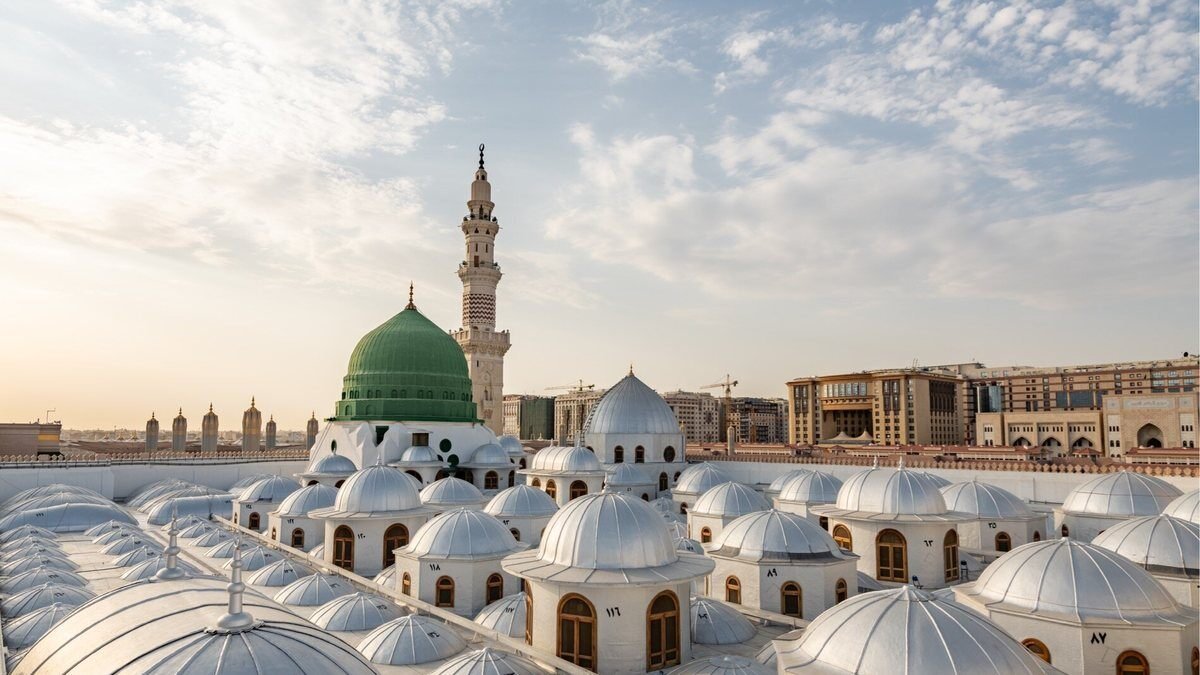
- Green Dome
- The dome over the burial chamber of the Prophet, the landmark most visible from the southern courtyards.
- Jannat al-Baqi’
- The cemetery beside the Prophet’s Mosque, visible from the eastern side.
- Masjid Quba
- The first mosque built in Islam, a short drive from the centre of Madinah and a standard stop on a Madinah ziyarah programme.
- Masjid al-Qiblatayn
- The mosque of the two directions of prayer, named for the change of Qiblah from Jerusalem to Makkah.
- Uhud
- The site of the battle of Uhud, with the graves of the martyrs, on most Madinah ziyarah itineraries.
- Ziyarah
- A visit to a site of religious or historical significance. It is distinct from the rites: skipping a ziyarah stop does not invalidate anything.
- Ziyarat
- The plural form, and the word most often used on itineraries for the half-day guided visits in Makkah and Madinah.
- Central area
- The hotel zone immediately around the Prophet’s Mosque in Madinah, which is what package descriptions normally mean by proximity there. See Madinah hotels and the central area.
The Mashair: Hajj’s Five Hardest Days
This vocabulary only applies to Hajj, and it is where a package’s real differences live.
- Mashair
- The collective name for the three sites outside Makkah used during Hajj: Mina, Arafat and Muzdalifah.
- Yawm al-Tarwiyah
- 8 Dhul Hijjah, the day pilgrims move to Mina.
- Mina
- The valley of tents where pilgrims stay during the Hajj days. Tent zone and camp category are decided by the package bought, not by the hotel standard in Makkah.
- Arafat
- The plain where pilgrims stand on 9 Dhul Hijjah. Standing at Arafat is the element without which Hajj is not valid.
- Day of Arafah
- 9 Dhul Hijjah. For those not on Hajj, fasting this day is an established voluntary practice (Sahih Muslim 1162).
- Jabal al-Rahmah
- The hill at Arafat, often photographed. Standing anywhere within the boundaries of Arafat is sufficient; the hill itself is not required.
- Muzdalifah
- The open ground where pilgrims stop after sunset on the Day of Arafah, usually spending part or all of the night in the open.
- Jamarat
- The three stoning sites in Mina, approached through a multi-level bridge structure.
- Jamrah al-Aqabah
- The largest of the three, and the only one stoned on 10 Dhul Hijjah.
- Rami
- The act of stoning the Jamarat.
- Yawm al-Nahr
- 10 Dhul Hijjah, the day of sacrifice: stoning, Hady, cutting the hair, and Tawaf al-Ifadah.
- Ayyam al-Tashriq
- 11, 12 and 13 Dhul Hijjah, the days on which the remaining stoning is performed.
- Nafrah
- The mass departure: from Arafat to Muzdalifah after sunset, and from Muzdalifah to Mina before or after dawn.
- Mashair Metro
- The dedicated rail line between Mina, Arafat and Muzdalifah. Whether your package uses it, buses, or both is a question to ask before booking.
- Shifting
- An administrative term, not a religious one: a package in which accommodation changes during the Hajj days, usually to a hotel further out. Non-shifting packages keep you in one place and cost more.
The Saudi System: Nusuk, Visas and Permits
These words appear in no classical text. They are the current administrative machinery, and they change.
- Nusuk
- The official platform supervised by the Saudi Ministry of Hajj and Umrah through which Umrah permits, Rawdah permits, Hajj registration and service packages are handled.
- Nusuk Hajj
- The Hajj side of the platform, serving pilgrims from countries without an official Hajj mission. It states that pilgrims “can book packages directly through the program’s digital platform without needing to deal with any external intermediaries.”
- Nusuk Umrah
- The Umrah side, which lists service providers and states that all providers on it are “officially licensed and approved by the Ministry of Hajj and Umrah.”
- Tasreeh
- Permit. In practice it means the Umrah permit or the Rawdah permit issued through Nusuk, each with its own timing rules.
- Umrah permit
- The permit required to perform Umrah. For travellers arriving from outside the Kingdom it is issued through the Nusuk app, and under the 2026 multiple-entry visa rules it must be issued before arrival.
- Rawdah permit
- The separate timed permit for entering the Rawdah in Madinah, booked in the Nusuk app, with different windows for men and women.
- Service provider
- A Saudi company licensed to deliver Hajj or Umrah services. Your package is bought from one of these; a US organizer works around it. See who really runs Nusuk Hajj packages.
- e-Wallet
- The payment account inside the Nusuk Hajj platform from which the package price is paid. The package price is paid inside the platform, not to an agency.
- All-Inclusive package
- A Nusuk package category which the platform describes as covering visa issuance, flights, accommodation in Makkah and Madinah, catering, transportation between cities, Mashair services and guidance. What your organizer must add therefore depends on which package you choose.
- eVisa
- The Saudi tourist visa, described by the official portal as “a one-year, multiple entry visa, allowing tourists to spend up to 90 days in the country”, and permitting “tourism-related activities such as, events, family & relatives visits, leisure, and Umrah (excluding Hajj)”.
- Hajj visa
- A separate visa category. A tourist or Umrah visa does not permit Hajj. See Saudi visa types compared.
- Multiple-entry Umrah visa
- Introduced in July 2026, valid 365 days from issuance with a cumulative stay of up to 90 days. Each visit requires purchasing a service package from an approved Nusuk provider, an Umrah permit must be issued before arrival, and it is not active during the Hajj season.
- Umrah season
- The administrative year for Umrah, with published opening and closing dates. For 1448 AH the Ministry set the last visa issuance at 9 March 2027, the last entry at 23 March 2027 and the last departure at 7 April 2027.
- Hajj season window
- The period from 1 Dhul-Qi’dah to 13 Dhul Hijjah, during which the multiple-entry Umrah visa is not activated.
- Mutawwif
- Historically the guide responsible for pilgrims from a particular region in Makkah. The role now sits inside the licensed service-provider system.
- Ministry of Hajj and Umrah
- The Saudi ministry that sets Hajj and Umrah policy and supervises Nusuk. Its rulings are administrative, not religious, and the difference matters.
- General Presidency
- The authority responsible for the Grand Mosque and the Prophet’s Mosque, which publishes capacity, access and service arrangements inside the two mosques.
- Unified Tourism Center
- The Saudi tourism contact number, 930, which the Ministry of Tourism has told guests to use to raise concerns about accommodation.
The Words on Your Invoice
Half the disputes between pilgrims and operators are arguments about these terms rather than about money.
- Quad occupancy
- Four people sharing one room. Advertised per-person prices are very often quad prices, which is the commonest reason two quotes look incomparable. See room occupancy explained.
- Triple occupancy
- Three sharing. Usually a double bed plus an extra bed rather than three equal beds.
- Double occupancy
- Two sharing, the standard baseline in most of the travel industry but not in Hajj and Umrah pricing.
- Single supplement
- The extra amount charged for a room to yourself, because package pricing assumes sharing.
- Land only
- A package without the international flight. Legitimate and sometimes cheaper overall, but it moves the hardest piece of the trip onto you.
- Walking distance
- A marketing phrase with no fixed meaning. Ask for metres from a named hotel to a named gate; our Makkah hotels guide converts the numbers into minutes.
- Haram view
- A room with a line of sight to the Grand Mosque. It describes a view, not a distance, and is priced separately from proximity.
- Full board
- Breakfast, lunch and dinner. In Hajj and Umrah packages a common variant is breakfast and dinner, with lunch left out because of the daytime schedule.
- Half board
- Two meals a day, normally breakfast and dinner.
- Transfer
- Any ground movement included in the package: airport to hotel, city to city, hotel to Haram. Each leg should be stated separately, since the gaps are where surprises live.
- Haramain High Speed Railway
- The rail line linking Makkah, Jeddah airport and Madinah. Whether your package uses the train or a bus is a real difference in a day’s comfort; see our Haramain train guide.
- Group leader
- The person travelling with the group and responsible for logistics on the ground. Ask for a name and a role, not a reassurance.
- Imam-led group
- A group accompanied by a qualified imam who provides religious guidance as well as leadership. The two roles are sometimes the same person and sometimes not.
- Whisper system
- Radio headsets that let a group hear its leader in a crowded space. Useful in the Mas’a and the Mataf, where normal speech does not carry.
- Deposit
- The initial payment that holds your place. A deposit should come with a written balance date and written cancellation terms; see refund and cancellation policies.
- Balance due date
- The date the remainder is payable. It is also the date most cancellation penalties step up, which is why it belongs in writing before you pay anything.
- Seller of travel
- A business registered under a state programme that regulates travel sellers. California, Florida, Washington and Hawaii operate such programmes; most states do not.
- Mahram
- In travel paperwork, a male relative accompanying a woman. Saudi administrative rules and religious opinion on this are not the same thing and should not be quoted as if they were; see our women’s guide to Umrah.
- Zamzam
- The water from the well in the Grand Mosque. Airlines and the Saudi authorities set their own rules on carrying it home, and those rules change, so check the current one before you pack.
- Meningococcal certificate
- Proof of ACYW vaccination. The Saudi Ministry of Health’s 1447H Umrah document requires it of travellers “from all countries”, given at least 10 days before arrival.
Eight Pairs People Mix Up
These are the confusions we see most often in questions from first-time travellers. Each pair sounds like one thing with two names and is actually two different things.
| Pair | The difference that matters |
|---|---|
| Hady and Udhiyah | Hady is a Hajj obligation for Tamattu’ and Qiran. Udhiyah is the Eid sacrifice and has nothing to do with being on Hajj. |
| Umrah permit and Umrah visa | The visa lets you into the country. The permit, issued through Nusuk, lets you perform Umrah. Having one does not give you the other. |
| Tawaf and Sa’i | Tawaf is seven circuits of the Kaaba. Sa’i is seven lengths between Safa and Marwah, counted one way, so it finishes at Marwah rather than back at Safa. |
| Rawdah and the Green Dome | The Rawdah is an area you enter with a timed permit. The Green Dome is the dome you see from outside. Entering one is not visiting the other. |
| Ziyarah and the rites | Ziyarah visits are recommended and valuable, but they are not part of Hajj or Umrah. Missing one invalidates nothing. |
| Shifting and non-shifting | A commercial distinction about whether your Mina or Makkah accommodation changes mid-trip. It is not a religious category. |
| Service provider and travel agency | The service provider is the licensed Saudi company delivering the package. The agency is who you talk to at home. They are rarely the same company. |
| Mina tent category and hotel stars | Your tent zone in Mina is set by the package you buy, not by the standard of your hotel in Makkah. A five-star hotel does not imply a close camp. |
Swipe the table sideways on a phone.
Two Terms Worth a Longer Note
“Walking distance”
No authority defines it, which means it is defined by whoever wrote the listing. The useful substitute is three specific numbers: metres from the hotel entrance to a named gate, the gate number itself, and whether the route is level, bridged, or involves a tunnel. Ask for those three and the phrase stops mattering.
“Nusuk approved”
Nusuk Umrah states that all service providers on its platform are “officially licensed and approved by the Ministry of Hajj and Umrah”. Those providers are Saudi companies. When a US agency says it works with Nusuk-approved providers, it is describing its supplier rather than its own standing — an honest statement that answers a different question than the one most readers think it answers. We go through every credential and where to check it in what travel agency credentials actually mean.
If You Are Still Early in Planning
Vocabulary is the easy part of preparation and it is worth doing first, because every other decision becomes clearer once the words stop being fog. The three pages most readers of this glossary need next are what Umrah is for the overall shape of the journey, Hajj and Umrah compared for how the two differ in practice, and your first Umrah, day by day for what the schedule actually feels like. For Hajj specifically, the month-by-month Hajj timeline from the USA puts the administrative terms in order of when you will meet them.
Learn the words with people who use them every season
Our departures travel with a group leader or imam, and our pre-departure sessions walk through the rites and the paperwork before you fly.
See Umrah departures
WhatsApp +1 201-201-8992
A UAMA community organization
What is the difference between Hajj and Umrah in one sentence?
Hajj is the major pilgrimage, obligatory once in a lifetime on those able, performed only on fixed days of Dhul Hijjah and including Arafat, Muzdalifah and Mina. Umrah consists of Ihram, Tawaf, Sa’i and cutting the hair, can be performed at almost any time of year, and does not include the Mashair days at all.
What does Tasreeh mean?
It means permit. In practice it refers to the permits issued through the Nusuk platform — most often the Umrah permit, which travellers arriving from outside Saudi Arabia must obtain through the Nusuk app, and the Rawdah permit for entering the Rawdah in Madinah. Each has its own timing rules, and they are separate from the visa.
Is a tourist visa enough for Umrah?
The official Saudi visa portal states that the tourist visa allows “tourism-related activities such as, events, family & relatives visits, leisure, and Umrah (excluding Hajj)”. So it covers Umrah but not Hajj, and a permit is still required to perform Umrah. Visa rules change, so check the official portal at the time you travel rather than relying on any article, including this one.
What does “shifting” mean in a Hajj package?
It is a commercial term, not a religious one. A shifting package moves your accommodation during the Hajj days, typically to a hotel further from the Haram, which lowers the price. A non-shifting package keeps you in one place throughout and costs more. Neither affects the validity of your Hajj; both affect how tired you are.
Why do different sources spell these words differently?
Because they are transliterations from Arabic, and there is no single accepted standard. You will see the same word written with a doubled vowel, with or without an apostrophe, and with different consonants — all referring to the same rite or place. We use one consistent spelling across the whole site so that a term you find here can be searched for anywhere else on it.
Definitions of rites follow the mainstream positions shared across the schools of Islamic law; where schools differ, the entry says so rather than choosing. This page defines terms and does not give religious rulings. Saudi administrative terms, permit rules, visa conditions and season dates are set by the Saudi authorities and change regularly — verify them at the official sources below at the time you travel. Last reviewed: October 2026.
Sources: Nusuk · Nusuk Hajj · Nusuk Umrah · Saudi Ministry of Hajj and Umrah · Ministry of Hajj and Umrah, 1448 AH Umrah season calendar · Saudi Press Agency N2637600, multiple-entry Umrah visa · Saudi Press Agency N2325213, Mataf capacity · Saudi eVisa portal · Saudi Ministry of Health, Health Requirements for Travelers for Umrah 1447H (2026) · General Presidency for the Affairs of the Grand Mosque and the Prophet’s Mosque · Sahih al-Bukhari 1190 · Sahih al-Bukhari 1196 · Sahih Muslim 1162 · Qur’an 2:158 · Qur’an 3:97